



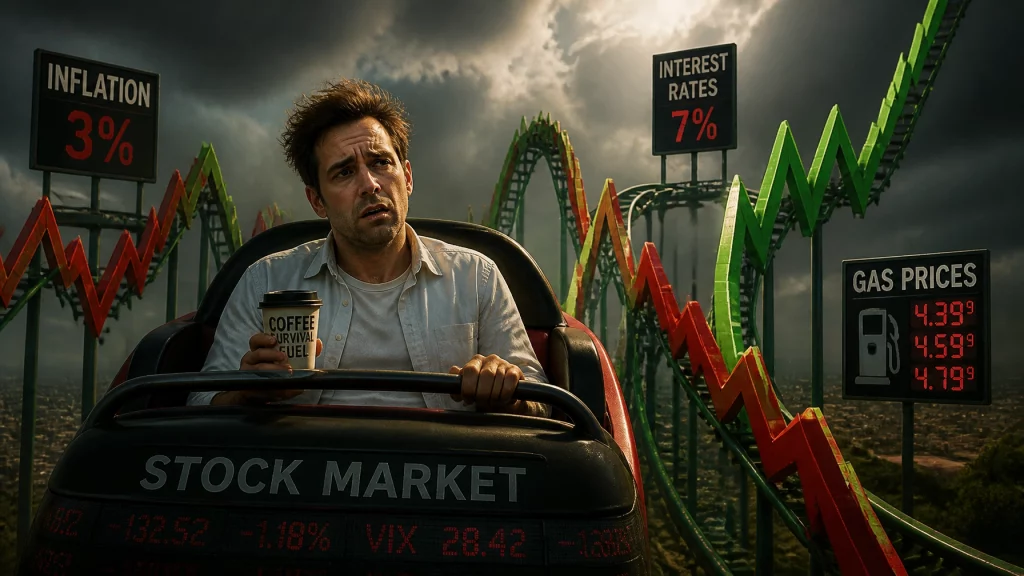
If you feel like you’ve been strapped into a rollercoaster that was designed by a toddler on a sugar high, you aren’t alone. Welcome to May 2026. We call it the "Whiplash Economy." One day the news tells you the GDP is humming along like a fine-tuned Tesla, and the next day you’re staring at a $14 carton of eggs wondering if you should just start raising chickens in your bathtub.
It’s a bizarre time to be alive, and an even weirder time to be a "regular guy" trying to balance a checkbook. We’re living through a period where the traditional rules of economics have been tossed into a woodchipper. The experts keep waiting for things to "normalize," but as we’ve seen over the last few years, "normal" is a relative term that usually means "slightly less chaotic than last week."
The Great Disconnect: TV vs. The Kitchen Table
Have you ever noticed that the guy in the suit on CNBC seems to be living in a completely different country than you? He’s talking about "resilient output" and "stabilizing labor markets," while you’re looking at your bank account and doing the mental math on whether you can skip the car insurance payment this month.

This is the core of the whiplash. According to recent reports, consumer sentiment in early April 2026 hit an all-time low, despite the fact that unemployment isn't spiking. Why? Because the cumulative effect of four years of "unprecedented" shocks: from pandemic hangovers to the recent energy spikes tied to the war in Iran: has finally broken our collective spirit.
We’ve written before about why the economy looks great on TV but feels rough at home, and the gap is only getting wider. It’s hard to feel "resilient" when over half of American families say they are worse off than a year ago due to prices. When you’re paying more for gas and groceries, a "positive GDP print" feels like a slap in the face.
3% is the New 2%: The Sticky Inflation Trap
For decades, the Federal Reserve had one job: keep inflation at 2%. They treated that number like a holy commandment. But in 2026, that 2% target looks like a nostalgic relic, right up there with DVDs and affordable Disney World tickets.
Current data shows inflation hovering around 3%, and it’s not moving. Why? Because of what economists call "supply-side whiplash." Every time we get close to that 2% goal, something else happens. Tariffs on imports have baked higher costs into everything from your toaster to your truck. The "tariff passthrough" that started in 2025 is now largely complete, meaning those higher prices are the new baseline.
As Hartford Funds recently noted, an "inflationary upturn" is the most likely path for the rest of 2026. This isn't the runaway hyperinflation of a banana republic, but it’s a slow, steady grind that eats away at your purchasing power like a termite in a log cabin. It’s "sticky." It’s annoying. And it’s the reason your $100 grocery trip now gets you three bags instead of five.
The Mortgage Mirage: Higher for Longer
If you were waiting for interest rates to drop back to the 3% range so you could finally buy that house with the wraparound porch, I have some bad news. The era of "free money" is dead and buried.

Central banks have brought the policy rate close to a "neutral" level: which in 2026 is around 3%: but the rates you actually pay are significantly higher. Most forecasts for the rest of the year suggest only one more rate cut, and even then, we’re looking at a "higher-for-longer" regime.
Investors now demand higher returns to compensate for the "whiplash" risk of the last few years. This means the 6.5% or 7% mortgage is likely here to stay. It’s a buzz saw of madness for the average homebuyer. We’re in a state of "stability without progress," where you can keep your job, but you can’t afford to move.
The Medical Industry: The Biggest Whiplash of All
If you want to see where the whiplash economy really hurts, look at your health insurance premiums. In 1960, medical costs in the U.S. were about 5% of our GDP. By 2025, that number hit 20%. Think about that: one out of every five dollars in the entire American economy is sucked up by the medical industrial complex.
And for what? Are we 400% healthier than we were in the 60s? Hardly. We have more cancer per capita, skyrocketing obesity rates, and diabetes is spreading faster than a viral TikTok. As John Flynn often says on our podcast, medicine has become part of a capitalist machine that prioritizes shareholders over bedside care.

The math is broken. We treat car insurance with logic: if a car is totaled, we pay the value and move on. But in medicine, there is no "totaled" value; there is only endless expense driven by an insurance marketplace that defines how the science must work.
The only way out of this whiplash is to pivot from "medical costs" to "health expenses." Smart companies like Amazon and Berkshire Hathaway are already trying to form independent healthcare models that are free from profit-making incentives. We need to spend that $100 on a gym membership and organic nutrition now to avoid the $50,000 colon cancer bill later. It’s the last frontier of expense reduction.
How to Navigate the Chaos
So, how do you survive an economy that feels like it’s trying to throw you off the back of a truck?
- Stop Trusting the Macro: If the news says "inflation is cooling" but your local mechanic just doubled his hourly rate, trust the mechanic. The macro data is a lagging indicator; your wallet is a leading one.
- Focus on Health as an Asset: In a whiplash economy, your ability to work and stay out of the hospital is your most valuable hedge. Treat your body like a capital investment.
- Expect the Unexpected: The defining feature of 2026 is the "shock." Whether it's energy disruptions in the Middle East or new trade wars, the "stable" 2010s are gone. Build a buffer, cut the fat, and stay nimble.
We’re all in this together, trying to make sense of a world where the numbers don’t always add up. But as long as you keep your eyes on the road and your hands on the wheel, you can make it through the turns.
Be mindful, be watchful and good luck.