



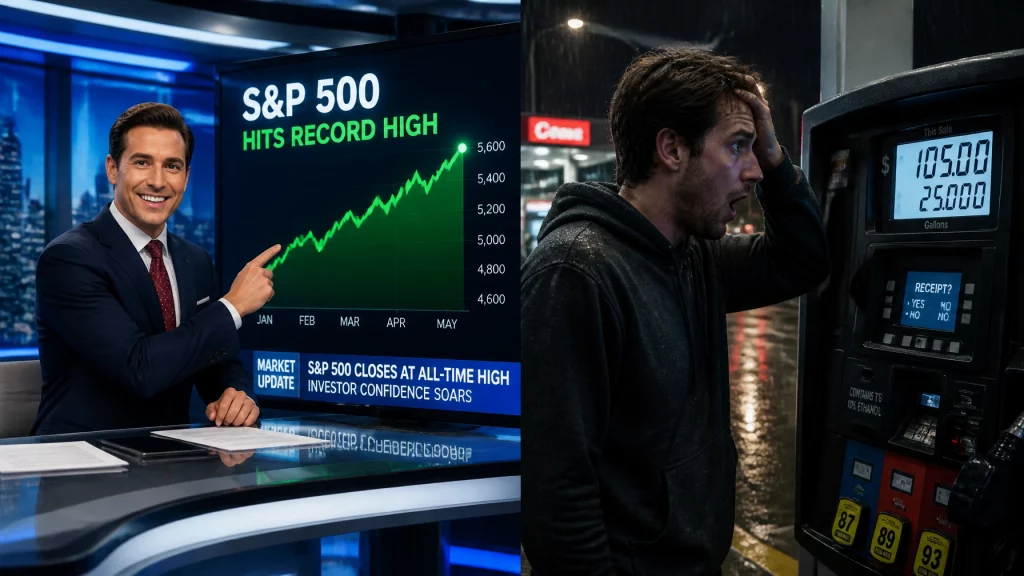
If you’ve turned on the news lately, you probably feel like you’re being gaslit by a talking head in a $3,000 suit. The S&P 500 is hitting record highs, Big Tech is reporting earnings that look like telephone numbers, and the "experts" are high-fiving each other over a "resilient" economy.
Meanwhile, you’re standing at the checkout counter at the grocery store, looking at three bags of lukewarm groceries that somehow cost $140, wondering if you accidentally bought a small share in the company that makes the eggs.
Welcome to the Great Disconnect of 2026. It’s the gap between what Wall Street sees on its monitors and what you see in your checking account. Today, we’re going to pull back the curtain on why things feel so rough at home despite the ticker tape parade on TV, and we’re going to talk about the hidden tax currently eating your paycheck: The War Premium.
The Two Economies: A Tale of Two Tickers
To understand why your wallet feels light, you have to understand that we are living in two different economies.
The first economy belongs to the corporations. When inflation hits, these companies don't just sit there and take it; they pass the costs directly to you. In many cases, they’ve gotten so good at "price optimization" that their profit margins actually expand while you’re cutting back on name-brand cereal. This is why the stock market looks great. If a company can charge you 20% more for the same box of crackers, their stock goes up.
The second economy: your economy: is the one where those price hikes actually have to be paid. Since early 2020, food-at-home prices (the stuff you buy to cook) have jumped by about 32%. Think about that. Nearly a third of your grocery budget has just evaporated into the ether. On paper, the "inflation rate" might be hovering around 3%, but that’s like saying a fire is "mostly out" while your kitchen is still actively melting.
Enter the "War Premium"
You’ve probably noticed that gas prices have been acting like a caffeinated kangaroo lately, jumping toward $5 or higher in many parts of the country. This isn't just about supply and demand in the traditional sense. It’s about something economists call the War Premium.

A "War Premium" is the extra cost added to commodities: primarily oil and gas: not because there isn't enough of it, but because the risk of geopolitical conflict makes everybody nervous. When there’s tension in the Middle East or Eastern Europe, oil traders get twitchy. They bid up the price of crude as "insurance" against future disruptions.
Here’s the kicker: the War Premium doesn't just stay at the gas station. It’s a silent tax on everything.
- Transportation: It costs more to truck those strawberries from California to your local store.
- Fertilizer: Much of the world’s fertilizer is tied to natural gas prices. High energy prices = expensive fertilizer = expensive corn, wheat, and beef.
- Packaging: Making the plastic for your milk jug requires energy.
So, while the TV tells you the "energy index" is a volatile outlier, you’re feeling that War Premium every time you pull the trigger on the gas pump or put a gallon of milk in your cart.
The Receipt That Never Ends
We’ve all been there. You go into the store for "just a few things": maybe some eggs, a loaf of bread, and some milk. You get to the register and the total is $80. You look at the receipt, expecting to find a hidden gold bar or a mistake, but no. It’s just the new reality.

The cumulative effect of the last few years has been a massive reset of the "price floor." Even if inflation hits 0% tomorrow, prices aren't going back to 2019 levels. They are staying right where they are, and for most of us, our wages haven't done a 32% vertical leap to match. This is the "squeeze" we talk about on the Regular Guy Economics podcast. We’re running faster just to stay in the same place.
The $1.25 Trillion Elephant in the Room
How are people surviving? Unfortunately, the answer isn't "record-breaking raises." The answer is plastic.
As of early 2026, U.S. credit card debt has ballooned to a staggering $1.25 trillion. People aren't necessarily using these cards to buy jet skis and Rolexes. They’re using them to bridge the gap between their paycheck and the "War Premium" at the pump.

When you look at the $1.25 trillion in revolving debt, you’re looking at a mountain of future pain. With interest rates remaining "higher for longer," the cost of carrying that balance is eating even more of the average family's disposable income. It’s a cycle: prices go up, you put the groceries on the card, the interest makes the groceries even more expensive next month, and the mountain gets taller.
We took a deep dive into this dynamic in our episode All Dollars Are Debt, and it’s a must-listen if you want to understand the trap the modern consumer is currently walking into.
Why the Disconnect Matters
The reason it’s important to talk about this is because it validates what you’re feeling. If you feel like you’re struggling despite "the economy" being good, you aren't crazy. You’re just looking at the scoreboard (the stock market) instead of the actual game (your cost of living).
Wall Street is playing a game of growth and margins. You’re playing a game of survival and stability. When the "War Premium" hits, Wall Street sees an opportunity for energy stocks to soar. You see a $100 fill-up that means you aren't going out to dinner this weekend.
What Can You Do?
First, stop listening to the "everything is fine" crowd. Recognize that we are in a high-cost environment that requires a different strategy.
- Audit the "War Premium" in your own life: Where can you cut back on energy-intensive costs?
- Tackle the plastic: That $1.25 trillion debt figure is a national crisis, but you can manage it on a personal level by prioritizing high-interest debt before the rates climb even higher.
- Stay Informed: Don't let the headlines distract you from the ground-level math.
The stock market might be the "mood" of the wealthy, but your wallet is the reality of the country. We’re here to help you navigate the madness, one grocery bill at a time.
Be mindful, be watchful and good luck.