


The $100 Billion Tariff Refund Went to Walmart, Target, and Home Depot : Where’s Yours?
There is a simple question at the center of the tariff refund story:
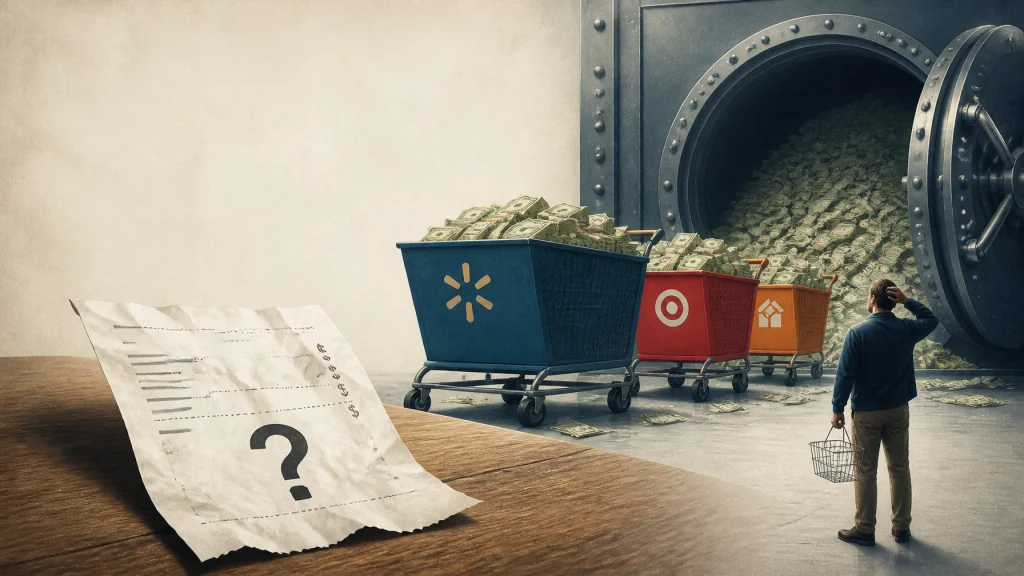
If consumers paid higher prices because of tariffs, why are corporations the ones receiving the refunds?
The answer is sitting in the fine print of the customs system. It is legal, tidy and completely disconnected from the way ordinary families experienced the tariff bill.
The Supreme Court struck down the sweeping tariffs imposed under the International Emergency Economic Powers Act, or IEEPA. The government had collected roughly $166 billion to $168 billion from importers before the ruling. By July 31, the administration had refunded approximately $100 billion.
That money is going back to the companies that officially paid the tariffs at the border.
Those companies include:
- Walmart: approximately $2.9 billion
- Target: approximately $994 million
- Home Depot: approximately $730 million
- TJX, owner of TJ Maxx, Marshalls and HomeGoods: approximately $331 million
- Lowe’s: approximately $80 million
The regular guy who paid more for tools, clothes, toys, appliances and groceries? There is no automatic check in the mail.
That is not a clerical oversight. That is how the system was designed.
The legal answer is easy. The economic answer is not.
A tariff is collected from the importer of record. That is the company or entity responsible for bringing goods into the United States. The importer pays Customs and Border Protection, and the government records that company as the party entitled to a refund if the tariff is later ruled unlawful.
So when Walmart receives a $2.9 billion refund, the government’s position is straightforward: Walmart paid the money.
But that is only the legal part of the story.
The economic part is what happened after Walmart paid the tariff. Companies do not generally absorb a sudden, enormous cost out of the goodness of their corporate hearts. They adjust prices, negotiate with suppliers, alter product mixes, reduce margins or pass the cost along through the supply chain.
Usually, some combination of all five happens.
The tariff was paid at the port, but the cost traveled. It showed up in the price of a refrigerator, a patio set, a package of imported clothing or a box of household goods. It showed up in the family budget as one more increase at a time.
The customer did not receive a customs receipt. The customer simply paid the shelf price.
Now the tariff has been declared unlawful, and the refund is traveling backward only as far as the importer.

The $100 billion refund is not a consumer rebate
This distinction matters because “refund” sounds like someone is getting their money back.
When a homeowner receives a tax refund, the connection is clear: the taxpayer sent money to the government, and the government sends some of it back.
The tariff refund is different. The importer paid the government, but the importer may have collected the money from customers through higher prices. There is no national database matching each tariff dollar to each purchase. There is no receipt-level refund process. There is no system asking whether a retailer raised prices by 10%, 15% or 25% after the tariff took effect.
The government is not attempting to reconstruct the entire chain of economic damage. It is paying the party listed in the customs paperwork.
That may be administratively practical. It is not the same thing as making consumers whole.
The Court of International Trade refund process and Customs and Border Protection’s procedures focus on import entries and the importer of record. They do not require a retailer to prove that it absorbed the tariff rather than passing it along.
That is the gap between accounting and economics.
What are Walmart, Target and Home Depot doing with the money?
To be fair, the companies are not all saying, “Thanks, Washington,” and immediately distributing the money to shareholders.
Walmart says it is using its $2.9 billion refund for “price investments.” The company has pointed to price cuts and thousands of rollbacks across groceries and general merchandise.
That sounds encouraging. Walmart also has a competitive reason to lower prices. Its entire business model depends on being perceived as the place where customers find everyday low prices. If the refund helps Walmart hold down prices, shoppers may benefit.
But “price investment” is not the same as a $2.9 billion consumer rebate.
The company controls how that money is allocated. Some could support lower prices. Some could protect margins. Some could fund store improvements, marketing or other business priorities. A corporation can make a reasonable business decision without making consumers financially whole.
Target has reported a refund of approximately $994 million and has discussed broad price cuts on thousands of items. Again, customers may see savings, but the savings are not necessarily equal to the tariff burden each customer paid.
Home Depot’s reported refund was approximately $730 million. A customer who bought a foreign-made power tool, appliance or building product during the tariff period is not receiving a transaction-specific refund from Home Depot.
The company may lower prices. It may use the money to support operations. It may do some of both.
The point is not that every retailer is acting dishonestly. The point is that the refund creates a new corporate asset, not a legally enforceable consumer claim.
Consumers paid the bill in the first place
Tariff supporters often describe tariffs as a charge paid by foreign countries. That is a catchy political slogan and a poor description of the cash flow.
The check at the border is written by the importer. The importer is located in the United States. The importer then decides how much of that cost moves through the supply chain.
Foreign producers can sometimes cut prices to remain competitive. Importers can sometimes accept lower margins. Retailers can sometimes absorb part of the cost. But consumers frequently carry a significant share because businesses are built to survive, not to volunteer for permanent cost increases.
That is why the refund question is so aggravating.
If the government had collected $166 billion from consumers directly, politicians would be under enormous pressure to return it. Because the money was collected through corporate importers, the refund can be described as a normal correction to a business transaction.
The household impact gets lost in the paperwork.

Why prices may not fall back to where they were
Even if companies sincerely want to lower prices, prices may not return to their old levels.
Businesses make pricing decisions based on current costs, not historical fairness. A retailer may have renegotiated supplier contracts, changed inventory, hired staff, paid higher freight costs or adjusted its profit targets. The tariff may be gone, but other expenses may remain.
There is also a basic market reality: companies do not cut prices merely because they have extra cash. They cut prices when doing so improves sales, market share or customer loyalty.
That is why a tariff refund can create a strange outcome. Consumers may receive some benefit through lower prices, but the benefit will be targeted, gradual and controlled by corporate strategy.
The company gets the money immediately. The shopper gets a possibility.
That is not much of a refund.
Where is the consumer’s share?
The most honest answer is that there may not be a clearly identifiable consumer share.
Some consumers may benefit from Walmart’s rollbacks. Some may benefit from Target’s price reductions. Some may see lower prices at Home Depot. But millions of purchases were made over months when tariffs were in effect. Those customers already paid the higher price and have no practical way to prove exactly how much of their purchase price represented the tariff.
The refund system was built to settle government accounts with importers. It was not built to settle accounts with every household in America.
That raises a policy question worth asking: Should companies that receive tariff refunds be required to disclose how much they pass through to customers?
At minimum, large retailers could report:
- The amount of the tariff refund received
- The categories affected by the tariffs
- The total value of related price reductions
- How long those price reductions will last
- How much of the refund is being used for other purposes
That would not produce a perfect consumer rebate, but it would give the public something better than a press release promising “price investments.”
A company should be allowed to earn a profit. It should not be allowed to treat a consumer-funded windfall as if the consumer never existed.
The kitchen-table lesson
The tariff refund story is another reminder that economic policy rarely moves in a straight line from Washington to the kitchen table.
The government imposes a tariff. Importers pay it. Prices rise. Families adjust their budgets. The Supreme Court later says the tariff was unlawful. The government refunds the money to the importer.
The family gets none of the paperwork and possibly none of the money.
That is why the headline number matters. One hundred billion dollars has already moved back into the business sector. The total collected was roughly $166 billion to $168 billion, meaning a substantial amount remains in the refund pipeline.
Walmart, Target and Home Depot may choose to return part of the benefit through lower prices. Customers should welcome that. They should also remain skeptical of the idea that a corporate price cut automatically equals a consumer refund.
A refund is not a refund simply because someone got paid.
The regular guy paid at the register. The corporation filed at the border. The corporation got the check.
Where’s yours?
Disclosure: Regular Guy Economics is not a financial advisor. This article is for educational and informational purposes only and is not investment advice.
For more kitchen-table economics, read The Tariff Bill Nobody Itemizes: How Trade Policy Costs Your Household $1,000 a Year, Your Raise Is Losing to Your Grocery Bill, and Household Debt Just Fell for Only the Second Time in a Decade: So Why Does Everyone Feel Broke?.
Be mindful, be watchful and good luck.