



If you woke up this morning, grabbed your coffee, and checked the markets, you probably felt a familiar tightening in your chest, and it wasn’t just the caffeine. Now here we are on Wednesday, April 15, 2026, and the picture is even clearer. The U.S. Navy has officially begun a total blockade of Iranian ports, and the oil markets reacted exactly how you’d expect: with a violent, 8% upward scream.
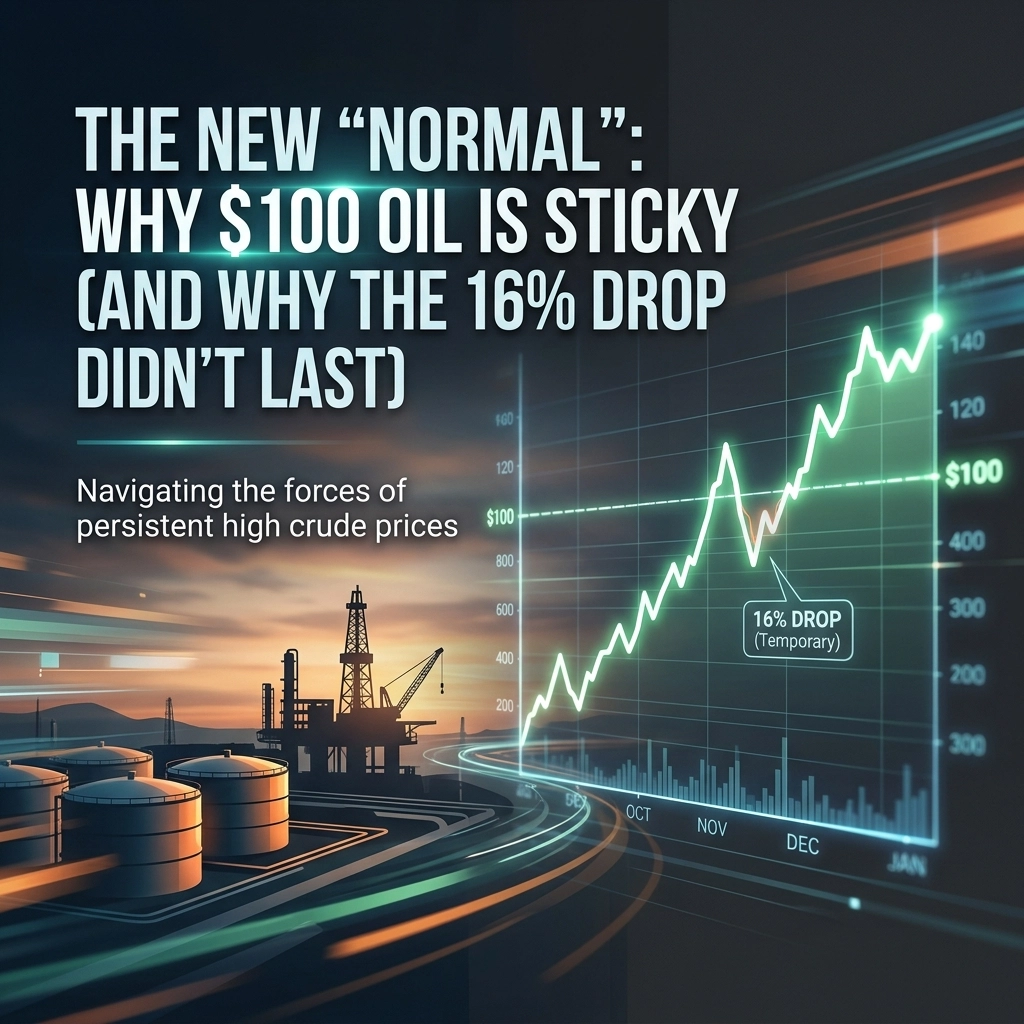
Brent crude is back over $100. Actually, it’s sitting comfortably north of that as I type this. For a few weeks there, we all allowed ourselves to breathe a little. Oil had dropped about 16% from its recent highs of $119, sliding down toward the mid-90s. There was talk of "de-escalation" and "market stabilization."
Well, those hopes just hit a steel wall of naval destroyers.
The reality is that $100 oil isn't just a temporary spike anymore. It’s becoming "sticky." It’s the new floor, the new normal, and the new tax on your life. Let’s break down why that 16% drop was nothing but a head-fake and why your wallet is about to feel the squeeze of a "geopolitical risk tax" that isn't going away anytime soon.
The 16% "Relief" That Wasn't
A few weeks ago, the narrative was that the peace talks in Pakistan were actually going somewhere. Diplomats were smiling, there was talk of unfreezing assets, and the "war premium" started to leak out of the oil price. When oil drops 16%, it feels like a victory for the regular guy. You see it at the pump: maybe not a huge drop, but a few cents here and there that make you think the worst is over.
But here’s the thing about oil markets: they hate uncertainty, but they fear reality. The 16% drop was built on hope. The current $100+ price is built on math.
The math says that when the U.S. decides to choke off $435 million a day in Iranian oil revenue, that supply doesn't just "find a way" to the market. It vanishes. And when supply vanishes while the world is still trying to drive to work, deliver packages, and fly planes, the price stays high. The drop didn’t last because the fundamentals of the war haven't changed: only the headlines did. Now that the headlines have caught up to the reality of the blockade, the price has snapped back like a rubber band.

Geopolitical Risk: The Invisible Tax
At Regular Guy Economics, we like to keep things simple. Usually, prices go up because people want more stuff or there’s less stuff to buy. But right now, we’re dealing with a third factor: the "Geopolitical Risk Tax."
Think of it this way. When you buy a gallon of gas, you aren't just paying for the oil, the refining, and the guy behind the counter. You’re paying for the "What If."
- What if Iran follows through on its threat to shut down neighbor’s ports?
- What if the Strait of Hormuz becomes a no-go zone for tankers?
- What if the U.S. naval blockade leads to a direct kinetic exchange?
Insurance companies for these massive oil tankers are hiking their rates through the roof. Shipping companies are taking the "long way" around to avoid conflict zones. Every single one of those "What Ifs" adds a dollar here and a dollar there to the price of a barrel. By the time it gets to your local gas station, that "tax" is costing you an extra $15 to $20 every time you fill up. It’s a tax that doesn’t go to the government to fix roads; it just evaporates into the ether of global instability.
Why $100 Oil is "Sticky"
Economists use the word "sticky" when prices don't want to come down even when the reasons for them going up start to fade. But $100 oil is sticky for a very specific, modern reason: the "Policy Trap."
The Federal Reserve is in a corner. They want to lower interest rates to keep the economy moving, but they can’t do that if inflation is ripping. And nothing drives inflation for the regular guy faster than energy costs. When oil is at $100, everything costs more. That Amazon package you ordered? The delivery truck uses diesel. The plastic packaging? Made from petroleum byproducts. The heat in your house? Connected to the global energy grid.
The search data tells us that analyst Stewart Glickman at CFRA thinks crude in the $80 range simply "isn't feasible" anymore. Why? Because the structural safety of the world’s oil chokepoints has been compromised. You can’t just "un-ring" the bell of a naval blockade. Even if the blockade ended tomorrow, the market now knows it can happen, and that knowledge stays priced in.

The Pakistan Failure: The $27 Billion Stumbling Block
We have to talk about why the peace talks in Pakistan fell apart this weekend. It sounds like high-level diplomacy, but it’s actually a very simple argument about a checking account.
Iran wanted $27 billion in frozen funds released as a condition for a ceasefire. The U.S. and its allies hesitated, wanting to see "behavioral changes" first. In the world of regular guy logic, this is like a landlord refusing to fix the heater until the tenant pays the back rent, while the tenant refuses to pay the rent until the heater is fixed. Meanwhile, the house is burning down.
Because those talks collapsed, the market realized that a diplomatic solution is months, if not years, away. When the talks ended, the "hope discount" disappeared, and the $100 floor was reinforced.
The Allied Split: A Divided Market
One of the weirdest developments in this "New Normal" is that the U.S. is largely going it alone on this blockade. The UK and France have signaled they are "skipping" the naval operation for now.
In the old days, a united front meant stability. Now, we have a split. This creates a fragmented market where some oil is moving, some is blocked, and nobody knows who is allowed to trade with whom. This friction is like sand in the gears of global commerce. Sand creates heat. In economics, that heat is called "price volatility," and it almost always leans to the upside.

What This Means for You
We often talk about how medical costs are a runaway train (currently hitting 20% of the GDP), but energy is the track that train runs on. If the energy costs stay this high, the cost of living for the average family becomes unsustainable.
We are seeing a shift where "energy independence" isn't just a political slogan anymore; it’s a survival strategy for your bank account. The 16% drop we saw recently was a "dead cat bounce": a temporary blip of optimism in a structurally broken system.
As long as the Navy is parked outside Iranian ports and as long as the $27 billion in Pakistan remains a point of contention, $100 oil is the baseline. You need to budget for it. You need to assume that the "Geopolitical Risk Tax" is a permanent line item on your monthly expenses.
The world is getting more expensive, not because we’re running out of oil, but because we’re running out of trust. And trust is the one commodity you can’t just pump out of the ground.
Be mindful, be watchful and good luck.