



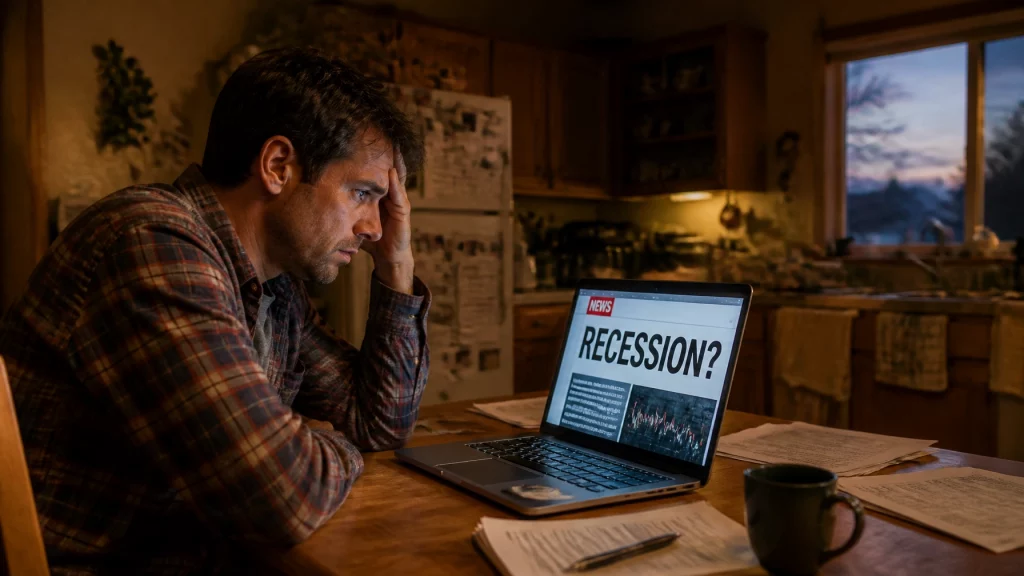
If you’ve been watching the news lately, you’ve probably noticed that the "experts" can’t seem to agree on whether we’re heading for a soft landing or a total nose-dive into the concrete. It’s May 2026, and the economic vibes are, frankly, a little weird. We’ve seen the stock market hit all-time highs while the average guy is still sweating bullets at the grocery checkout line. We talked about this paradox recently in The Stock Market vs. Your Wallet, but today we’re digging into the red flags.
Recessions aren't like a surprise party; they usually call ahead and leave a few messages on your machine. You just have to know how to check the voicemail. Here are 10 things you should be watching right now to see if the "R-word" is coming for your neighborhood.
1. The Yield Curve: The Rollercoaster Going Upside Down

The yield curve is the granddaddy of all recession indicators. Usually, you get paid more interest for lending money to the government for a long time (10 years) than a short time (2 years). It makes sense: more time equals more risk. But when the 2-year yield is higher than the 10-year yield, it’s called an "inversion."
It’s the financial version of a rollercoaster track looping upside down. Historically, every major recession since 1950 has been preceded by this inversion. It basically means investors have lost faith in the near future and are parking their cash for the long haul. Keep an eye on the 10-year minus 2-year spread; if it stays below zero for months, the "buzz saw of madness" is usually right around the corner.
2. The Sahm Rule: When Unemployment Tips the Scales
Economist Claudia Sahm figured out a simple rule that is surprisingly accurate: If the three-month moving average of the unemployment rate rises by 0.50 percentage points or more relative to its low during the previous 12 months, we’re in a recession.
In early 2026, we’ve seen a slight softening in the job market. It starts slow: a hiring freeze here, a "strategic reorganization" there: but once that 0.5% threshold is crossed, the momentum is hard to stop. You can track these numbers yourself at the Bureau of Labor Statistics, or just listen to our podcasts where we break down the latest payroll dumps.
3. Initial Jobless Claims: The Early Warning Leak
Before the unemployment rate officially jumps, you’ll see it in the "Initial Jobless Claims." This is the number of people filing for unemployment for the first time each week. Think of it like a leak in a dam. A few drops are normal, but a persistent uptrend over several weeks means the structural integrity of the economy is starting to give. If we start seeing these numbers consistently climb above the 250k-300k mark per week, start battening down the hatches.
4. Consumer Spending: The Engine is Sputtering
The U.S. economy is basically three kids in a trench coat, and those three kids are "Consumer Spending." About 70% of our GDP comes from us buying stuff: lattes, trucks, subscriptions to things we don't watch.
Lately, real (inflation-adjusted) consumer spending has been looking a bit tired. When regular guys start trading the name-brand cereal for the generic stuff and putting off that new car purchase, it’s a signal that the core engine of the economy is losing steam. Major firms like J.P. Morgan are already flagging this as a 40% risk factor for late 2025 and 2026.
5. Credit Card Delinquencies: The Jenga Tower

This is where it gets personal. We’ve seen credit card balances hit record highs as people use plastic to bridge the gap between their wages and the cost of eggs. But the real warning sign isn't the debt: it’s the delinquencies.
When people stop paying their credit card bills or auto loans, it’s because they literally have no other choice. It’s like a Jenga tower where the bottom blocks are being pulled out to build the top. Eventually, the whole thing topples. If delinquency rates continue to climb past pre-pandemic norms, it means the "Regular Guy" has officially run out of runway.
6. Oil Prices: The Gas Station Ghost

Every U.S. recession since WWII (except for the weird COVID blip) has been preceded by a sharp spike in oil prices. Why? Because oil is in everything. It’s in the gas you put in your tank, the diesel in the trucks that deliver your groceries, and the plastic in your phone.
With global tensions pushing Brent crude toward the $100+ range in 2026, we’re seeing a massive tax on the global economy. When it costs $80 to fill up a sedan, that’s $80 not being spent at a local restaurant or a small business. High oil is the silent recession-maker.
7. Consumer Sentiment: The "Vibe-cession"
Economics is 50% math and 50% feelings. If everyone thinks there’s going to be a recession, they stop spending, which causes a recession. It’s a self-fulfilling prophecy. Currently, consumer sentiment is a bit of a rollercoaster. We’re hopeful because of tech breakthroughs, but we’re cynical because our rent went up 20% in two years. Watch the University of Michigan’s Consumer Sentiment Index; if it takes a nose-dive, the spending will follow shortly after.
8. Payroll Growth: The Slow Crawl
We don't just want to see people keeping their jobs; we want to see new jobs being created. In a healthy economy, we’re adding 200,000+ jobs a month. In a "pre-recession" economy, that growth starts to look anemic: maybe 50,000 or even negative numbers. If the monthly payroll reports start looking like a slow crawl, it’s a sign that businesses are in "hunker down" mode.
9. Interest Rates: The Fed’s Tightrope Walk
The Federal Reserve has been playing a dangerous game of "higher for longer" to kill inflation. But interest rates are a blunt instrument. They’re like trying to perform heart surgery with a sledgehammer. The risk for 2026 is that the Fed keeps rates too high for too long, accidentally snapping the neck of the housing market and small business lending. Recent outlooks from RSM suggest a 30% probability that this tightening cycle finally catches up with us.
10. Geopolitical Shocks: The Wildcards
Finally, there’s the stuff we can’t control. Whether it’s conflict in the Middle East affecting oil or trade wars with major partners, these "outside shocks" are often the final nudge that pushes a fragile economy over the edge. In our current 2026 landscape, the world is more connected: and more volatile: than ever. One bad week of headlines can change the entire economic trajectory.
The Bottom Line
Is a recession guaranteed? No. But the indicators are flashing yellow. It’s a "buzz saw of madness" out there, and the best thing you can do is stay informed. Don't panic, but don't ignore the stack of credit cards or the gas pump prices either. We spend a third of our lives working to make this money; it’s worth spending ten minutes a week making sure we know where it’s going.
Be mindful, be watchful and good luck.