



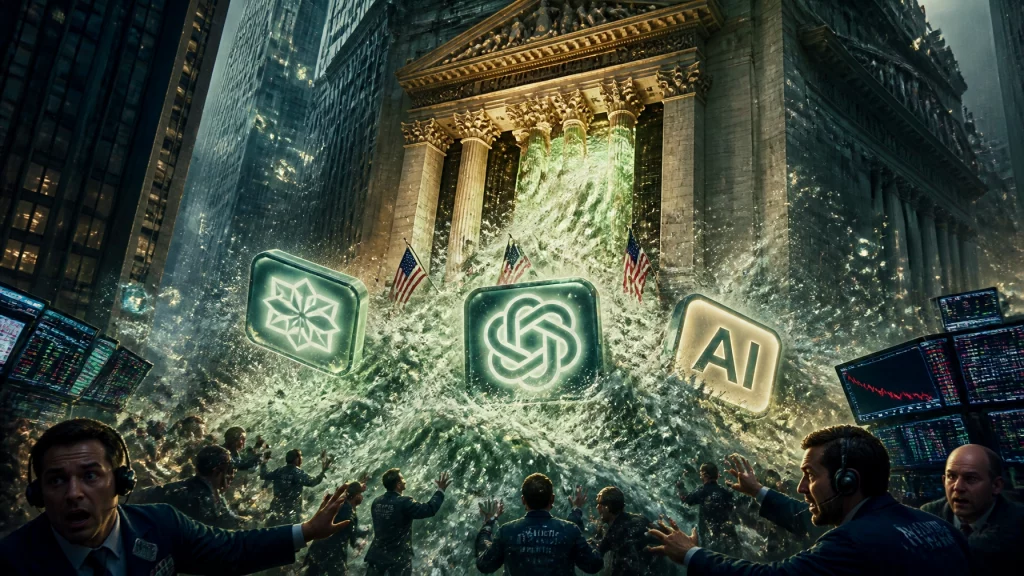
It is Saturday, June 13, 2026, and the air around the Artificial Intelligence trade smells even more like late-stage mania than it did two days ago. For three years, the story has been "transformation," "revolution," and "the end of work." Now the story is getting a Wall Street wardrobe change. Instead of private-market fantasy alone, the AI craze is marching straight toward the public markets with a parade of trillion-dollar ambition.
The conversation has shifted from "What can AI do?" to "Who is going to finance all of this?" For the average person watching a 401(k), a brokerage account, or a job market that feels thinner by the month, the answer is messy. This doesn’t look like a clean pop. It looks like a giant capital vacuum with a new coat of IPO paint.
The IPO Floodgates Are Open, but the Revenue Math Still Stinks
The numbers involved in the current AI build-out are still staggering. This year alone, global spending on AI data centers and capital expenditure is expected to hit $725 billion. That is already a mountain of money. Now Wall Street wants to stack an IPO frenzy on top of it.
SpaceX debuted Friday under ticker SPCX at roughly a $1.8 trillion valuation, the biggest public-market splash of the year. At nearly the same moment, OpenAI confidentially filed for an IPO with valuation chatter running from roughly $850 billion to $1 trillion, while Anthropic also moved ahead with its own confidential filing. That is the new shape of the AI trade in June 2026: the bubble is not obviously popping, it is being repackaged for public buyers.
The trouble is that the operating numbers still look like two completely different movies. OpenAI’s reported adjusted operating margin has been running around -122%, meaning it has been losing about $1.22 for every $1 of revenue. Some projections now point to cumulative or annualized losses still landing somewhere in the $10 billion to $30 billion range by 2030 if compute costs and pricing pressure do not behave. Anthropic, on the other hand, has been circulating numbers that point to a first profitable quarter in Q2 2026 and an eye-popping $47 billion ARR. Same sector, same hype, very different plumbing under the sink.

That is why this market feels so strange. The old dot-com bubble sold dreams with no roads. The 2026 AI wave has roads, servers, customers, and invoices. But it also has a giant split between the firms that might someday print cash and the firms that are still setting cash on fire to keep the growth story alive. As discussed in the analysis of farms vs. servers, the infrastructure is being built at a breakneck pace, but the actual utility for the average business remains elusive. Most firms are still paying "AI taxes" to Big Tech providers without seeing their own bottom lines move an inch.
The "Job Apocalypse" Myth and the Quiet Reality
Back in 2023 and 2024, the headlines were full of predictions about a "Job Apocalypse" where AI would replace everyone from truck drivers to poets. Fast forward to mid-2026, and even Sam Altman has admitted that the early predictions were "wrong" about mass, overnight layoffs across the entire workforce.
However, the lack of a sudden explosion doesn’t mean the labor market is healthy. The reality is a quiet, steady attrition. The market is currently seeing about 11,000 jobs a month being cut specifically in entry-level white-collar roles. These aren't the dramatic factory closures of the past; these are the junior analysts, the paralegals, and the customer support tiers that are simply not being hired anymore.

As noted in the report on AI coming for the jobs, the "Low-Fire Era" is ending. Companies aren't replacing their entire staff with robots; they are just making their existing staff 10% more productive with AI tools and then letting the bottom 10% of the workforce go through "natural turnover" or small, targeted cuts. It is a slow-motion reshuffle that makes the entry-level ladder much harder to climb for the next generation.
The Two-Speed Economy: IPO Floodgates vs. Regulatory Walls
The stock market now tells two different AI stories at the exact same time. On one side are the mega-listings and confidential filings. On the other side are the regulators showing up with clipboards, subpoenas, and export-control language that can ruin a growth model in a weekend.
OpenAI is now dealing with a joint investigation from state attorneys general, which puts another giant question mark over governance, data practices, product design, and safety controls just as the company is preparing for public-market scrutiny. Anthropic has its own headache: the Department of Commerce export controls that are hitting top-tier models tied to Fable 5 and Mythos 5. That matters because these companies are not just selling chatbots anymore. They are selling access, distribution, and confidence. Once Washington starts messing with any of those three, valuation math gets slippery fast.

Then there is the price war problem. Reports now indicate OpenAI is weighing steep token price cuts to fend off Anthropic and the cheaper Chinese model push coming from DeepSeek V4. That may help keep customers from bolting, but it also turns the entire "trillion-dollar IPO wave" into a knife fight over margins. Public investors love growth until they discover growth has been bought on sale.
This concentration risk is still the real threat to the market. The two-tier economy has not gone away. Big Tech still has more cash than some nations, and the average American company is still dealing with high rates and mediocre productivity. But now there is a fresh twist: a few giant AI names may soak up staggering amounts of market liquidity while the rest of corporate America is told to clap politely and pay higher software bills.
It’s Not Just a Bubble, It’s a Liquidity Vacuum
The 2000 dot-com bubble was full of companies that barely existed selling ideas that barely worked. The 2026 AI situation is different. These companies are real, the technology is real, and the revenue is real. But so are the costs, the regulatory threats, and the need for a truly absurd amount of capital.
Instead of a clean "pop," what is happening looks more like a liquidity drain. Every dollar funneled into giant data centers, GPU clusters, and moonshot IPOs is a dollar that is not going somewhere else. That is becoming easier to spot in the broader market. The latest "hot PPI" print came in at 6.5% year over year, which is another reminder that inflation pressure and tight money have not exactly gone on vacation. In that environment, capital has to choose its favorite toys.

That is one reason the AI listings matter beyond Silicon Valley cocktail chatter. When giant offerings like SPCX hit the tape and trillion-dollar AI filings line up behind it, they can pull oxygen out of everything else. Bitcoin hanging around $63,000 is part of that story. Speculative money is not infinite. Some of it is getting sucked out of crypto and redirected toward the next glossy "future of civilization" pitch deck with a ticker symbol attached.
As explored in the breakdown of AI's impact in 2026, this drain makes life more expensive for everyone else. Data centers bid up electricity. Frontier labs hoover up engineering talent with pay packages smaller firms cannot touch. Enterprises face pressure to buy AI services even while vendors are slashing prices to defend market share. That is not a normal, healthy capital cycle. That is a market trying to finance the moon while pretending gravity is optional.
The truth is that AI is a tool, not a miracle. The bubble may not be popping yet, but it is definitely getting a public-market facelift. Until the spending starts producing durable profits instead of giant valuations, the economic pressure on the Regular Guy is only going to increase.
Be mindful, be watchful and good luck.