



Wednesday, June 10, 2026
The airwaves and news cycles are currently saturated with a singular, buzzing acronym: AI. Since the initial explosion of generative models back in late 2022, the narrative has shifted from science fiction curiosity to an economic titan that supposedly dictates the fate of every portfolio, job, and utility bill in the United States. But as we sit here in mid-2026, it is time to perform a cold, hard autopsy on the hype versus the reality for the average citizen.
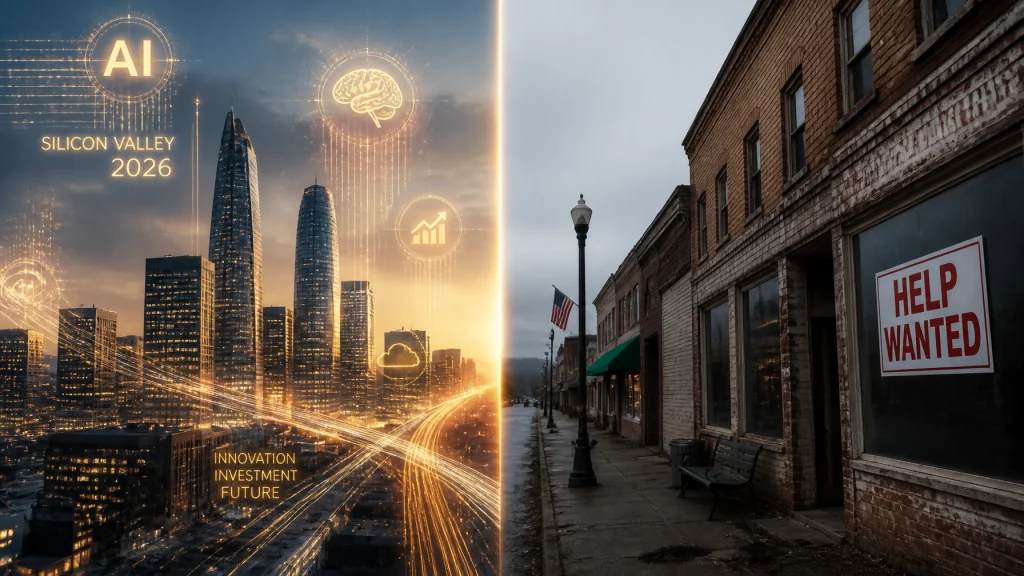
Is the AI boom real? For a select group of shareholders, absolutely. For the person trying to pay their electric bill or the recent college graduate looking for an entry-level analyst role, the "truth" is significantly more complicated: and a lot less shiny.
The Two-Tier Economy: The Mag 7 and the Other 493
We are currently witnessing the most dramatic economic divergence in modern history. On one side of the canyon, we have the "Magnificent Seven": those tech behemoths that have essentially become the gatekeepers of the new digital age. These companies are seeing record-breaking profits and, more importantly, staggering revenue-per-employee metrics. They own the GPUs, the data centers, and the foundational models that everyone else is forced to rent.
On the other side of that canyon is the rest of the economy: the "other 493" companies in the S&P 500 and the millions of small businesses that make up the backbone of our communities. For these organizations, AI is not yet a profit engine; it is a massive, recurring subscription cost. While the tech giants report triple-digit growth, many traditional businesses are still struggling to find a way to make these tools do more than just write slightly better emails. The productivity boost promised to the masses hasn't arrived; it’s currently being hoarded at the top of the mountain.

The Job "Apocalypse" and the Entry-Level Squeeze
Remember the "Job Apocalypse" everyone predicted back in 2024? Sam Altman eventually had to admit that the industry was "wrong" about an overnight mass layoff event. We didn't wake up to 50% unemployment. However, the lack of a sudden explosion doesn't mean there isn't a slow-motion fire burning through the labor market.
According to recent Goldman Sachs data, AI is currently "wiping out" approximately 11,000 jobs per month. While that might seem like a rounding error in a country of 330 million, the type of jobs being lost is what matters. The brunt of this displacement is falling squarely on entry-level white-collar roles: the very jobs that used to be the "on-ramp" for young professionals. Junior analysts, paralegals, and basic coders are finding their roles automated away before they even get a foot in the door. As reported by Fortune, Gen Z is losing the most ground, with 21,900 AI-attributed layoffs in April 2026 alone. We aren't seeing a mass replacement of humans; we are seeing a massive "thinning of the herd" at the bottom of the professional ladder.
The $725 Billion Bet vs. The 95% Failure Rate
The scale of capital expenditure (Capex) in 2026 is nothing short of eye-watering. We are on track to see $725 billion spent globally on data centers and AI infrastructure this year. We are building digital cathedrals at a pace never seen before, turning rural landscapes into sprawling complexes of silicon and cooling fans.

But here is the "Regular Guy" reality: while the infrastructure is being built, the actual utility of the software for most businesses is currently a disaster. Internal industry reports indicate that a staggering 95% of AI "pilots" at regular companies are failing to reach a stage where they provide a positive Return on Investment (ROI). Companies are throwing money at consultants and licenses only to find that their data is too messy, their processes are too human, or the AI simply isn't smart enough to handle the nuance of a real-world business problem. We are in the middle of a massive "Infrastructure Phase" where the concrete is being poured, but the buildings on top are mostly empty.
AI as an Inflationary Force
The biggest lie currently being told is that AI is a "deflationary" force that will make everything cheaper. In the long run (think 2028 and beyond), that might be true. But in June 2026, AI is decidedly inflationary.
Why? Look at your electricity bill. The insatiable hunger of data centers is driving up power demand at a rate that our aging grid can barely handle. In regions where data centers are clustering, utility companies are passing the costs of grid upgrades and new power plants directly to the consumer. Furthermore, the $725 billion being sucked into AI Capex is capital that isn't being spent on building homes, improving physical infrastructure, or lowering the cost of consumer goods. AI is currently a "Capital Black Hole," pulling resources away from the tangible economy and into the digital one.

The Truth for the Regular Guy
So, does the AI tech boom matter? It matters if you are an investor in the top 1% of tech firms. It matters if you are a utility company looking to justify a rate hike. And it matters if you are a 22-year-old trying to find your first "real" job in a market that is increasingly opting for an LLM subscription over a human salary.
For everyone else, the AI boom is currently a spectator sport with a high ticket price. The "deflationary" promise of cheaper groceries, cheaper healthcare, and a 20-hour work week is still stuck in the "loading" screen. We are told to be patient, but as any regular guy knows, you can't pay the mortgage with a promise.
We need to stop looking at the shiny demos and start looking at the spreadsheets. Until AI starts lowering the cost of a gallon of milk or a gallon of gas, it is just another high-tech tool for the elite to optimize their margins while the rest of us deal with the fallout.
To learn more about how we analyze these trends, check out our About John Flynn page or listen to our latest episodes on the Regular Guy Economics Podcast. For more deep dives into the madness of the modern market, visit our blogs.
Be mindful, be watchful and good luck.