



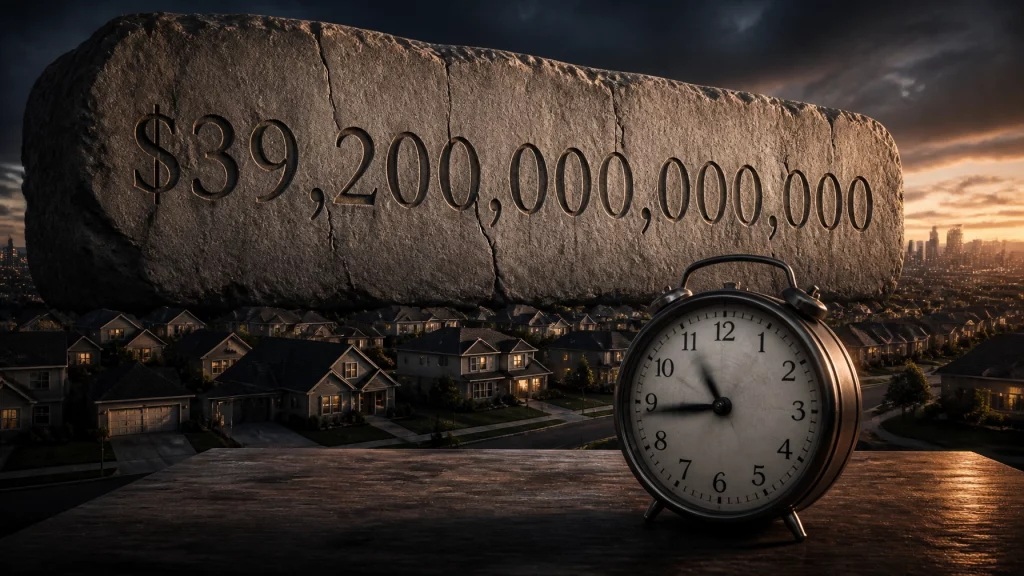
Today is Thursday, June 11, 2026, and the United States has officially crossed a threshold that would have sounded like science fiction just a decade ago. The gross national debt now stands at a staggering $39.2 trillion.
Numbers that large tend to make eyes glaze over. Trillions are abstract. They are the financial equivalent of trying to imagine the distance to the edge of the universe: too big to matter to the person just trying to pay for eggs and a car note. But while the total debt is a headline-grabber, the real story isn't the principal. It’s the interest.
The bill has come due, and it’s no longer a "future problem." It is the defining economic reality of 2026.
The $107 Billion Monthly "Minimum Payment"
Think of the United States like a household that has been running up a massive credit card balance for thirty years. For a long time, the interest rates were near zero, so the monthly payment stayed low even as the balance ballooned. But the world changed. Rates went up, the balance kept growing, and now the "minimum payment" is eating the family budget alive.
As of this month, the U.S. is paying roughly $107 billion every single month just in interest.
To put that into perspective, $107 billion a month is more than $1.2 trillion a year. That is more than the entire annual budget for the Department of Defense. It is more than the government spends on veterans' benefits, education, and transportation combined. In fact, interest is now the second-largest line item in the entire federal budget, trailing only Social Security.
When a country reaches the point where it spends more on the memory of past spending than on its current defense or its children's future, the economic engine starts to sputter. This isn't a political talking point; it’s simple arithmetic.
The Crowding Out Effect: Why Your Mortgage Stays High
One of the most frequent questions asked in 2026 is: "Why haven't mortgage rates dropped back to 3%?"
The answer lies in the Crowding Out Effect.
The government doesn't just "have" money; it has to borrow it by selling Treasuries. When the government needs to borrow trillions of dollars every year just to keep the lights on and pay the interest on old debt, it becomes a massive, hungry ghost in the room. It is competing with every regular guy for the same pool of available capital.

When the government is the biggest borrower in the market, it pushes interest rates higher for everyone else. If the bank can get a decent, "safe" return by lending money to Uncle Sam, they have no reason to offer you a cheap mortgage. Your 7% or 8% mortgage rate is directly tied to the fact that the government is soaking up all the cash to pay for the $39.2 trillion debt.
This competition for capital also hits the business world. Small businesses that need loans to expand, hire, or innovate are finding that the "cost of money" is staying stubbornly high. This leads to the "shuffling" economy discussed in recent deep dives on the AI Tech Boom’s impact in 2026, where only the largest companies can afford to play the game while everyone else gets squeezed.
The "Interest Trap" and the Looming Doom Loop
The most dangerous part of the current situation is what economists call the Interest Trap.
We have reached a point where we are borrowing money just to pay the interest on the money we already borrowed. Imagine taking out a new credit card every month just to pay the interest on your previous five cards. You aren't buying anything new. You aren't improving your house. You’re just running faster and faster to stay in the same place.

According to the Congressional Budget Office, interest payments are now the fastest-growing part of the federal budget. By the time we hit the end of this decade, interest could consume nearly one-fifth of all federal spending.
This creates a "Doom Loop":
- High Debt leads to higher interest payments.
- Higher Interest Payments increase the annual deficit.
- The Deficit requires more borrowing.
- More Borrowing increases the total debt.
- Return to Step 1.
Breaking this cycle requires either massive spending cuts, significant tax increases, or a level of economic growth that the world hasn't seen in decades. Without one of those, the "trap" simply tightens.
The Opportunity Cost: What We Aren't Building
Every dollar that goes to a bondholder in Tokyo, London, or New York is a dollar that isn't being spent on the things that actually make a country wealthy and productive.
Consider the "Opportunity Cost." For the $107 billion we spent on interest just this month, the United States could have:
- Completely rebuilt every major failing bridge in the country.
- Funded NASA’s entire annual budget four times over.
- Provided a massive tax credit to every middle-class family to offset the cost of living.

Instead, that money is effectively gone. It is "dead money." It doesn't build anything, it doesn't heal anyone, and it doesn't protect the country. It is simply the price of past profligacy. As this cost continues to climb, the ability of the government to respond to new crises: whether a recession, a war, or a pandemic: becomes severely limited. The "fiscal space" is disappearing.
How to Navigate the Madness
For the Regular Guy, the national debt crisis isn't something that can be fixed from the kitchen table, but it is something that must be understood to protect one's own finances.
- Expect Higher Rates for Longer: Don't bet the farm on a return to the "free money" era of 2010-2020. The government's need for cash will keep a floor under interest rates.
- Watch the Primary Deficit: Pay attention to news about the "primary deficit": that’s the deficit before interest. If that doesn't start shrinking, the interest trap will only get worse.
- Stay Informed: Listen to the Regular Guy Economics Podcast for weekly breakdowns of how these macro numbers affect your micro world.
The situation is serious, but it isn't a reason to panic. It’s a reason to be prepared. Understanding the math of the madness is the first step toward surviving it.
Be mindful, be watchful and good luck.