



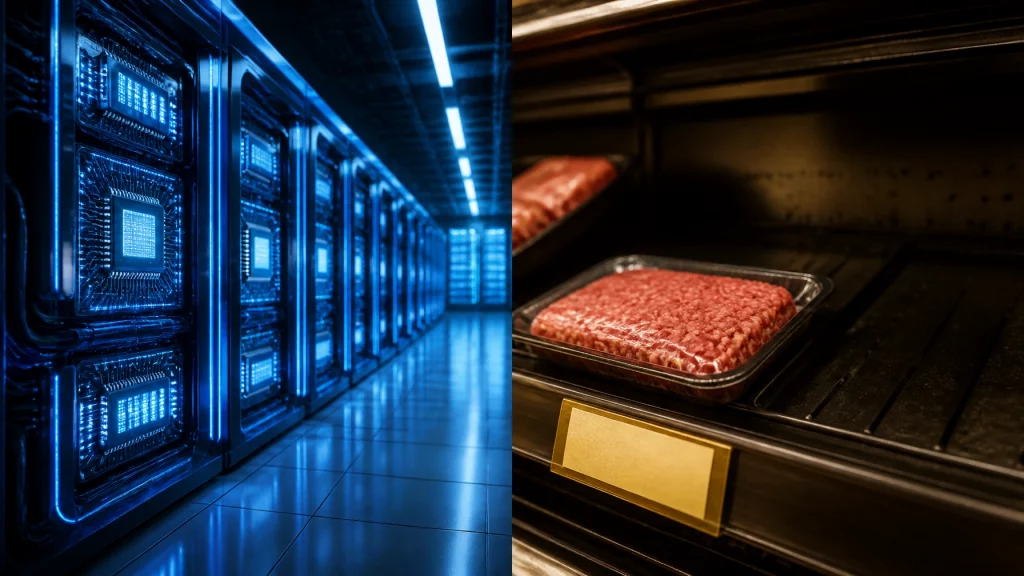
If you’ve walked through a grocery store lately and felt a sharp, stabbing pain in your chest that wasn’t a heart attack, don’t worry: it’s just the price of beef.
Welcome to the Two-Tier Economy of 2026. On one side of the velvet rope, we have Big Tech companies like Microsoft, Nvidia, and Amazon pouring tens of billions of dollars into AI data centers like they’re playing a high-stakes game of Monopoly with real money. On the other side, we have the "Regular Guy" standing in front of the meat case, doing the mental gymnastics required to convince himself that ground turkey is "basically the same thing" as a prime ribeye.
The headlines will tell you the economy is "resilient." The pundits on TV will point to a stock market that looks like a rocket ship fueled by silicon chips and chatbots. But back here on planet Earth, the air is getting a little thin. With the latest PCE (Personal Consumption Expenditures) inflation reading hitting 3.8% and personal savings plummeting to a four-year low of 2.6%, the disconnect has never been wider.
It’s time we talk about why the "vibecession" isn't a vibe: it’s a math problem.
The AI Cloud vs. The Grocery Aisle
Let’s look at the madness. In the last year, Big Tech has entered a "Capex Arms Race." We aren't talking about a few million bucks for new office chairs. We’re talking about $100 billion investments in "Stargate" supercomputers and global data center expansions. To the C-suite, money is infinite because the promise of AI is the ultimate golden goose. They are building a future where robots do our taxes and write our emails, and Wall Street is rewarding them with valuations that make the GDP of small nations look like lunch money.
But here’s the kicker: none of those billions are making your eggs cheaper. In fact, you could argue they’re doing the opposite. As Big Tech hoards energy, land, and top-tier talent to build their digital cathedrals, the rest of the economy is left fighting over the scraps.
While the "Magnificent Seven" stocks are winning, the "Average Eight" (which is what I call the eight items in your grocery basket that now cost $100) are losing. This is the hallmark of the Two-Tier Economy. The capital is flowing up, but the costs are flowing down.

The 3.8% Mirage
The government loves to tout the PCE inflation number because it’s the Fed’s "preferred" metric. Right now, it’s sitting at 3.8%. On paper, that sounds manageable. It sounds like the "soft landing" we’ve been promised since 2023 is finally here.
But the 3.8% figure is a mirage. It’s a broad average that includes everything from the price of a new software subscription to the cost of a haircut. It doesn't accurately reflect the "Regular Guy Index." If you look at the things you actually need: food, energy, and housing: the numbers are far more aggressive.
When you see that headline 3.8%, remember that it’s being dragged down by things that don't help you pay the rent. Sure, the price of a flat-screen TV might be down 10%, but you can’t eat a 65-inch 4K OLED. Meanwhile, meat prices, particularly beef, have been on a tear. Between herd liquidations due to drought and the rising cost of labor and transport, that ribeye has transitioned from a Tuesday night staple to a "special anniversary only" luxury.
We've seen this before in other sectors. Like I discussed in my thoughts on why it's Time to Destroy the Medical Industry, the mismatch between what we pay and what we get is reaching a breaking point. In medicine, costs have climbed to 20% of GDP without making us any healthier. In the broader economy, we're seeing a similar trend: the "cost of living" is rising while the "quality of life" for the average household is stagnating.
The 2.6% Savings Trap
The most alarming number in the recent data isn't inflation: it’s the personal savings rate. At 2.6%, we are at a four-year low.
Think about what that means for a second. In 2020 and 2021, the average American had a decent cushion. Whether it was from stimulus checks, reduced spending during lockdowns, or just a better ratio of wages to prices, people had a "rainy day" fund.
Today, the clouds aren't just gray: it’s a full-on monsoon, and the umbrella is full of holes. People are dipping into their 401(k)s, maxing out credit cards, and draining their savings just to maintain their standard of living. This is the definition of "running to stay in place."

When savings hit 2.6%, the margin for error disappears. One car repair, one medical bill (which, as we know, are out of control), or one missed paycheck sends a household into a tailspin. Yet, if you look at the stock market, you'd think we were in the middle of the greatest economic expansion in human history.
This is the "Two-Tier" reality:
- Tier One: Corporations and high-net-worth individuals whose wealth is tied to assets (stocks, real estate, AI infrastructure). They are getting richer as the dollar devalues because they own the things that inflation pushes up.
- Tier Two: Everyone else. People whose wealth is tied to their wages. They are getting poorer because their "asset" (their time and labor) isn't keeping pace with the cost of the things they need to survive.
Why Ribeye is the New Rolex
Let's get back to the ribeye. I use steak as an example because it’s a perfect proxy for the "middle-class dream." A decade ago, a guy with a decent job could grill steaks for his family on a weekend without checking his bank balance first.
Today, the ribeye is becoming a Veblen good: something people buy just to show they can afford it. When a single steak costs $30 at the local supermarket, it’s no longer food; it’s a status symbol.

This "luxury-fication" of basic goods is a dangerous signal. When the middle class starts "trading down" (moving from ribeye to ground beef, from brand names to generics, from organic to… whatever is on sale), it creates a permanent shift in the economy.
The big tech giants don't care because their margins are built on software and services. They aren't worried about the price of grain or the size of cattle herds. But the Regular Guy cares. He cares because his "resilient spending" that the economists keep talking about is actually just him desperately trying to keep his family fed while the floor moves beneath him.
Surviving the Disconnect
So, what do we do? We have to stop listening to the "everything is fine" narrative coming out of Washington and Wall Street. If your bank account says things are tight, believe your bank account, not the 3.8% PCE headline.
The Fed is currently in a "long slow ghosting" phase with rate cuts: something we’ve talked about before in our post 2027 is the New 2024. They can’t cut rates because inflation is sticky, but they can’t raise them without breaking the very tech-heavy market that is keeping the "appearance" of wealth alive.
We are stuck in the middle.
To survive the Two-Tier Economy, you have to be your own CFO. You have to recognize that the system is currently optimized for Big Tech and "Tier One" assets. If you're in "Tier Two," your priority has to be rebuilding that 2.6% savings rate, even if it means more ground turkey and fewer ribeyes for a while.
The madness isn't going away anytime soon. The gap between the "AI future" and the "Grocery store present" is likely to widen before it closes. We need to stay focused on the fundamentals: reduce debt, find ways to increase your "asset" value (skills, side hustles, or investing in the very companies that are winning), and above all, don't let the shiny stock market numbers gaslight you into thinking your struggle isn't real.
We see the madness. We’re living it too.
Be mindful, be watchful and good luck.