



October 4, 2026
There is a long trip between a conflict near the Strait of Hormuz and the gasoline pump at the corner store.
It starts with ships, insurance contracts, and traders watching a narrow strip of water thousands of miles away. It ends with a driver standing beside a fuel pump, watching the numbers spin upward and wondering which other household bill will have to wait.
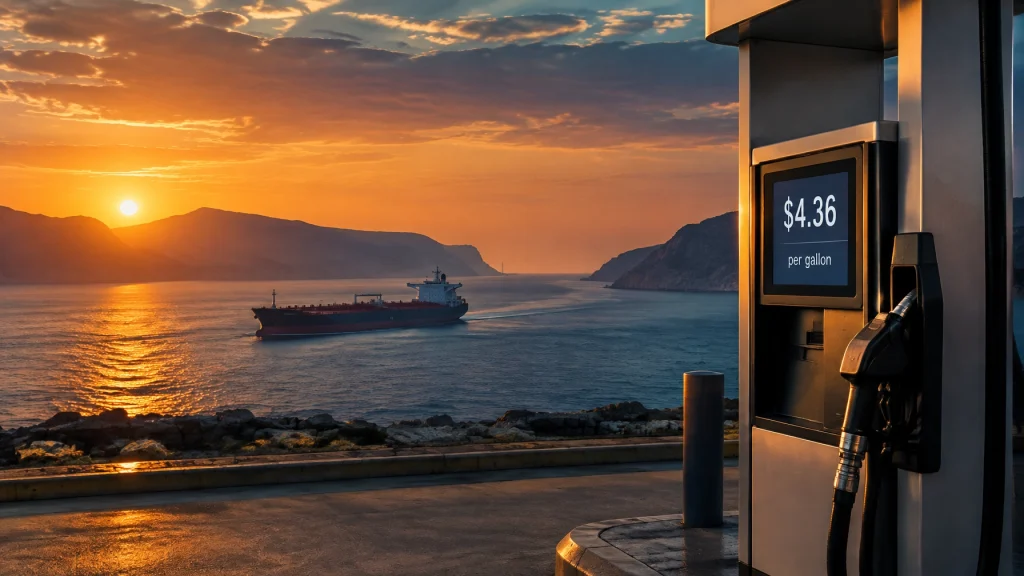
The national average price of regular gasoline is now $4.36 per gallon. That is down from the war peak of $4.56, but still up roughly 48% since the end of February. For anybody who drives to work, takes children to school, delivers goods, or lives in a place without useful public transportation, that is not an abstract market statistic. It is a pay cut.
The question is how a shipping lane becomes a household expense.
Step one: A narrow waterway creates a very large worry
The Strait of Hormuz is a narrow maritime passage between the Persian Gulf and the Gulf of Oman. Before the conflict, roughly 20% of the world’s petroleum moved through it.
That figure needs a little kitchen-table translation.
It does not mean that exactly one-fifth of the world’s oil suddenly stopped moving. It means that about one-fifth of global petroleum flows through a chokepoint where disruption could delay tankers, raise insurance costs, force ships to take longer routes, or prevent some cargoes from moving at all.
Markets do not wait for the tanks to become empty before reacting. Oil is priced partly on what is available today and partly on what might be available next week.
If a tanker operator believes a route has become dangerous, the operator may:
- Delay a shipment.
- Reroute the vessel.
- Demand a higher freight rate.
- Buy more expensive war-risk insurance.
- Refuse the route altogether.
Each choice adds cost or reduces the reliability of supply. Buyers then compete for the barrels that can still move safely. That competition pushes crude prices higher.
The market is not saying that 20% of the world’s oil vanished. It is pricing the risk that a threat to 20% of the world’s petroleum flow could become a much larger supply problem.
That distinction matters. A threatened supply line can move the price of every barrel, including barrels that never go anywhere near the Strait of Hormuz.

Step two: Crude oil rises before gasoline reaches the pump
Crude oil is the main raw material, but it is not the whole gasoline bill.
Think of gasoline as a loaf of bread. Crude is the wheat, but somebody still has to mill it, bake it, package it, ship it, sell it, and collect the taxes. The price on the shelf reflects every stage.
The U.S. Energy Information Administration explains that crude prices respond to worldwide supply and demand. Oil is traded in a global market, so a disruption in one region can affect prices everywhere.
The pump price generally includes:
- Crude oil: the largest single component.
- Refining, turning crude into gasoline and other usable products.
- Transportation and distribution: pipelines, terminals, tanker trucks, and storage.
- Taxes: federal, state, and sometimes local fuel taxes.
- Retail margin: the amount left for the gas station after its costs.
The EIA’s gasoline breakdown shows crude oil accounting for roughly half of the retail price in a typical high-price environment. The rest comes from refining, distribution, marketing, and taxes.
So when crude jumps, gasoline usually rises. But gasoline does not rise by the same percentage because crude is only one piece of the final price.
If crude oil represents about half of the pump price, a 20% increase in crude does not automatically mean a 20% increase in gasoline. Refining margins, taxes, transportation costs, regional supply, and station competition all affect the final number.
That is the basic arithmetic. Unfortunately, the arithmetic is not the whole story.
Step three: One barrel produces more than gasoline
A refinery does not take a barrel of crude and produce only gasoline. It produces a mix of products, including gasoline, diesel, jet fuel, heating oil, lubricants, and other petroleum products.
That creates an important connection between the family car, the delivery truck, and the airplane overhead.
Diesel and jet fuel are closely related refinery products made from the same general crude-oil supply chain. When military demand, airline demand, trucking demand, or shipping demand pushes those products higher, refiners have to respond to the entire product market.
A refinery cannot simply announce, “Gasoline is all we want today.” Its equipment is designed to produce a product mix. Changing that mix has physical and financial limits.
A squeeze in diesel or jet fuel can therefore affect gasoline in several ways:
- Refiners may bid more aggressively for crude.
- Refining capacity may be directed toward the most profitable products.
- Tightness in one product can increase the value of refinery capacity overall.
- Transportation and logistics costs can rise across the petroleum system.
- Inventories of gasoline may become more valuable because replacement supplies are uncertain.
This is why the price of gasoline can rise even when the immediate problem appears to involve shipping, diesel, or jet fuel. The products share a barrel, a refinery, storage facilities, pipelines, and shipping networks.
The oil market is less like a row of separate buckets and more like a plumbing system with several connected pipes. Put pressure on one section and the rest of the system notices.

Step four: Wholesale prices move before your local station changes
The gasoline at a local station was not refined that morning. It may have been purchased days earlier, shipped through a terminal, stored in a tank, and delivered by truck.
Even so, retail stations watch wholesale prices closely. When replacement fuel becomes more expensive, the station has to consider what it will cost to refill its underground tanks.
Suppose a station has 10,000 gallons of gasoline underground. If the wholesale replacement cost rises sharply, selling the existing gasoline at yesterday’s price could leave the owner unable to buy the next load.
That is why stations can raise prices quickly after a wholesale price jump. They are not only pricing the gasoline already in the ground. They are pricing the gasoline they must purchase next.
This brings us to the famous “rockets and feathers” pattern.
Gasoline prices often rise like a rocket and fall like a feather. A cost increase can reach the pump within days, while a cost decline may take longer to show up.
Research summarized by the Federal Trade Commission has found evidence of this asymmetric pass-through in gasoline markets. In plain English, retail prices may respond faster to rising costs than to falling costs.
Why?
Stations react immediately to a cost signal
When crude or wholesale gasoline prices rise, a station knows its next delivery will cost more. Raising the posted price protects the station’s ability to replace its inventory.
This is especially important for independent stations with thin margins and limited cash reserves. A few cents per gallon across thousands of gallons can quickly become a working-capital problem.
Stations may delay price cuts to rebuild margin
When wholesale prices fall, the station may still be selling fuel purchased at the older, higher price. Cutting the retail price immediately could lock in a loss on that inventory.
There is also a less sympathetic explanation: once customers have accepted a higher price, a station may not rush to give the money back. If the competition is slow to cut, each station has an incentive to wait.
Consumers also do not shop for gasoline with perfect information. Some drivers need fuel immediately. Some stations are far away. Some people do not compare prices until the tank is nearly empty.
That gives retailers room to hold prices higher for a while.
The result is a familiar experience: the sign changes upward overnight, while the downward adjustment arrives in small steps, if it arrives at all.
The pattern is not identical at every station or in every market. Local competition, inventories, taxes, transportation costs, and regional refinery conditions matter. But the general complaint has sound economic footing: rising costs often reach the consumer faster than falling costs do.
The $4.36 question is really a wage question
A national average of $4.36 does not affect everyone equally.
A household with a short commute, access to a train, or the ability to work from home may absorb the increase. A rural household driving a large pickup 40 miles to work has fewer choices.
The same is true for workers who must travel between job sites, parents driving children to school and activities, and small businesses that depend on vans and trucks.
If a vehicle holds 18 gallons, filling the tank at $4.36 costs about $78 before any loyalty discount. A household that fills up once a week is spending roughly $20 more per tank than it would at $3.25 per gallon. Over a month, that is close to $80. Over a year, it approaches $1,000.
That money does not disappear. It comes out of somewhere else:
- Fewer restaurant meals.
- Delayed vehicle repairs.
- Less money saved.
- A smaller grocery budget.
- More credit-card borrowing.
- Fewer visits to family and friends.
This is why gasoline inflation is more than a transportation story. It is a household-budget story.
Fuel is also built into the cost of almost everything delivered by truck, from groceries to building supplies. A higher diesel bill eventually appears in freight charges, business expenses, and consumer prices.
The pump is simply the most visible place where the bill arrives.

What should drivers watch next?
The most useful indicators are not just the price on the sign. Watch the chain:
- Whether tanker traffic through Hormuz normalizes.
- Whether war-risk insurance and shipping costs decline.
- Whether crude prices retreat.
- Whether refinery outages add another supply squeeze.
- Whether gasoline and diesel inventories rebuild.
- Whether wholesale prices fall for more than a few days.
A single lower crude-oil quote does not guarantee a lower pump price tomorrow. The fuel already in storage, the next shipment, regional refining conditions, and local competition all matter.
But sustained improvement in the shipping lane and wholesale market should eventually work through the system. The question is how quickly, and whether consumers receive the full benefit on the way down.
The economics are simple enough to explain at the kitchen table: a threatened shipping lane raises the risk premium on global oil, crude prices rise, refineries and transportation networks pass along their costs, and the local station reprices its inventory.
The complicated part is that the market moves faster when the news is bad than when the news gets better.
The ghosts are overseas. The invoice is in the driveway.
Be mindful, be watchful and good luck.
Educational disclaimer: This article is for general informational and educational purposes only. It is not investment advice, financial advice, or a recommendation to buy or sell any security, commodity, or other financial product. Energy markets can be volatile, and readers should speak with a qualified financial professional before making investment or money decisions.