



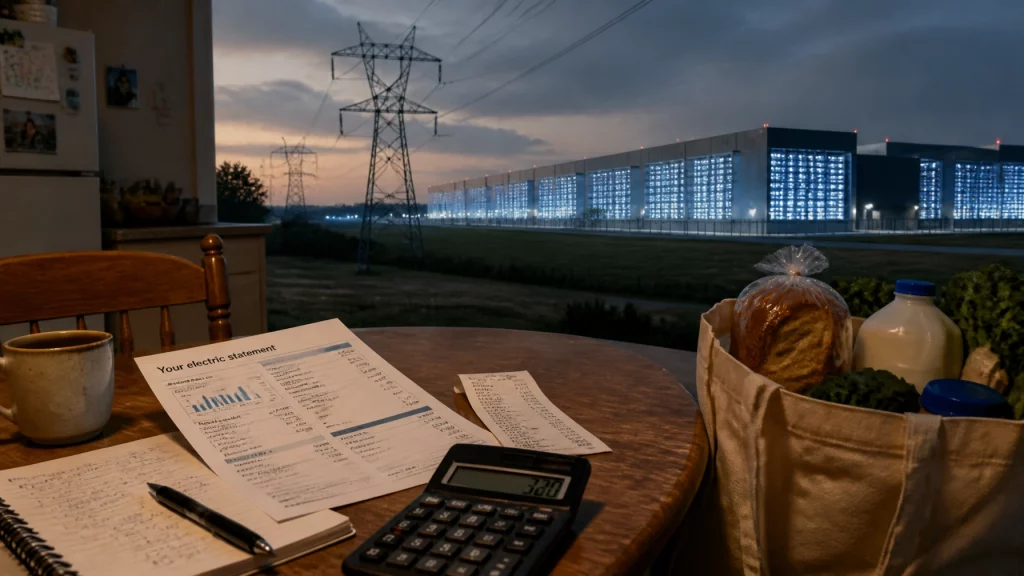
The artificial-intelligence boom is no longer confined to technology stocks, venture-capital presentations, and software sales pitches.
It has arrived at the kitchen table.
More specifically, it may be arriving on the next electric bill.
Goldman Sachs expects household electricity prices to rise another 6% through 2027, while data centers account for roughly 40% of electricity-demand growth. That does not mean every household in America will see an identical 6% increase. Electricity markets are local, utility rates are regulated state by state, and data centers are clustered in particular regions.
But the direction is clear: the AI boom requires an enormous amount of power, and somebody has to build, fuel, maintain, and pay for the machinery that supplies it.
The question now moving through state capitals and public utility commissions is simple enough for anybody to understand:
Should the data centers pay for the new power system they require, or should the rest of us help cover the tab?
The AI marketplace was never floating in the clouds
The sales pitch for artificial intelligence often sounds weightless.
AI will make businesses more productive. It will automate routine work. It will create new industries. It will improve medicine, education, logistics, customer service, and probably the quality of your next restaurant recommendation.
All of that may be true. But AI still runs on physical equipment inside massive buildings. Those buildings consume electricity around the clock. They need cooling systems, backup generation, substations, transmission connections, and a reliable stream of power that does not take lunch breaks.
That is the literal transmission from the “Fantasy of the AI Marketplace” series to the real economy.
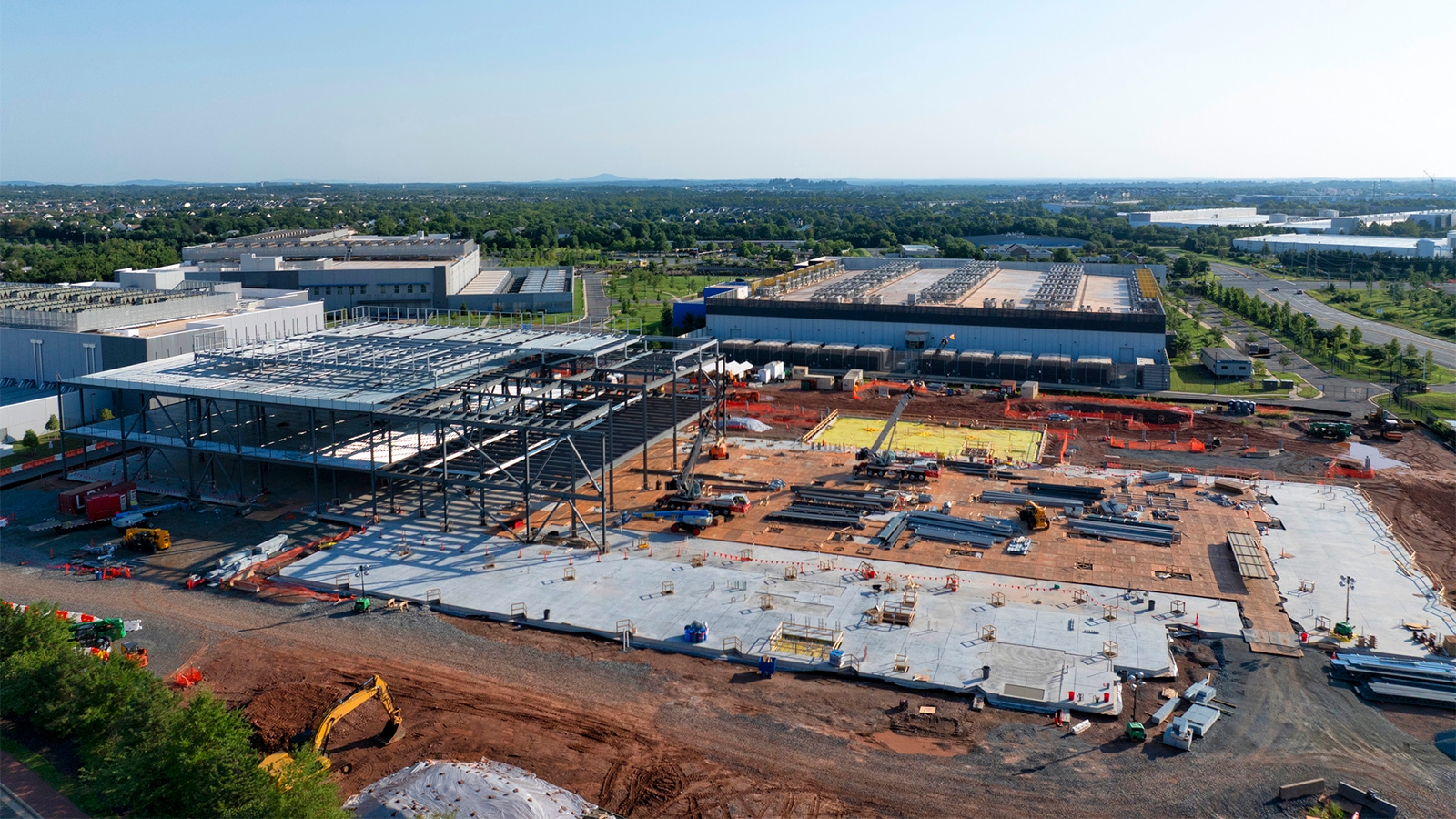
The market fantasy says technology creates value with a few clicks. The physical economy says a data center may require the power consumption of a large city, plus billions of dollars in supporting infrastructure. The first version fits neatly on a conference-room screen. The second version shows up as construction projects, transmission towers, local zoning fights, and utility-rate cases.
Goldman Sachs projects U.S. data-center power demand could rise from 31 gigawatts in 2025 to 66 gigawatts in 2027. Data centers’ share of peak summer power demand could increase from 4.1% to 8.5% over the same period.
That is not a rounding error. That is a new industrial load arriving at high speed.
Why the electric bill can rise even when the data center pays its own bill
The data center generally pays for the electricity it consumes. This is not a case of a server farm plugging into the grid for free.
The problem is that the price of electricity includes much more than the power used in a single building. Someone must pay for:
- New power plants and other generation capacity
- Transmission lines
- Substations and transformers
- Distribution upgrades
- Reliability and reserve capacity
- Maintenance on the larger system
- Higher wholesale prices when demand grows faster than supply
In much of the country, utilities operate as regulated monopolies. A state commission approves the utility’s total revenue requirement and determines how that cost gets divided among residential, commercial, and industrial customers.
The traditional logic is straightforward: spread the cost of a reliable grid across everyone who benefits from it.
That logic works reasonably well when demand grows gradually across a broad population. It becomes more questionable when a handful of companies arrive with electricity appetites measured in cities.
As Harvard Law School’s Ari Peskoe explained in Harvard Law Today, data centers can raise rates in two ways. First, utilities may build infrastructure for those facilities and spread the cost across all ratepayers. Second, enormous new demand can push wholesale prices higher when generation does not arrive quickly enough.
In plain English: the data center pays for the electricity going through its meter, but the public may help pay for the larger electrical highway built to reach that meter.
The lower-income household gets hit first
A higher electric bill is unpleasant for a wealthy household. It is a budget emergency for a lower-income household.
Electricity is a necessity. Families cannot simply decide to consume none of it. They need refrigeration, lighting, heating, cooling, hot water, and basic appliances. A household can postpone a vacation or buy fewer restaurant meals. It cannot easily postpone keeping the refrigerator cold during a heat wave.
Because electricity takes up a larger share of lower-income households’ spending, the same percentage increase produces a larger financial punch. A family with plenty of disposable income may absorb an extra $15 or $25 a month. A family already choosing between groceries, gasoline, rent, and medicine may not have that flexibility.
This is why the data-center debate is not merely a technology story. It is a distribution story.
The benefits of AI investment flow first toward technology companies, investors, executives, construction firms, and the regions winning new facilities. The costs can spread much more broadly through utility rates and wholesale markets.
That is a familiar economic arrangement: concentrated benefits, distributed costs. It is also how apparently cheap political decisions become expensive household decisions.
Your neighborhood may not have a data center: but your grid may
You do not need to live beside a giant computing campus to feel its effects.
Electricity markets operate across large regional networks. A data center in Northern Virginia, Ohio, Texas, Georgia, or another fast-growing hub can influence the need for generation and transmission well beyond the facility’s property line.
Northern Virginia offers a useful example of the scale involved. The region is one of the world’s largest data-center clusters, and its electricity demand has grown sharply. The issue is not simply whether one facility can connect to a nearby line. The entire system must be reinforced to handle multiple giant customers operating simultaneously, including on the hottest afternoons and coldest mornings.
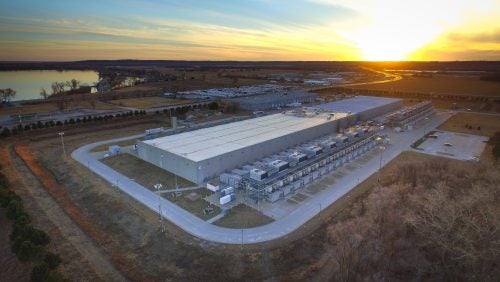
That means new substations, additional transmission capacity, backup resources, and enough reserve power to prevent one large customer from destabilizing service for everybody else.
The Energy Information Administration has identified data centers and large computing facilities as major drivers of renewed U.S. electricity-demand growth after years of relatively flat consumption. The grid is being asked to expand after spending a long stretch behaving as if electricity demand had stopped growing.
The timing is awkward. Infrastructure takes years to permit and build. AI companies want capacity now.
The electric grid, unfortunately, does not respond to a venture-capital deadline.
The states are beginning to ask the right question
State governments want data centers because they bring construction activity, investment, tax revenue, and political bragging rights. A new facility can be presented as proof that a state is participating in the future rather than watching it pass by.
But economic development is not automatically a good deal.
A state that offers cheap power, tax incentives, and favorable utility treatment may attract a data center while quietly transferring part of the cost to ordinary ratepayers. The ribbon-cutting ceremony happens today. The infrastructure surcharge arrives over years.
Some states and utilities are now proposing stronger protections. These can include:
- Separate rate classes for data centers
- Minimum monthly payments based on reserved capacity
- Upfront contributions toward transmission and generation
- Financial guarantees if a project is delayed or canceled
- Contract termination fees
- Requirements that large users pay for the capacity they demand, whether they use every kilowatt-hour or not
A 2025 Georgetown Environmental Law Review analysis described one Indiana settlement requiring very large customers to pay monthly minimums equal to 90% of their contracted capacity, along with collateral and termination provisions.
That is the basic idea: if a company asks the utility to build a massive system for it, the company should not be allowed to disappear when the bill arrives.

What should the regular guy watch for?
The next time your utility requests a rate increase, look beyond the headline percentage.
Ask what is driving the request. Is the utility building ordinary replacement infrastructure, or is it expanding rapidly for a small number of massive customers? Are data centers receiving special rates? Are those contracts public? Is the large customer paying for the transmission and generation capacity it reserved?
These are not abstract questions. They determine whether the costs are paid by a global technology company or divided among millions of households.
The solution is not to ban data centers or pretend artificial intelligence has no economic value. The United States needs investment, innovation, and a modern power system.
The solution is to stop pretending that the infrastructure is free.
If AI companies believe their facilities will generate enormous profits, they can finance the power capacity required to operate them. If a project is economically viable only when residential customers subsidize its electricity, perhaps the project is not quite as productive as the presentation deck suggests.
The AI revolution may be real. The cost-free version is the fantasy.
For more plain-English economic analysis, visit Regular Guy Economics’ general coverage and explore the Regular Guy Economics podcast.
The data center down the road may power the next great technology boom. It should not quietly power its expansion with money pulled from the family budget next door.
Be mindful, be watchful and good luck.