



It’s May 2026, and if you’ve looked at your bank account lately, you probably feel like you’ve been through a twelve-round boxing match with a heavyweight. Between the fallout from the conflict over Tehran and the general "everything is expensive" vibe of the last few years, the Regular Guy is just looking for a break.
Memorial Day is right around the corner. We’ve got record numbers of people, about 45 million, planning to ditch their cubicles and head somewhere, anywhere, that doesn't involve a Zoom call. But when you start looking at the receipts, something weird is happening. Usually, when oil prices spike (and they have, with national gas averages hitting $4.50 and California seeing $6.00 at the pump), everything that moves gets more expensive.
But the travel data coming in this week looks like a glitch in the Matrix.
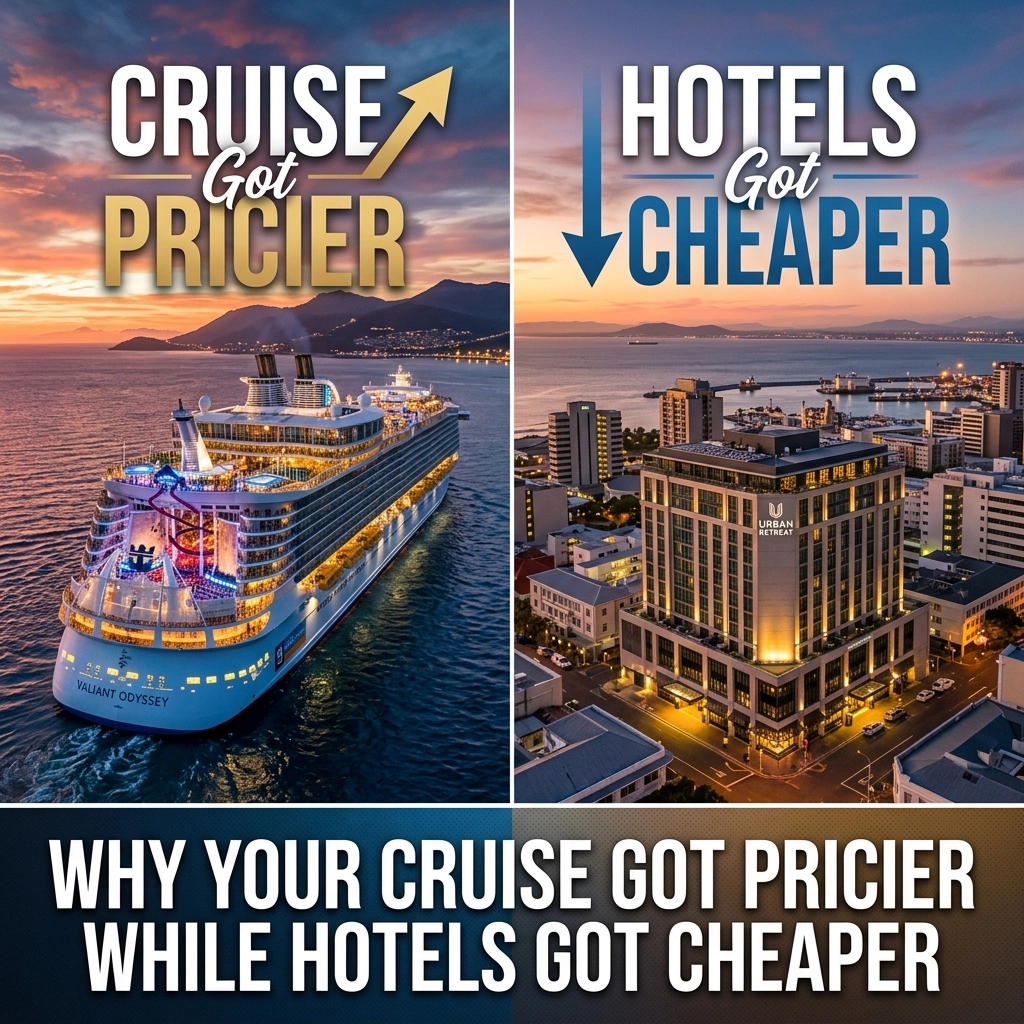
Cruises departing from U.S. cities are up 14% over last year, averaging about $2,750 for a trip. Meanwhile, U.S. hotel rates have actually dropped by 4%, and car rentals are down about 1%. It’s the same oil shock, the same economy, and the same group of exhausted travelers, but we’re seeing two completely different directions.
Why is the "Floating City" charging you a premium while the "Building Downtown" is cutting you a deal? Let’s break down the economics of why your cruise got pricier while your hotel got cheaper.
The Cruise Ship Trap: Fixed Supply and the 109% Problem
To understand why cruises are costing you an arm and a leg, you have to understand the most basic rule of economics: Supply and Demand.
In the cruise world, "Supply" is a very fixed thing. You can’t just snap your fingers and build a new 20-deck mega-ship because demand went up this weekend. It takes years and billions of dollars to get a new ship in the water. Right now, there aren't enough ships to handle the sheer volume of people who want to stand on a balcony and eat unlimited soft-serve ice cream.
The industry welcomed nearly 35 million passengers in 2024, and 2026 is looking even more crowded. Some major lines, like Royal Caribbean, are reporting a "load factor" of 109%. Now, if you’re a Regular Guy, you’re wondering how you fill a ship to 109%. It’s not magic; it just means they are stuffing three or four people into cabins designed for two.

When a ship is 109% full, the cruise line has zero incentive to give you a deal. They don't need to send you those "Last Minute Special!" emails because the cabins were sold out six months ago. They have what we call "pricing power." Because they have a limited number of "beds" and a massive line of people waiting to sleep in them, they can hike the price 14% and people will still pay it.
The Marine Fuel Factor
Then there's the fuel. Your car runs on gasoline. A hotel runs on the local power grid. But a cruise ship runs on "Bunker Fuel" or Marine Gas Oil. These ships are basically floating power plants that have to push 100,000 tons of steel through the ocean.
When the situation over Tehran sent oil markets into a tailspin, the cost of moving that steel went through the roof. Because cruise lines have such high demand, they don't have to "eat" that cost. They just tack it onto your ticket. You aren't just paying for the shrimp cocktail; you’re paying for the thousands of gallons of heavy oil it takes to get you to Cozumel.
Why Hotels are Throwing You a Bone
Now, look at the hotel side. If cruises are a "closed system" with limited supply, the hotel industry is a free-for-all.
Over the last few years, developers have been building hotels like they were going out of style. In almost every major U.S. city, we have an "overbuilt" situation. If you want a room in Orlando, Vegas, or Nashville, you have a thousand choices.

Hotels compete locally. If the Marriott across the street drops its price by $10 to fill its rooms, the Hilton has to follow suit. They don’t have the luxury of a 109% load factor because there’s always another hotel being built two blocks away.
Even though their "input costs", the price of electricity, the laundry service, the cleaning supplies, have all gone up because of the energy crisis, they can’t always pass those costs on to you. If they raise their prices too much, you’ll just stay at an Airbnb or find a cheaper motel. They are "price takers," not "price makers." In this current Memorial Day rush, hotels are actually eating their increased costs just to make sure their beds aren't empty. A 4% drop in price during a period of $4.50 gas is basically the hotel industry waving a white flag and saying, "Please, just come stay with us."
The "Ratchet Effect" of Fees
There is one area where both cruises and hotels (and especially airlines) agree: the fees.
You might notice that even if the "base price" of a hotel is 4% cheaper, the "Resort Fee" or the "Destination Fee" hasn't moved. This is what we call the "Ratchet Effect." When a crisis hits: like the current war-driven energy spike: companies raise fees to "cover costs." But when the war ends and fuel prices settle, those fees never go back down.
Delta’s CEO recently admitted that higher checked baggage fees are likely here to stay as a "revenue generator" even after fuel prices stabilize. The same thing happens with your cruise. They might give you a "deal" on the cabin, but the price of the "Ultimate Beverage Package" or the "WiFi Basic Plan" only goes one way: Up.

Running the Road-Trip Math
So, what’s a Regular Guy to do? If you’re one of the 40 million people planning to drive this Memorial Day, you’re facing a $4.50 national average. For a family of four on an 800-mile round trip, you’re looking at about $150-$200 just in gas, depending on your MPG.
Last year, that same trip cost you about $130. It’s a jump, for sure. But when you compare that to four plane tickets (which are up 15-18% for the summer) or a $2,750 cruise, the "Great American Road Trip" is still the winner for the budget.
The break-even point has moved, though. It used to be that driving was a "no-brainer" for saving money. Now, you actually have to do the math. If you’re staying in a hotel that’s 4% cheaper than last year, you’re actually offsetting some of that expensive gas. The "Hotel + Car" combo is currently the only part of the travel industry that isn't trying to actively rob you.
The Takeaway for Your Wallet
The divergence we’re seeing is a classic lesson in market structure.
- Cruises are a luxury with a "bottleneck" on supply. They can charge whatever they want because they know you can't build a ship in your backyard.
- Hotels are a commodity with way too much supply. They have to beg for your business, even when their own costs are rising.
If you’re looking for the "Loophole" this summer, skip the boat. The cruise lines are in a "Record Profit" phase, and they aren't interested in your budget. If you want to make your Memorial Day dollars stretch, find a city with an oversupply of hotels, grab a fuel-efficient rental car (since those rates are down 1%), and skip the $2,750 floating buffet.
In this economy, the "Regular Guy" wins by moving toward the supply and away from the bottlenecks. The cruise lines are currently the bottleneck. The hotels are the open door.
Be mindful, be watchful and good luck!