



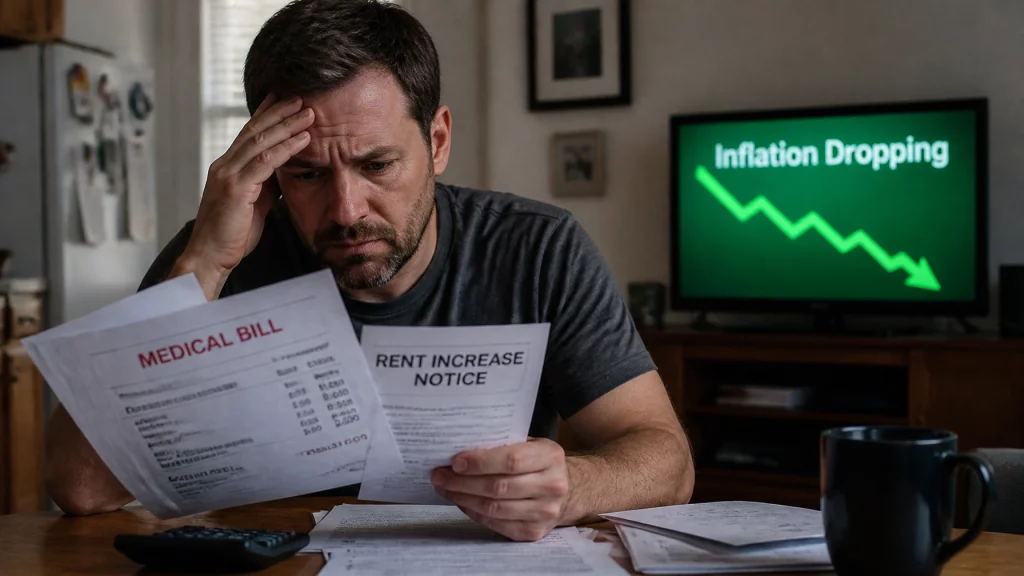
If you’ve spent any time lately reading the financial news or listening to a government press secretary, you’ve probably felt that distinct sensation of being gaslit. You know the one. It’s that feeling when someone looks you straight in the eye and tells you the sky is neon green while you’re standing outside in a rainstorm under a slate-gray firmament.
The "green sky" in this scenario is the official narrative that inflation is cooling, the economy is normalizing, and we’re all on the fast track back to the 2% promised land. The "gray rain" is the actual bill from your landlord and the eye-watering deductible on your health insurance.
In June 2026, the gap between the "spreadsheet economy" and the "kitchen table economy" didn’t just widen: it became a canyon. While the Federal Reserve and big-bank analysts are pointing at falling energy prices as a sign of victory, regular people are raising their inflation expectations. According to the latest New York Fed Survey of Consumer Expectations, Americans now expect headline inflation to hit 3.7% over the next year. But that number is a polite fiction; the real story is in the subcategories that actually matter for your survival.
The Tale of Two Inflations
When the Fed looks at inflation, they love to strip out "volatile" items like food and energy. It’s a convenient way to make a messy situation look clean. In June 2026, they have a new favorite metric: falling gasoline prices. Projections suggest gasoline inflation will stay at a measly 1.5%: the lowest since 2022.
If you drive for a living, that’s great news. But for the average household, a cheaper tank of gas is a drop in a very leaky bucket. While the "official" forecasts and market-based models like the Cleveland Fed estimates suggest we’re heading toward 2.5%, the regular guy on the street is bracing for a 9.4% spike in medical care and an 8.3% jump in rent.

This is why your gut is telling you the headlines are lying. If the things you must buy (shelter and health) are rising four times faster than the things you might buy (a new TV or a cheaper flight to Vegas), your personal inflation rate isn't 3.7%. It’s a crisis.
The Sticky Killers: Rent and Healthcare
Why do we expect prices to keep rising? Because we can see the "sticky" costs moving in the wrong direction. Unlike a gallon of milk or a gallon of gas, which can fluctuate week to week, rent and healthcare costs are structural. Once they go up, they rarely, if ever, come back down.
In June 2026, consumers are staring down a projected 9.4% increase in medical care costs. Think about that. That’s nearly double the expected increase in food prices and vastly outpaces any wage growth the average worker has seen in the last twelve months. Whether it’s rising premiums, the soaring cost of labor-intensive home health care, or the "invisible tax" of pharmaceutical markups, the medical industry is the primary engine of modern inflation.

Then there’s the rent. While platforms like Zillow forecast shelter inflation around 3% for the year, the people actually signed to leases are expecting 8.3%. Why the discrepancy? Because official data often lags behind reality by six to twelve months. If you’re a "Regular Guy" looking for a new apartment today, you aren’t seeing a 3% increase; you’re seeing a landlord who is trying to recoup two years of property tax hikes and maintenance costs in a single lease renewal.
The Gaslighting of "Consumer Sentiment"
There is a specific number that should be keeping every politician and central banker up at night: 44.8. That is the current consumer sentiment reading, and it is abysmal. It’s the kind of number you expect to see during a deep recession or a national catastrophe, not during a period where "the data" says we’re doing just fine.
When 57% of Americans say high prices have directly harmed their financial security, they aren’t being "pessimistic" or "uninformed." They are reporting from the front lines. The Peterson Institute for International Economics (PIIE) recently warned that services inflation could keep overall rates above 4% through the end of 2026. This aligns far more closely with the lived experience of the public than the sanitized projections coming out of Washington.

The reason it feels like gaslighting is that the "victory" being declared over inflation is based on things that don't help the average family stay solvent. If your rent goes up $300 a month, saving $15 at the pump doesn't make you "better off." It makes you $285 shorter than you were last month.
Why the "Regular Guy" is the Better Economist
There is a tendency for "experts" to dismiss household inflation expectations as being "unanchored" or driven by "vibes." But history shows that the regular guy is often a leading indicator. When people expect prices to rise, they change their behavior. They demand higher wages, they delay major purchases, and they pull back on the discretionary spending that keeps the wheels of the economy turning.
The current "frown-shaped" economy: where the very top is doing great and everyone else is treading water: is perfectly captured in these June numbers. We are seeing a massive concentration of wealth where 23.6 million millionaires are doing just fine, while the rest of the country is watching 20% of their paycheck disappear into the black hole of medical and housing costs.

The Fed might be right that the rate of increase is slowing for some goods, but they are wrong about the impact. For most people, the damage is already done, and the "sticky" nature of the remaining inflation means there is no relief in sight.
So, are you right to expect prices to keep rising? Yes. Because you’re looking at your bank account, not a seasonally adjusted spreadsheet. You’re looking at the cost of staying alive and keeping a roof over your head, and those are the two sectors where the "inflation fire" is still burning bright.
The "madness" we talk about at Regular Guy Economics isn't just about the numbers; it's about the disconnect between the people running the system and the people living in it. Until the cost of a doctor’s visit and a two-bedroom apartment starts trending toward that mythical 2% target, the "recovery" will remain a fairy tale told to people who can't afford the book.
Be mindful, be watchful and good luck.