



Tuesday, August 11, 2026
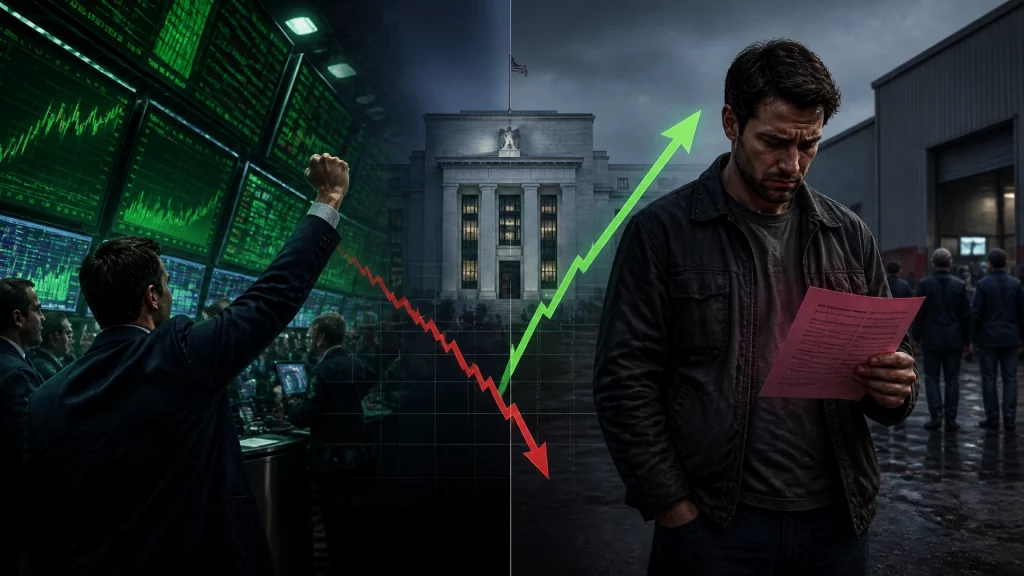
There are few economic headlines more backward than this one: America lost jobs, and the stock market went up.
The July jobs report showed that the United States lost 23,000 nonfarm jobs. Economists had expected a gain of roughly 83,000. June’s number was revised down to a loss of 20,000, and May’s total was revised sharply lower as well.
That is not a healthy employment report. It is not good news for the person looking for work, the recent graduate trying to start a career, or the household already nervous about the next paycheck.
But Wall Street liked it.
Stock futures rose. Treasury yields fell. And the odds of a Federal Reserve rate hike in September dropped from better than 50% to approximately 40%: 44%, according to the CME FedWatch figures reported by CNBC.
Welcome to the upside-down economy, where a weaker labor market can be a bullish signal.
The jobs report Wall Street actually reads
Regular people read a jobs report and ask a straightforward question:
Are there more jobs or fewer jobs?
Wall Street asks a different question:
What will this do to interest rates?
That is the entire trick.
The Federal Reserve has two major responsibilities: keeping prices reasonably stable and supporting maximum employment. When the economy appears too strong and inflation remains stubborn, the Fed can raise interest rates. Higher rates make borrowing more expensive, cool spending, slow business investment and, eventually, put pressure on hiring.
When the labor market weakens, the calculation changes. A bad jobs report can convince investors that the Fed is less likely to raise rates. It may even encourage expectations of a rate cut.
That matters enormously to financial markets.
Lower interest rates reduce the cost of borrowing. They make corporate debt cheaper, mortgages more affordable and speculative investments more attractive. They also increase the present value of future corporate profits, which is a fancy way of saying that investors are often willing to pay more for a company’s future earnings when money is cheaper.
So the market’s reaction was not really a celebration of lost jobs.
It was a celebration of the possibility that the Fed might stop making money more expensive.
That distinction may be technically correct, but it is also morally and economically revealing.

Cheaper money is good for assets: not necessarily for households
A lower interest-rate environment can lift stock prices. It can boost real estate values, support private equity deals and make it easier for highly leveraged companies to refinance their debt.
But the average household does not experience the economy through the S&P 500.
A worker experiences it through:
- Whether the job application receives a response.
- Whether hours are cut.
- Whether a raise beats inflation.
- Whether health insurance premiums consume another slice of the paycheck.
- Whether the mortgage payment, car payment and credit-card balance are still manageable.
The July report offered little comfort on those fronts.
Average hourly earnings rose by just two cents during the month. Annual wage growth slowed to 3.2%, the weakest pace since May 2021. That is not a disaster by itself, but it means workers are losing one of the few tools available to keep up with rising prices.
The report also showed that the unemployment rate declined to 4.1%. That sounds positive until the details arrive with a baseball bat.
The labor-force participation rate fell to 61.4%, its lowest level in more than five years. The labor force shrank by 264,000 people, while household employment fell by 87,000. In other words, the unemployment rate improved partly because fewer people were working or actively looking for work.
That is not exactly a victory parade. It is more like declaring the waiting room empty because several patients went home.
The Bureau of Labor Statistics employment report contains the numbers, but the human meaning is easy to understand: fewer people are finding work, and some people have stopped searching.
Why the Federal Reserve matters so much to Wall Street
The Fed’s benchmark interest rate is not the rate on a particular credit card or mortgage. It is the short-term policy rate that influences the broader cost of money throughout the economy.
When investors believe rates will remain high, they adjust prices across the financial system. Bonds become more attractive relative to stocks. Growth companies with profits expected far into the future become less attractive. Borrowing-heavy businesses face larger interest bills.
When investors believe rates may fall, the reverse often happens.
The July jobs report made the economy look less capable of tolerating another rate increase. That matters because the Federal Open Market Committee had just voted 9–3 to hold rates steady, while several officials had been warning that stubborn inflation could require a September hike.
The jobs report complicated that argument.
The economy did not merely create fewer jobs than expected. It lost jobs. The prior months were revised lower. Wage growth cooled. Healthcare employment, which had been one of the most dependable sources of job creation, rose by 22,000, well below its 12-month average of 36,000.
That combination gave traders a reason to believe that the labor market was finally weakening enough to restrain the Fed.
The market did what markets do: it repriced the future.

This is the Wall Street–Main Street disconnect in one clean example
Wall Street is not a person. It is a collection of investors, banks, funds, corporations and algorithms responding to incentives.
Those incentives are not the same as the incentives facing a regular household.
A family wants stable employment, rising wages and affordable necessities. An investor wants a favorable return on capital. If a weak jobs report reduces the chance of higher rates, that investor may make money even though the underlying news is painful for workers.
This is why the market can rise when the economy is deteriorating.
Wall Street is not necessarily saying, “Wonderful, people are losing jobs.”
It is saying, “Wonderful, the Federal Reserve may not raise rates.”
That may sound like a small difference, but it is the difference between measuring the economy by human welfare and measuring it by asset prices.
A stock market rally does not prove that the economy is healthy. It proves that investors believe future financial conditions may be less restrictive than previously expected.
Those are not the same thing.
The perverse incentive at the center of modern finance
The “bad news is good news” trade has been around for years, but it becomes more disturbing when the bad news is attached to people’s livelihoods.
If markets reward evidence of weakness, then everyone begins watching for weakness. Investors study layoffs, hiring freezes and falling wage growth for signs that the Fed might loosen policy.
The worse the employment picture becomes: up to a point: the better the rate outlook may appear.
That is an upside-down incentive structure.
It does not mean the market wants a depression. There is a limit to this logic. If job losses become severe enough, consumers stop spending, corporate revenues collapse and investors begin to fear a recession. At that stage, bad news becomes bad news again.
The market’s preferred version of bad news is narrow and convenient: employment weakens just enough to stop the Fed from hiking, but not enough to destroy corporate profits.
That is a very precise request to make of an economy populated by actual human beings.
What regular people should take from the rally
The first lesson is not to assume that a rising stock market means conditions are improving for workers.
The second is to watch the details beneath the headline unemployment rate. Participation, household employment, wage growth and revisions can tell a much clearer story than the single number placed at the top of the press release.
The third is to understand that interest-rate expectations can dominate market behavior. A company can report disappointing news and still see its stock rise if investors believe the news will produce cheaper money. A strong economic report can push stocks lower if it raises fears of tighter monetary policy.
That is not madness from the market’s point of view. It is a system responding to its own incentives.
But it is madness to confuse that system with the well-being of the country.
The July jobs report did not make job losses good. It made the possibility of a Fed hike less likely. Wall Street cheered the second fact while Main Street absorbed the first.
That is the whole story: and the whole problem.

The market is not your neighbor. It does not care whether the family budget balances, whether a young person can find an entry-level job or whether a worker has quietly stopped searching.
The market cares about money.
And when money might become cheaper, Wall Street can find a reason to celebrate almost anything.
For the latest employment data, compare the market reaction with the underlying numbers in the CNBC July jobs report and the BLS release.
Be mindful, be watchful and good luck.