



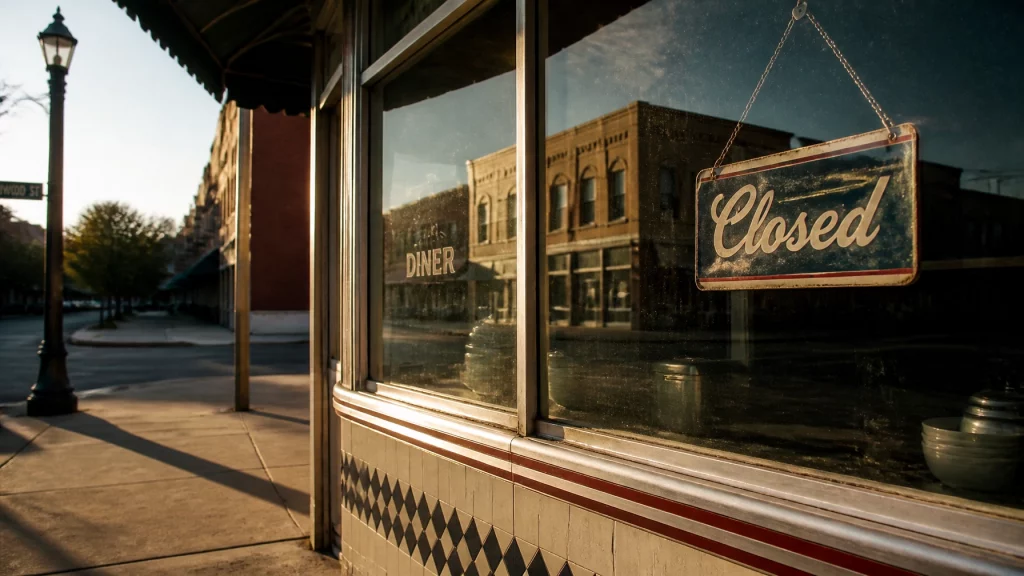
Walk down any Main Street in America right now, and you’ll see it. The neon "Open" sign is dark. The vinyl booths are empty. A handwritten note taped to the glass door says, "Thank you for 30 years, but we can no longer make the numbers work."
To the casual passerby, it’s just a bummer: one less place to get a decent omelet. But to anyone paying attention to the Regular Guy Economics podcast, that closed diner is a crime scene. It is a forensic breakdown of why the American economy is currently eating itself from the inside out.
Small businesses, particularly diners, are the ultimate economic laboratories. They operate on the thinnest of margins: usually between 3% and 5%, and in many cases even less. The National Restaurant Association has noted that the traditional restaurant formula used to look roughly like this: about 33% food, 33% labor, 29% other expenses, and maybe 5% left over if the weather cooperated, the fryer didn’t die, and the dishwasher showed up on time. That is not a fat business. That is a business balanced on a toothpick.
They don't have the luxury of "creative accounting" or massive government subsidies. They live and die by the math of labor, rent, and commodities, with insurance, utilities, taxes, and regulations lining up behind them with a baseball bat. When those horsemen start galloping, the diner is the first thing to get trampled.
A Little History: What the Diner Used to Mean
Before getting into the wreckage, it helps to remember what the diner actually was. For most of the postwar period, the diner was one of the cleanest expressions of local capitalism in America. A family leased or owned a building, bought a grill, hired a cook, poured a million cups of coffee, and served working people food at a price that still left room for everybody to survive.
In 1970, a basic diner breakfast in many parts of America could be had for around $1.25 to $1.75. Two eggs, toast, coffee, maybe hash browns if the owner liked the regulars. By 1980, that same plate often ran around $2.50 to $3.50. In 1990, the range was more like $4.00 to $5.50. By 2000, a no-frills breakfast was often $5.50 to $7.50. Today, in 2026, that same order in a lot of towns is $12 to $18, and in plenty of suburbs or tourist towns it can flirt with $20 before tip.
Now here is where the scam reveals itself. Those menu prices went up, yes. But the cost structure underneath them changed even more dramatically.
In 1970, food inflation mattered, but commercial rent was not usually priced like a venture capital fantasy. Utilities were annoying, not homicidal. Insurance existed, but it had not yet mutated into a full-time assault. Payroll systems were simpler. Compliance manuals were thinner. Owners were not paying software subscriptions just to schedule shifts, process payroll, manage delivery tickets, reconcile online reviews, and answer a health department email.
Back then, the breakfast plate was mostly about ingredients and labor. Today the breakfast plate is ingredients, labor, payroll tax, workers’ comp, credit card fees, insurance, internet, hood cleaning, grease trap service, linen contracts, delivery app competition, equipment financing, local permit fees, and the landlord’s latest spiritual awakening about "market rent."
That is why older Americans look at a $16 egg plate and think the owner has lost his mind. In many cases the owner is not gouging anybody. The owner is trying not to drown.
The Labor Math: The End of the Service Model

For decades, the "Regular Guy" economy relied on a specific labor deal. You worked hard, you got paid a wage that allowed the business to stay profitable, and the customer got a cheap breakfast that still made sense. That deal is dead.
A diner owner in 1980 might have paid a cook $3.50 an hour and charged $2.50 for eggs and toast. That sounds primitive now, but the relationship between revenue and labor still worked. The cook’s wage fit the menu. The menu fit the town. The town fit the mortgage. That was the ecosystem.
Fast forward to 2026. That same cook costs $18 an hour, and in many markets more than that once payroll taxes, workers’ comp, overtime risk, and the universal law of "nobody will stay for base wage alone" are included. Meanwhile the eggs and toast are $16 on the menu and customers are furious about it. The problem is not that labor went up. The problem is that everything else went up too, and the menu price cannot rise enough to cover the whole pile without driving away the regulars.
That is the part people miss.
If a cook goes from $3.50 to $18, that is roughly a five-fold increase. Fine. But rent may have gone up six-fold. Insurance may be up multiples beyond that. Utilities are wildly higher. Food inputs swing around like a drunk with a chainsaw. Even payment processing is clipping 2% to 3% off the top before anybody gets paid.
In the small business world, labor used to be expected around the 25% to 30% neighborhood. Today, for full-service restaurants, labor often runs 30% to 35%, and once the hidden extras are included, it can press toward 38% to 40%. Industry guides for 2025 and 2026 keep repeating the same warning: once labor and food together push above 65% to 70% of sales, the oxygen in the room starts disappearing.
Here is a rough diner example using real-world percentages.
Suppose a small diner does $1,200,000 in annual sales. Sounds decent. Sounds like somebody must be doing great. Not so fast.
- Food and beverage cost at 32%: $384,000
- Labor at 34%: $408,000
- Rent/occupancy at 8%: $96,000
- Utilities at 3.5%: $42,000
- Insurance, admin, repairs, supplies, software, licenses, cleaning, card fees, and miscellaneous overhead at 18%: $216,000
That totals $1,146,000 before debt service, taxes, and owner compensation headaches. What is left? $54,000. That is a 4.5% margin in a year where nothing catastrophic happened.
Now add one punch to the mouth:
- labor rises 3 points,
- food rises 2 points,
- rent rises 1 point.
Suddenly the margin is gone. Not reduced. Gone.
When labor costs exceed the value the customer is willing to pay for a sandwich, the business doesn't just "struggle": it ceases to be a business. It becomes a charity run by an exhausted owner until the bank account hits zero.
The Actual Profit Math of a Diner
This is where the romance ends and the spreadsheet starts. Most people see a full dining room and assume the owner is printing money. That is because most people have never looked at restaurant math, which is one of the rudest math lessons in America.
A diner makes money a nickel at a time. Breakfast helps because eggs, potatoes, and toast used to be cheap inputs with high turnover. Coffee had beautiful margins. Refill the cup, smile, keep the booth moving. Lunch and dinner were a little riskier, but if the breakfast crowd was steady, the place could survive.
The modern expense stack looks more like this for a typical full-service small-town diner:
- Food cost: 28% to 35%
- Labor: 30% to 35%
- Occupancy/rent: 6% to 10%
- Utilities: around 3% to 5%
- Insurance: 1% to 3%, sometimes more in litigious states
- Repairs and maintenance: 1% to 3%
- Credit card processing and tech: 2% to 4%
- Cleaning, linen, paper goods, licenses, accounting, payroll services, and compliance: several more points
That is why the phrase "prime cost" matters. Prime cost is food plus labor. It is the beating heart of a restaurant P&L. If prime cost is supposed to live around 60% to 65%, and it drifts into the 70s, the owner is basically rearranging deck chairs on a sinking diner.
Take a simple plate:
- 2 eggs
- 4 strips of bacon
- toast
- potatoes
- coffee
- butter, jelly, condiments
The customer sees breakfast. The owner sees:
- ingredient cost,
- spoilage risk,
- cook time,
- dishwashing labor,
- table occupancy time,
- credit card fee,
- sales tax handling,
- utilities,
- and one more chair wearing out.
The diner business is not "sell food." It is "sell enough gross margin per seat hour to cover a building and a workforce." That is a much nastier game.
The Breakfast Plate Index: Commodity Madness

If you want to see inflation in its purest form, look at a plate of eggs and bacon. The "official" inflation numbers from the government often feel like they’re being whispered from a different planet. A diner owner sees the real numbers every Tuesday when the delivery truck pulls up.
And the nastiest part is not just that costs are higher. It is that costs are less predictable.
- Eggs: hammered by avian flu, feed costs, transportation, and supply disruptions
- Pork belly/bacon: sensitive to feed prices, herd cycles, processing costs, and energy
- Coffee: exposed to drought, crop disease, shipping, and global futures markets
- Wheat: vulnerable to weather, fertilizer, war shocks, and export disruptions
Commodity volatility destroys small operators because they cannot hedge like giant chains do. A multinational restaurant company can lock in contracts, negotiate volume discounts, shift suppliers, reformulate menus, and spread pain across hundreds or thousands of locations. A diner in Ohio, Pennsylvania, or upstate New York gets a revised invoice and a headache.
Eggs are the poster child. They are one of the most basic diner items in existence, yet they have become a rolling disaster movie. In recent years, bird flu outbreaks repeatedly tightened supply and sent wholesale egg prices screaming higher. USDA reporting showed egg prices surging sharply in 2025 again after earlier spikes. A breakfast house that lives on omelets cannot just remove eggs from the menu and pretend everything is fine.
Coffee is another quiet killer. Customers do not want to hear a lecture about Brazil’s weather, crop damage, container freight, or commodity futures. They want hot coffee and free refills. But coffee beans, cups, lids for takeout, creamers, sugar packets, and brewing equipment all cost more than they used to. The old "coffee carries the house" model is not as reliable when the input cost and service overhead have both been inflated.
Wheat and bread matter too. Toast is not just toast anymore. It is grain prices, bakery contracts, fuel surcharges, labor at the distributor, and shrink from stale product. Same for bacon. Same for sausage. Same for every diner staple that used to feel simple.
When the raw ingredients for a $12 breakfast now cost the owner $5 to $6 before the grill is even hot, the math starts coughing. Throw in the cost of napkins, cleaning supplies, utilities to keep the walk-in cold, and the labor to prep, cook, serve, and clear the plate, and that $12 breakfast really wants to be $18 or $20.
But the regular guy customer often only has $12 to $15 mentally budgeted for breakfast. That gap between real cost and tolerated price is the dead zone. That’s where diners go to die.
The Commercial Real Estate Trap: Empty Storefronts and Full Greed
Rent is the most cold-blooded line item on a ledger. Unlike food costs, which might fluctuate, or labor, which can be trimmed by closing on Tuesdays, rent is a fixed, unrelenting weight.
In many towns, commercial real estate is being treated like a high-yield tech stock. Landlords, increasingly backed by private capital, REIT structures, or institutional money, often underwrite properties based on projected rent growth rather than the lived economics of the town. That creates the absurd modern sight everyone has seen: a row of empty storefronts with "For Lease" signs gathering dust while local operators are told the rent is "market."
Market according to whom? Certainly not the lady trying to sell pancakes.
The empty storefront paradox works like this: a landlord may prefer a space to sit vacant rather than reset the rent lower, because a lower lease can hurt the paper valuation of the property. In a world where buildings are financial instruments first and community assets second, vacancy can be tolerated longer than common sense would suggest. The spreadsheet can sometimes reward emptiness more than occupancy.
That is why small businesses get priced out of the very districts they helped make desirable. The diner creates foot traffic, familiarity, and a sense of place. Then the area becomes "hot," the valuation rises, the taxes rise, the lease gets repriced, and the original operator gets handed a bill fit for a national chain. This is the Property Tax Trap wearing a commercial apron.
When a diner's lease comes up for renewal and the rent jumps 15% or 20%, it’s over. You cannot sell enough coffee to cover a several-thousand-dollar monthly increase. Not in a town where the customers are also getting crushed by groceries, insurance, and property taxes.
The Regulatory Pile-On
Here is the part nobody romanticizes on Instagram. Running a diner is not just making hash browns and remembering that Frank likes rye toast. It is navigating a nonstop obstacle course of compliance.
A small diner has to deal with:
- health inspections,
- food safety rules,
- payroll tax filings,
- workers’ compensation coverage,
- unemployment insurance,
- wage-and-hour compliance,
- overtime rules,
- break rules depending on state,
- tip reporting,
- licensing,
- grease disposal,
- fire suppression inspections,
- hood cleaning,
- ADA obligations,
- recordkeeping,
- and often mandatory technology systems just to stay organized.
None of those things are individually insane. Taken together, they become a full-time second business layered on top of the first one.
A large chain spreads compliance cost over hundreds of units. A small-town diner spreads it over one grill and maybe 80 seats on a good day. That is brutal economics. Even payroll tax alone adds real weight; restaurant operators commonly figure another 8% to 12% on top of gross wages once taxes and related labor burdens are counted. Workers’ comp is another lovely surprise depending on state, claims history, and classification. Insurance premiums generally do not ask whether the owner had a slow winter.
This is where good intentions get weaponized by scale. Big companies hire compliance departments. The diner owner is the compliance department, often after closing, while sitting under a flickering office light with a stack of invoices and a migraine.
The Ghost Kitchen Threat
Here comes the next twist in the story. Just when the traditional diner is getting crushed by labor, rent, food, and regulation, a new competitor shows up without the same overhead baggage: the ghost kitchen.
Ghost kitchens and virtual restaurants are not magic, and many of them have ugly economics too, especially when third-party delivery platforms take 15% to 30% right off the ticket. But from the perspective of the neighborhood diner, they still create a nasty form of competition.
A ghost kitchen can skip:
- the dining room,
- much of the front-of-house labor,
- expensive buildout aesthetics,
- parking headaches,
- and some of the customer-facing maintenance that a physical diner cannot avoid.
The customer opens an app, sees twenty burger or breakfast concepts, and half of them may be coming out of some shared kitchen with lower upfront costs and no need to keep the coffee hot for three old friends talking about the Yankees for 90 minutes.
That is the key difference. The diner is not just selling food. It is carrying the cost of place. The ghost kitchen often is not.
Now, to be fair, plenty of ghost kitchen dreams have already face-planted. The hype was bigger than the unit economics. Shared kitchen rents, platform dependence, and app commissions have chewed up a lot of operators. But even a flawed model can still pressure traditional diners because it increases supply and fragments demand without carrying the same social obligations or customer-service format.
The result is more competition for the same food dollar in town, and that food dollar is already weaker than it used to be.
The Local Multiplier Effect: Why the Diner Matters More Than the Receipt

When the diner closes, the damage isn't contained to those four walls. It’s a systemic failure.
- The Local Bakery: just lost its bread, pie, or pastry account.
- The Produce Guy: loses recurring weekly business.
- The Hardware Store: loses light bulb, repair, and supply sales.
- The Staff: ten people are now looking for work, often at a big-box retailer where a lot more of the money exits town.
- The Foot Traffic: falls off, and neighboring shops feel it.
This is where the local multiplier effect matters, and it is not hippie folklore. Multiple studies on local business spending show that money spent at independent businesses tends to circulate longer and more deeply through the surrounding economy than money spent at chains or remote platforms. Depending on the study and sector, local multipliers commonly come in around 1.6x to 3x, while chain-style or absentee-owned spending can leak out much faster and have dramatically weaker local recirculation. Some studies have found locally owned firms re-spend around 44% of revenue locally, versus around 14% for a big-box comparator. Other work has shown local food and retail models generating far stronger secondary economic activity than standard chain formats.
In plain English: a dollar at the diner does not just buy eggs. It helps pay the cook, who buys gas locally, who pays the landlord, who hires the plumber, who shops in town, who sponsors Little League, who keeps the town stitched together. A dollar spent through a giant national chain or abstract digital platform may still create jobs, sure, but much more of it gets vacuumed out through centralized purchasing, corporate overhead, distant shareholders, and nonlocal profit extraction.
That is why a diner closure feels bigger than a business closure. It is the loss of a local circulatory organ.
According to JPMorgan Chase Institute research, the median small business has fewer than 27 days of cash buffer. That means when labor, food, rent, and insurance all spike together, the business is not falling apart over years. It can go from stable to dead in a month.
What a Town Loses When the Diner Dies
This is where the spreadsheets stop telling the whole story.
The diner is what sociologists call a third place. Not home. Not work. A third place. It is where retirees argue about politics before 8 a.m., where cops and teachers cross paths, where contractors eat before the job, where somebody grieving a funeral can sit quietly with coffee, and where the teenager working a first shift learns how adults actually behave when life is not filtered through a phone.
When that place disappears, the town loses more than meals. It loses informal trust. It loses weak social ties that hold communities together. It loses a place where people from different incomes and backgrounds still occupy the same room without requiring an app, a membership, or a security gate.
And yes, there are economic ripples attached to that social loss too.
A lively main street supports perceived safety, walkability, and property values. Empty storefronts signal decline. Decline changes behavior. Less foot traffic means fewer eyes on the street. Fewer eyes on the street usually means weaker informal social control. That can feed vandalism, nuisance activity, and a broader feeling that nobody is in charge. Then the nice family drives to the chain strip center off the highway instead. Then another local shop sees sales sag. Then another window goes dark. That is how a town starts looking abandoned even before it technically is.
The diner is a small institution, but it is still an institution. Once enough of those disappear, community cohesion starts to thin out like cheap coffee.
Is There Hope, or Is It Just Waffle House and Nothingness?
There is some hope, but it is probably not going to look like 1987 again.
The old model of the family diner with cheap rent, steady labor, low regulation friction, and affordable commodity inputs is not coming back in clean form. That era is gone. But adaptation is still possible for operators willing to think sideways.
Some of the survival models already showing up include:
- Pop-up concepts: lower fixed overhead, shorter commitments, proof-of-demand before signing a terrible lease
- Food truck pivots: mobility, lower occupancy costs, less dining-room overhead
- Community-supported kitchens: shared prep spaces, co-op models, event-based revenue, and local buy-in
- Hybrid operations: part diner, part catering, part retail pantry, part prepared-food business
- Direct-order systems: reducing reliance on third-party delivery toll booths
- Smaller footprints: fewer seats, tighter menu, more takeout discipline
- Shared kitchens and incubators: not glamorous, but less suicidal than signing a full traditional lease in the wrong market
There are also towns and landlords that could choose sanity. Local governments can simplify permitting, rationalize fee structures, and stop treating every small operator like a mini Fortune 500 compliance target. Landlords can accept slightly lower rents in exchange for actual occupied storefronts and healthy districts. Consumers can stop pretending every local meal should cost 2004 prices while demanding 2026 wages and spotless service.
And there is one more truth worth saying plainly: not every diner can or should survive. Some businesses are badly run, poorly located, or frozen in amber. That is capitalism too. But what is happening across the country is not just natural business selection. It is the cumulative effect of cost inflation, financialization, regulation, labor distortion, and consumer weakness all colliding in one humble building with a grill.
The Verdict
The closing of a small-town diner is the ultimate indicator that the "macro" economy is disconnected from the "micro" reality. The stock market might be up, and the GDP might look "stable" on a spreadsheet in D.C., but if a guy can't sell a burger or an egg plate at a profit to his neighbors, the foundation is cracked.
This is not really a diner story. It is a national story wearing an apron.
It is the story of an economy where asset owners have pricing power, institutions have scale, chains have leverage, platforms have algorithms, and the local operator gets stuck paying retail for everything while trying to sell into a customer base that is already exhausted.
It is the story of America becoming too expensive to remain local.
We are moving toward a "franchise-only" economy where every meal comes from a corporate kitchen designed by a committee to maximize shareholder value. The soul of the local economy is being traded for "efficiency," but that efficiency usually means higher prices, lower quality, weaker community ties, and more money leaving town.
The diner isn't just a place to eat; it's a lighthouse. When the light goes out, it’s time to start worrying about the shore.
Be mindful, be watchful and good luck.