



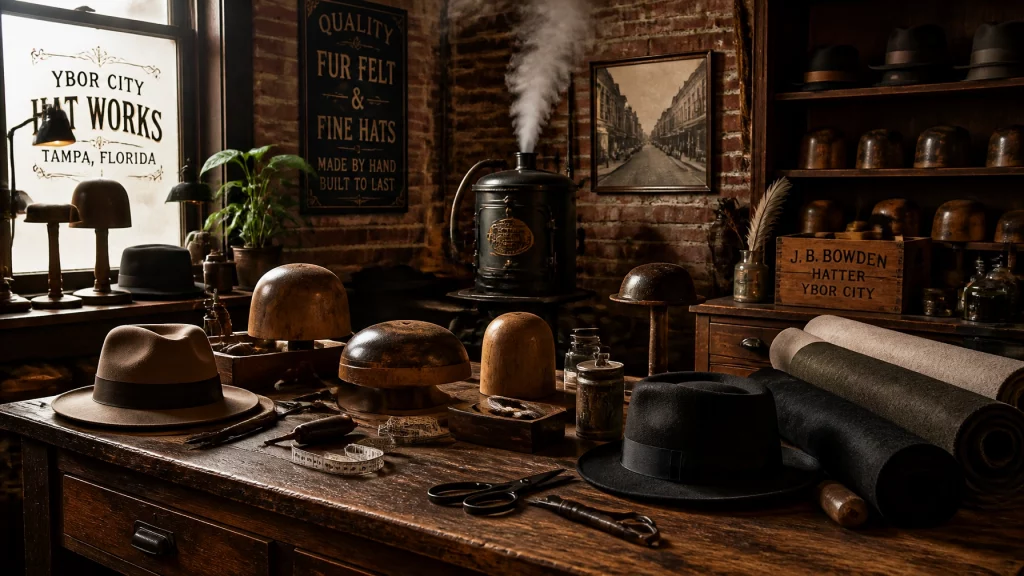
Walking into 'Til Death Hat Co. in Tampa’s historic Ybor City isn't just a shopping trip; it’s a full-on sensory assault in the best way possible. You’re immediately hit with the smell of hot steam, heavy beaver felt, and the faint, sweet scent of cedar. This isn't a "pick a size and move on" kind of place. This is a custom milliner shop where Ash Dudney, a Tampa native, builds bespoke hats by hand, one customer at a time.
But this isn't just a story about cool headwear. If you look closely at the math behind Dudney’s workbench, you’ll see the blueprint for how we fix the American economy.
The Art of the Invasive Species
Dudney didn’t just wake up one day and decide to make hats. He trained under the legendary Tom Hirt: the man responsible for the iconic hats in the film Tombstone. When you’re learning from the guy who made Val Kilmer look that good as Doc Holliday, you’re not just learning a trade; you’re inheriting a lineage of craftsmanship.
However, Dudney added a uniquely Florida twist. He personally hunts invasive Burmese pythons and green iguanas in the Everglades and the Keys, then uses their skins for hat bands and accents. It’s the ultimate "Florida Man" economic model: taking an environmental disaster and turning it into a high-value, luxury export.

The Math of the $1,000 Hat
In the world of "Regular Guy Economics," we often talk about the "race to the bottom." That’s the economic phenomenon where companies strip away quality, offshore labor to the lowest bidder, and flood the market with cheap, disposable goods. It’s how we ended up with $20 hats made of polyester that fall apart after three rains.
Bespoke manufacturing: making things to measure: flips that script. When a product is custom, it commands a premium price. That premium isn't just "brand markup"; it’s the cost of time, skill, and superior materials.
Because Dudney can charge a premium for a handmade, heirloom-quality hat, he can afford to pay himself and his staff a living wage that reflects their actual skill level. He isn't competing with a factory in Southeast Asia; he’s competing with the ghost of quality that left America decades ago. When you buy a custom piece, that money doesn't disappear into a Cayman Islands tax haven or a massive corporate logistics chain. It stays in Ybor City. It pays for local rent, local groceries, and local taxes. It’s the "multiplier effect" in action.
Lessons from the Logistics Trenches
I spent years at XPO Logistics, and let me tell you, when you sit at the crossroads of global supply chains, you see the math of decline in real-time. You watch the ships come in full of cheap plastic and leave empty. You see the sheer volume of "stuff" that is designed to be thrown away.
That experience is what forced me to look deeper into the Regular Guy Economics podcast and really question the sustainability of our model. For decades, NAFTA and the drive for offshoring decimated manufacturing towns in the Midwest. We traded our skilled middle class for cheaper t-shirts, and we’re only now realizing how much that trade actually cost us.
The Great Reshoring of 2026
Fast forward to today. As we move through 2026, we are seeing a massive shift. The "Great Reshoring" is no longer a buzzword; it’s a $1.7 trillion reality. Companies are realizing that global supply chains are brittle and that "just-in-time" delivery doesn't work when the world gets weird.
We are seeing a move toward "local-for-local" manufacturing. This means making products in the U.S. to be sold in the U.S. And at the tip of that spear is the custom, small-batch manufacturer. The custom menswear market alone has ballooned into a $16.5 billion industry. People are tired of looking like everyone else in clothes that don't fit. They want things that are made for them.

The Greying of the Needle
Here is the terrifying part of the math: we have a massive skill gap. Currently, less than 3% of the clothing sold in the United States is actually made here. We’ve spent forty years telling our kids that the only way to succeed is to get a four-year degree and sit in a cubicle. Meanwhile, the people who actually know how to make things are retiring.
There are only about 17,000 tailors left in the entire country, and their median age is 54. We are staring at a "Greying of the Needle." When that generation retires, if we haven't passed those skills on to people like Ash Dudney, that knowledge is gone forever. You can't just "AI" your way into hand-shaping a beaver-felt brim. It requires muscle memory and a "feel" for the material that takes years to master.
Anti-Waste: The Sustainable Choice
Beyond the wages and the local economy, there’s the sustainability angle. The fast fashion industry is one of the biggest polluters on the planet. Millions of tons of cheap clothing end up in landfills every year.
A custom hat or a made-to-measure suit is the ultimate anti-waste product. You buy it once. You take care of it. You might even pass it down to your kids. It’s "Slow Fashion." It’s the idea that it’s better to have one thing that is perfect than ten things that are mediocre. By investing in craftsmanship, we are investing in a future that isn't built on a foundation of garbage.

The Bottom Line
What Ash Dudney is doing at 'Til Death Hat Co. isn't just about fashion. It’s a micro-demonstration of how we rebuild the American soul. When we prioritize skill over scale, quality over quantity, and local craft over global logistics, we create an economy that actually serves the people living in it.
So, next time you’re in Tampa, go see the man. Watch the steam rise. See the python skin being worked into a masterpiece. It’s a reminder that the "madness" of the modern economy can be conquered: one stitch at a time.
Be mindful, be watchful and good luck.