



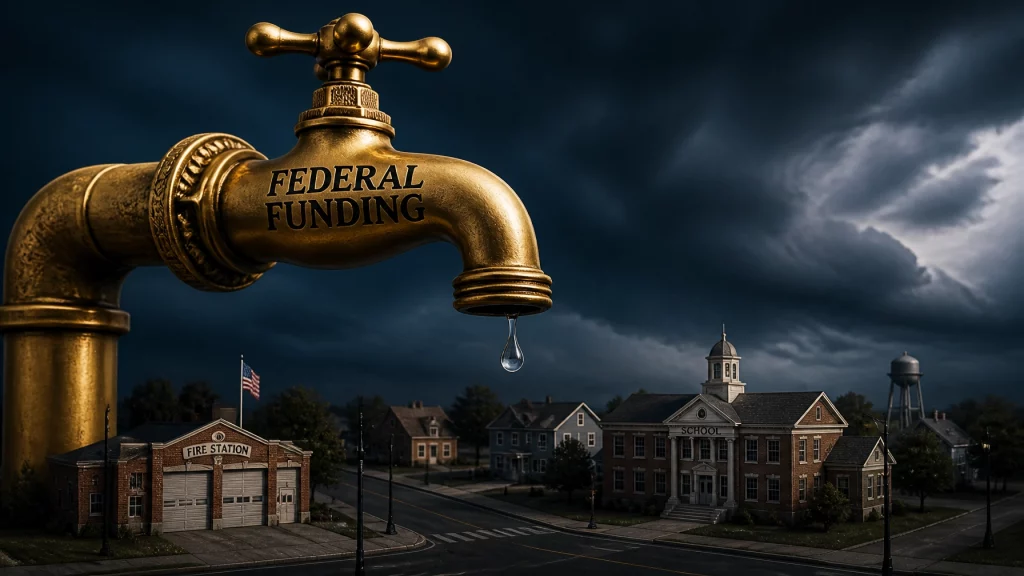
For decades, the relationship between Washington D.C. and your local town square has been like a high-stakes plumbing project. The federal government owns the big tap, and the states have been happily holding out their buckets. But as the global debt clock ticks toward a staggering $353 trillion and the U.S. debt-to-GDP ratio barrels toward 142%, that golden tap is starting to sputter.
We’ve talked before about the math of the madness and why the interest payments on our national debt are starting to crowd out everything else. But here is the part that most people miss: The federal debt crisis isn't going to stay in D.C. It’s coming for your potholes, your local fire station, and your kid's fourth-grade teacher.
When the federal government finally runs out of other people’s money to borrow, it won’t just be "federal programs" that get the axe. The pain is going to cascade down the mountain, and by the time it reaches you, it’s going to look like a massive hike in your property tax bill.
The $1.1 Trillion Addiction
To understand the danger, you have to realize just how dependent our states have become on federal "allowance." Right now, the federal government sends roughly $1.1 trillion per year to state and local governments. That represents about 33.5% of all state expenditures.
Think about that. One out of every three dollars your state spends comes from a city 2,000 miles away that is currently $34 trillion in the hole. Here is where that money goes:
- Health/Medicaid: A massive $1,001.5 billion. This is the gorilla in the room.
- Education, Training, and Social Services: $165.9 billion.
- Transportation: $148.7 billion.
For years, states have treated this money like a permanent gift. But with interest on the debt now costing more than the entire defense budget, the "gift" is becoming a liability. The proposed FY2027 federal budget is already showing the first cracks, with plans to eliminate $13 billion in grants that cities and counties depend on for things as basic as clean water and community policing.
The Balanced Budget Trap
Here is the catch that makes this a looming disaster: Unlike the federal government, which can print money and run deficits until the heat death of the universe, 49 out of 50 states have some form of a balanced budget requirement.
When the federal tap runs dry, states cannot just "print more." They have exactly two options: cut services or raise taxes. There is no third door. There is no magical accounting trick. When that 33.5% of their budget starts to shrink, the "Regular Guy" is the one who gets stuck with the bill.

Scenario 1: The Tax Shift
The most immediate response to a federal funding cut is the "Tax Shift." Washington stops paying for a program, but the program is legally mandated or socially necessary. So, the state passes the cost to the county, and the county passes the cost to you.
We are already seeing this. In some markets, property taxes are already up 15% or more. Why? Because the cost of local services is rising while federal and state support is stagnating. The "Regular Guy" gets squeezed from both ends. You’re still paying federal income taxes (which are increasingly just going toward paying interest on debt, not providing services), and now you’re paying higher local taxes just to keep the library open. It’s a double-taxation trap driven by federal incompetence.
Scenario 2: The Service Cut
If the local population hits a "tax ceiling" and refuses to pay more, we enter the era of the Service Cut. This is where the livability of your community starts to erode.
When that $13 billion in local grants disappears in 2027, what goes first? It’s usually the stuff you notice.
- Public Safety: Police departments shrink, and "community policing" becomes a luxury of the past.
- Fire & EMS: Response times begin to creep up. A three-minute delay doesn't sound like much until it's your kitchen on fire.
- Schools: Funding for special education, lunch programs, and bus routes gets slashed.
We’ve argued in our post about Fixing Capitalism that the social contract is fraying. This is exactly what it looks like in practice: paying more for a version of society that works significantly worse.

Scenario 3: Death by a Thousand Cuts
The most likely outcome isn’t a sudden collapse, but a "Death by a Thousand Cuts." This is a mix of both higher taxes and worse services, slowly boiling the frog.
The "affordability crisis" gets worse because the tax burden shifts downward. Federal income tax is generally progressive, the more you make, the higher your percentage. But property taxes and sales taxes are regressive. They hit the regular guy, the plumber, the teacher, and the small business owner way harder as a percentage of their income.
As the federal government pulls back to save itself from its own debt spiral, it is effectively dumping its problems onto the local property tax roles. Your local town council isn't "greedy"; they are just the last people standing when the music stops in the great game of musical chairs played by the Department of the Treasury.
Connecting the Dots
This isn't an isolated issue. It’s the same thread we’ve been pulling on across all our recent analysis.
- In our NATO post, we pointed out that the U.S. can’t afford to be the world's policeman while our own infrastructure is crumbling.
- In our debt clock breakdown, we warned that interest payments would eventually eat the "discretionary" budget.
Well, those "discretionary grants" to your local town are exactly what’s on the menu. The federal government’s inability to balance a checkbook is going to manifest as a $500 increase in your annual property tax assessment or a school district that can no longer afford to fix the roof.

The Reality Check
We need to stop thinking of "federal debt" as a number on a screen in D.C. It is a direct threat to your quality of life. Every billion dollars sent overseas or wasted on a redundant federal agency is a billion dollars that won't be there when your state needs to backfill a Medicaid shortfall or fix a bridge.
The federal tap is running dry. It’s time for the Regular Guy to start looking at their local school board and town council meetings with a lot more scrutiny. Because when Washington cuts the cord, you’re the one who has to catch the falling weight.
Be mindful, be watchful and good luck.