



If you’ve been hanging around the water cooler lately, or more likely, scrolling through the doom-and-gloom sections of financial Twitter, you’ve probably heard some smart-sounding person mention the "Sahm Rule." It sounds like something out of a Tom Clancy novel or a secret society for people who actually understand their 401(k) statements.
But here’s the truth: The Sahm Rule isn't a secret. It’s just a math equation. And unlike the "new math" your kids are learning in elementary school, this one actually makes sense for the regular guy.
In the next three minutes, we’re going to break down what it is, why it nearly gave everyone a heart attack in 2024, and why, as of June 2026, we can all take a collective breath.
What is the Sahm Rule, Anyway?
The rule was created by an economist named Claudia Sahm. She didn't want to wait for the official government suits at the NBER (National Bureau of Economic Research) to tell us we were in a recession six months after it already started. She wanted a "real-time" indicator.
The Definition: The Sahm Rule says a recession has started when the three-month average unemployment rate rises by 0.5 percentage points (or more) above its lowest point from the previous 12 months.
Think of it like a smoke detector in your kitchen. It’s not telling you that your house might catch fire next year. It’s telling you that the toast is currently burning and you should probably check the living room for flames.

Why Should You Care?
In the world of economics, most indicators are about as reliable as a weather forecast in April. But the Sahm Rule has a legendary track record. Since 1960, every single time this rule has triggered, the U.S. was either already in a recession or about to fall into one.
It matters because it’s usually the first "official" warning sign that the economy is cooling too fast. When companies stop hiring and people start losing jobs, the "vibes" shift. People spend less, businesses cut back more, and the downward spiral begins.
Earlier this month, we talked about how jobless claims were hitting four-month highs, which always gets people jittery. The Sahm Rule is the ultimate "jitter" check.
The Great "False Alarm" of 2024
If you remember back to 2024, things got weird. The Sahm Rule actually flickered. It crossed that 0.5% threshold, and every headline writer in the country started dusting off their "RECESSION IS HERE" banners.
But a funny thing happened: The recession never showed up.
Why? Because the labor market was doing something it had never done before. Usually, unemployment goes up because people are getting fired (lower labor demand). In 2024, unemployment ticked up because a massive wave of people: including new immigrants and folks re-entering the workforce: were looking for jobs at the same time (higher labor supply).
The economy wasn't shrinking; it was just trying to digest a whole lot of new workers. It was a "false positive" that sparked a massive debate among economists. Some said the rule was broken; others said it was just a unique post-pandemic glitch. Either way, the "regular guy" kept working, kept spending, and the "Sahm Scare" eventually faded away.

Where We Stand Today (June 2026)
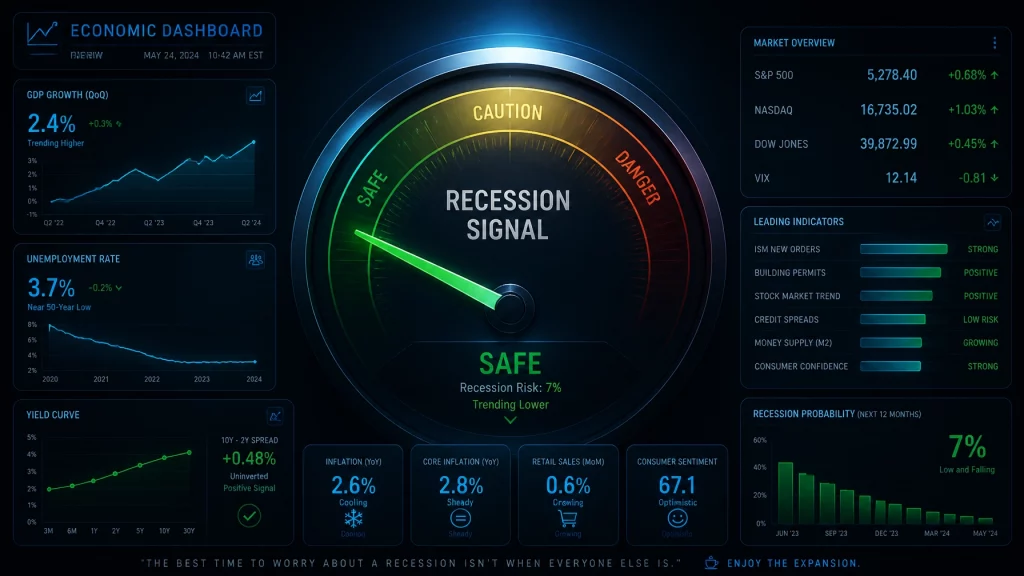
Fast forward to right now. It’s June 2026, and the latest May reading for the Sahm Rule indicator is sitting at 0.10.
For those of you who aren't math nerds: 0.10 is a very good number. It’s well below the 0.50 "panic zone." Despite all the talk about tariffs driving up prices and the shift toward AI-driven layoffs, the broader labor market is holding its own.
We aren't in a recession. We aren't even really flirting with one right now. We’re in the "safe zone."
While New York is busy celebrating the economic windfall of the Knicks making the Finals (and trust me, that $465 million boost to NYC is real), the rest of us can rest easy knowing that the big, scary recession indicator is currently silent.

The Bottom Line
The Sahm Rule is a tool, not a crystal ball. It tells us when the labor market is losing its grip. Right now, the grip is firm.
Does that mean everything is perfect? Of course not. Eggs still cost too much, and your insurance premium probably went up again. But in terms of the "big picture" economic stability, the Sahm Rule is giving us a green light.
So, the next time you hear someone at a BBQ mention that "the Sahm Rule is about to trigger," you can look them in the eye and say, "Actually, the May reading was 0.10. We're good." You'll sound like the smartest guy at the party, and you can get back to focusing on the important stuff: like whether the Knicks can actually close out the series.
Be mindful, be watchful and good luck.