



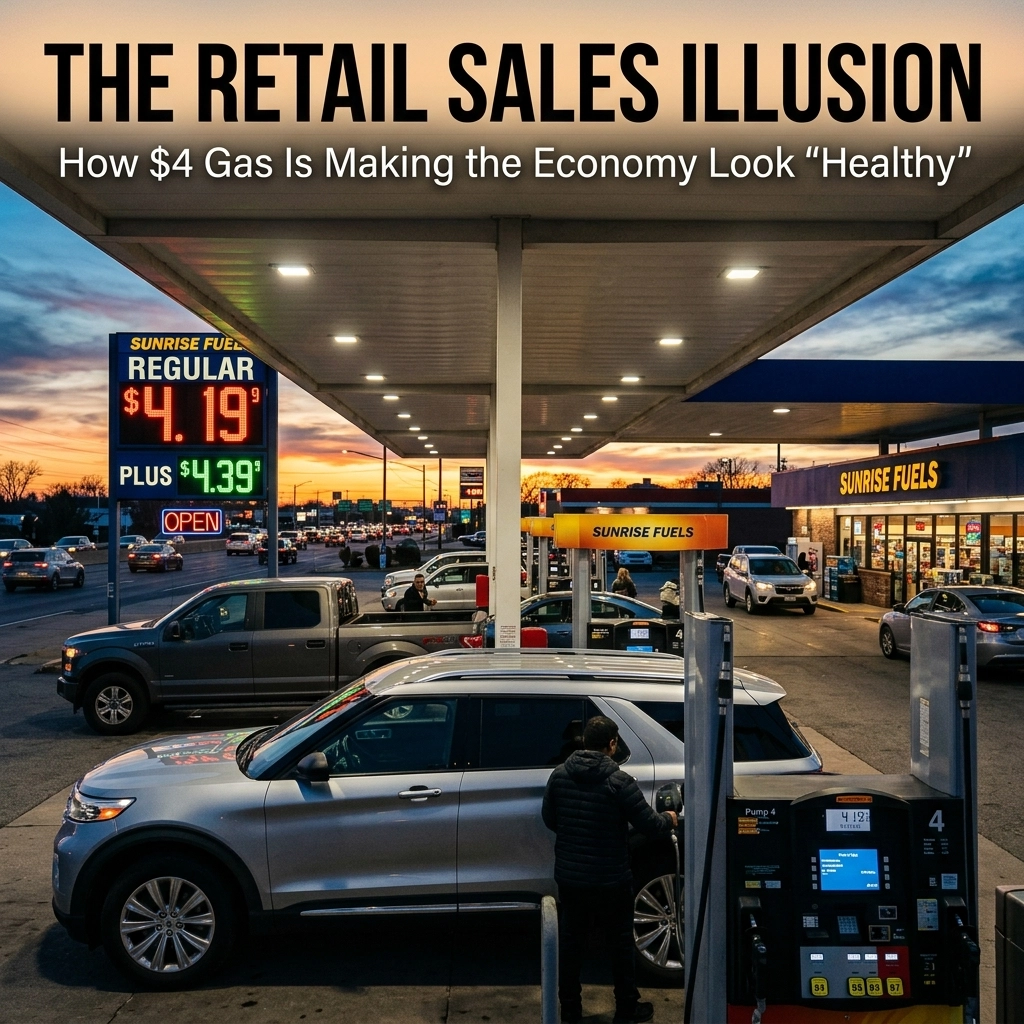
If you’ve turned on the news this morning, Friday, May 1, 2026, you’ve probably already seen some "expert" in a $3,000 suit grinning about the latest retail sales numbers. They’re pointing at a green line on a chart, telling us the American consumer is "resilient" and that spending is holding up just fine.
On paper, they aren't exactly wrong. The numbers are up. People are still swiping their cards. Money is still moving. But if you’re like most of us at Regular Guy Economics, you’re looking at your checking account, your gas receipt, and your grocery bill wondering where that supposed "strength" is hiding, because it sure doesn’t feel like prosperity.
Here’s the dirty little secret the headline numbers won’t tell you: a big chunk of that "growth" isn’t coming from folks buying more fun stuff. It’s coming from households getting whacked at the pump. When gas hangs around that psychological wall of $4.00 a gallon, the economy starts running a shell game with your paycheck.
So for this Friday morning update, let’s pull back the curtain on the retail sales illusion and look at what’s actually happening out in the real world.
The Inelastic Trap: Why You Can’t Just "Say No"
In economics, there’s a fancy term called "price inelasticity." It sounds complicated, but for a regular guy, it’s simple: It’s the stuff you have to buy no matter how much it costs.
If the price of a flat-screen TV doubles, you probably just won't buy a TV this year. That’s elastic. But if the price of gas hits $4.00, $4.50, or $5.00, you still have to get to work. You still have to drop the kids at school. You still have to get groceries.

Because demand for gas is inelastic, we keep buying roughly the same amount of fuel even when the price spikes. When gas goes from $3.20 to $4.20, your "spending" in the retail sales report goes up by about 30% in that category. The government looks at that and says, "Wow! Look at that consumer spending! The economy is booming!"
But you didn't buy 30% more gas. You didn't go on a cross-country road trip. You just got 30% poorer while doing the exact same commute you did last month. That’s the illusion. High gas prices act like a hidden tax that inflates retail sales figures while actually draining the lifeblood out of the "discretionary" side of the economy: the stuff we actually want to buy.
The $4.00 Psychological Wall
There’s something about that number: $4.00. It’s a behavioral tipping point. Once the giant sign at the corner station flips to a "4," something changes in the consumer brain.
We stop being casual spenders and start acting like wartime quartermasters. You’ve probably felt it already on this Friday morning. You pull up to the pump, see the price, and suddenly that little impulse buy inside the station is dead on arrival. No energy drink. No bag of jerky. No goofy extra stop. Now it’s gas apps, rewards points, and driving across the street to save a penny like it’s a blood sport.
That shift in behavior is a major red flag. While the total dollar amount spent on gas stays high, or climbs, the spillover spending disappears. Retailers call this "basket size reduction." Regular people call it "I had to fill the tank, so we’re not ordering pizza tonight." When the gas tank eats an extra $40 or $60 a month, that’s one less dinner out, one less pair of shoes, one less weekend trip, and one more hit to real household wealth.

The "illusion" of a healthy economy persists because the total spending number looks flat or slightly up. But if you look under the hood, the quality of that spending is rotting. We’re trading steak for 87-octane.
The K-Shaped Reality: A Tale of Two Economies
One reason the guys on TV seem so confused about why we’re grumpy is that the economy is currently "K-shaped."
On the top half of the "K," you have the high-income earners. For someone making $250,000 a year, gas going up a dollar a gallon is an annoyance, but it doesn't change their life. They keep buying the organic kale, they keep their Netflix subscription, and they keep the retail numbers looking "resilient."
On the bottom half of the "K," you have the regular guys. The people working for hourly wages or fixed salaries. For this group, that $4.00 gas isn't an annoyance: it’s a budget-breaker.
The search data proves this. While high-income households haven't changed their driving patterns much, lower-income households are already shifting. They’re driving less, combining trips, and cutting back on everything else to keep the car running.
This divergence is why the "average" retail sales number is so misleading. If Bill Gates walks into a bar, the average person in that bar is a billionaire. But that doesn't help the guy at the end of the bar who can't afford a second beer. When luxury spending by the top 10% stays high, it masks the fact that the bottom 60% are drowning.
Nominal vs. Real: The Great Deception
We have to talk about "Nominal" vs. "Real" spending. This is where the math really gets sneaky.
Retail sales reports are almost always "nominal." That means they don't account for inflation. If you spent $100 at the grocery store last year and $110 this year, the retail report says spending is up 10%.
But if that $110 only bought you 90% of the food you got last year, are you really doing better? Of course not. You’re spending more to get less.

When $4 gas hits, it drives up the cost of everything. The truck that delivers the bread uses diesel. The ship that brings the electronics uses fuel. Those costs get passed to you. So, retail sales look "strong" because prices are higher, but the actual volume of goods moving through the economy: the stuff that creates real jobs and real wealth: is often stalling or shrinking.
Why This Matters for the Rest of 2026
If we keep pretending that high spending equals a healthy economy, we’re going to run into a wall. You can only "charge it" for so long. Households are already leaning harder on credit cards to bridge the gap between wages and basic survival costs, and that is not a sign of strength. That is a sign of stress wearing a necktie.
When retail sales are being "propped up" by mandatory spending like gas and food instead of elective spending like home upgrades, weekend travel, new gadgets, or a night out, the foundation gets brittle fast. The headline says "healthy consumer." The reality says families are spending more dollars while building less wealth. It only takes one small shock, another round of layoffs, a housing wobble, or a fresh jump in energy prices, to crack the whole illusion wide open.
The "Health" Mirage
It reminds me of how we look at the medical industry. We spend more on healthcare every year, and people point to that as a sign of a massive, "growing" sector. But as I’ve said before, spending more on cancer treatments and insulin doesn't mean we’re a healthier nation. It usually means we’re sicker.

The same logic applies to the economy. If we’re spending more money just to survive and get to work, the economy isn't "healthy": it's expensive. True economic health is when prices are stable enough that we have money left over after the "must-haves" to invest in our futures, start small businesses, or just enjoy a Saturday afternoon without checking the gas gauge.
What You Should Do
Don't let the headlines gaslight you. If it feels like you’re working harder, spending more, and somehow owning less at the end of the month, you’re not crazy. You’re just paying attention to the real numbers instead of the nominal fantasy.
Here is the Regular Guy game plan for $4 gas on this Friday morning:
- Ignore the "Resilience" Headlines: A lot of that so-called strength is just higher prices on necessities.
- Watch the Volume, Not the Dollars: Focus on how much stuff you actually brought home, not just the bigger total on the receipt.
- Treat Fuel Like a Budget Leak: Combine errands, reduce waste, and protect cash flow anywhere you can.
- Be Skeptical of "Healthy" Retail Sales: If growth is coming from gas, groceries, and other must-haves, that’s not wealth creation. That’s erosion with a fancy label.
The math doesn’t lie, but the interpretation can absolutely get goofy. Wall Street is staring at a spreadsheet. You’re staring at a gas pump, a debit card, and a monthly budget. Trust your eyes.
Be mindful, be watchful and good luck!