



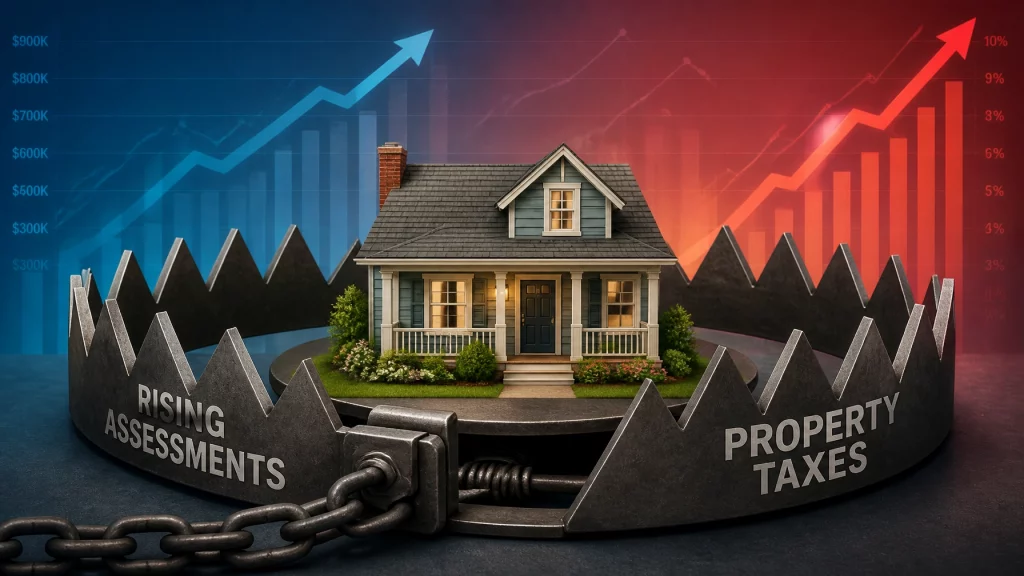
The Great American Dream has a hidden "expiration date" that nobody mentions at the mortgage closing. We are told that if we work hard, pay down the principal, and eventually burn that mortgage paperwork, the house is finally "ours." But for millions of homeowners in 2026, that victory lap is being cut short by a silent, growing predator: the property tax assessment.
In theory, owning a home outright should be the ultimate financial safety net. Without a monthly bank payment, your cost of living should plummet, allowing a fixed income or a modest salary to go much further. In reality, the tax man has become the new landlord. Across the country, rising assessments are turning homeowners into perpetual renters of their own land, often at prices that rival an old mortgage payment.
The Math of the "Perpetual Rent"
Property taxes are unique because they are not based on what a homeowner can afford to pay. They are based on what the government says the property is worth. In a hyper-inflated housing market, that creates a nasty disconnect. If a neighborhood becomes trendy, a warehouse becomes luxury lofts, or a new employer sets up shop nearby, the paper value of a house can surge even if the kitchen is still from 1994 and the roof still leaks over the garage.
That is the central insult of the property tax trap. The gain is theoretical unless the house is sold. The bill, unfortunately, is very real and due in cash.
For a homeowner on a fixed income, a double-digit increase in assessed value is not some accounting curiosity. It is a direct raid on groceries, medicine, utilities, and car repairs. Maryland’s 2026 Group 2 reassessment showed an average statewide increase of 12.7%, with residential properties up 13.2% on average. In Falls Church, Virginia, the 2026 real estate assessment base rose 6.9% overall, with detached single-family homes up roughly 8.1%. Indiana’s statewide gross assessed value update for 2026 came in around 11%, driven by strong housing prices and higher cost tables. Texas, meanwhile, keeps reminding the country that “no state income tax” does not mean “low taxes,” especially when combined effective property tax rates in many places are among the highest in America.
And here is where the whole game gets crooked. Local governments do not always need to raise the tax rate to raise the tax bill. They can leave the rate alone, let assessments soar, and still collect more money. Same rate, bigger base, heavier bill. It is the oldest trick in the municipal finance book.
A Little Historical Context: How the Burden Shifted
This mess did not come out of nowhere. Property tax fights are really about a much bigger tax story stretching from 1960 to 2026.
Back in 1960, state and local property tax collections were roughly 3.2% to 3.3% of national income, according to long-run tax policy research. Through the 1960s and 1970s, property taxes remained a huge pillar of local government finance, especially for schools. By the late 1970s, around the time of the tax revolts, property tax collections as a share of national income had climbed toward roughly 3.5%. Then came a public backlash.
That backlash was not just about numbers on a spreadsheet. Inflation pushed nominal home prices higher. Assessments followed. Income growth did not always keep pace. Homeowners looked at their tax bills and felt like the government was charging rent on the American Dream.
From the 1980s forward, Washington began leaning harder into federal income tax cuts. The top federal income tax rate, which sat at 91% in the early 1960s, came down dramatically over time. The Reagan era cut rates hard. Later rounds of tax cuts kept the federal burden lighter for many upper-income households and investors. But local governments still had to fund schools, police, fire departments, roads, water systems, debt service, pensions, and all the rest of the municipal circus. If federal money and state support did not fully cover it, counties, cities, and school districts went hunting for the revenue source they control most directly: property taxes.
That is the quiet transfer regular homeowners have been living through for decades. Federal taxes were cut. Local bills kept climbing. The burden did not disappear. It moved.
In broad terms, the national effective property tax burden as a share of income has not exploded every single year in a straight line. It has bounced with housing values, recessions, and policy caps. But for the household budget, the lived experience is simpler than the economists like to admit: payroll taxes come out quietly, income taxes get argued over once a year, and property taxes arrive like a crowbar in the mailbox. They are visible, local, and impossible to ignore.

The Assessment Machine: How the Number Gets Cooked Up
Most homeowners know their tax bill went up. Fewer know how the local government got there.
Property tax systems usually start with market value and then turn that into assessed value. Those are not always the same thing.
- Market value is the estimated amount the property would sell for in an open market.
- Assessed value is the value the taxing authority places on the property for tax purposes.
- In some states, assessed value is basically full market value.
- In others, it is a fraction of market value or a capped value that moves under special rules.
- Then exemptions, caps, and credits get layered on top, turning assessed value into taxable value.
Simple, right? Which is exactly why normal people hate this system.
Most local governments use some version of mass appraisal. They do not walk through every house like a careful buyer. They use sales data, neighborhood comps, land tables, age schedules, square footage, depreciation assumptions, and computer models. That works reasonably well in stable markets. In crazy markets, it can become a legalized hallucination.
If three renovated colonials sold for absurd money in 2022 because buyers were stampeding during the low-rate panic, the assessment model may use those sales to suggest that every somewhat similar house nearby is worth dramatically more. Never mind that one house has a new chef’s kitchen and another still has carpet in the bathroom. The machine likes categories. The real world likes details.
The Lag Problem: 2021-2022 Was Insane, and the Bills Are Still Catching Up
The lag problem is where this gets especially ugly.
Assessments usually trail the market. A property tax bill in 2026 may still reflect sales evidence from 2024 or even valuation assumptions baked in earlier. In states with periodic reassessments, the lag can be even more dramatic. That means the market spike from 2021 and 2022, when cheap mortgages and panic buying sent home prices into orbit, is still rolling through local tax systems long after the buying frenzy cooled.
So a homeowner can get hit with a tax bill based on yesterday’s peak even while today’s market is flatter, weaker, or downright soggy. That is like paying restaurant prices for a steak that was cooked two years ago.
Maryland is a clean example. The state reassesses on a three-year cycle and phases in increases over three years. That sounds gentle until realizing it means a hot market can keep feeding future tax bills long after the party ended. The state’s 2026 reassessment showed that almost 93% of reviewed residential properties rose in value. Even if the local rate stays unchanged, the taxable base keeps marching upward in installments.
This is why so many homeowners feel gaslit. The headlines say the housing market is cooling. The assessment notice says congratulations, the castle is apparently worth a mint. The wallet says absolutely not.
Real 2026 Case Studies: The Pain Has Addresses
This is not an abstract theory class. The 2026 numbers are ugly enough on their own.
Falls Church, Virginia
Falls Church is a perfect example of how a “small” rate cut can still mean a bigger bill. The city’s 2026 total assessed property base rose 6.9% to about $6.86 billion. Detached single-family homes increased about 8.1%. Even after officials trimmed the real estate tax rate from $1.185 to $1.18 per $100 of assessed value, the median homeowner was still expected to pay about $557 more per year. Earlier budget discussions put the average increase around $611.
That is the trick in broad daylight: cut the rate by a hair, raise the assessed value by a lot, and call it relief.
Indiana
Indiana’s 2026 assessment update showed about an 11% statewide increase in gross assessed value, according to the Indiana Chamber. Earlier pay-2026 figures based on the prior cycle showed a 12% jump from 2024 to 2025. Residential values rose roughly 10.4% in that earlier cycle, commercial about 16.1%, and industrial about 15.6%.
Indiana does have circuit breaker caps and 2026 relief measures, including a homestead credit worth 10% up to $300 in many cases. That helps. But it does not change the underlying point: the assessment base climbed hard, and if the base stays inflated, future levies have more room to do damage.
Maryland
Maryland’s 2026 Group 2 reassessment covered 789,178 properties. The average increase was 12.7% overall, with 13.2% for residential property and 11% for commercial. Value growth slowed from the crazier 2023 and 2025 cycles, but “slower than insane” is not exactly comforting. In some counties, residential increases were far higher. Washington County, for example, saw residential increases in that group averaging 22.8%.
Maryland softens some of this through phased-in increases and homestead credits, but that only changes the timing of the punch, not whether the punch lands.
Texas
Texas remains the heavyweight champion of confusing homeowners. The state has no personal income tax, which sounds fantastic right up until the local property tax bill arrives wearing steel-toed boots. Effective property tax rates often run around 1.5% to 1.6% statewide, with many local combinations much higher depending on city, county, school, and special district overlays. Some 2026 surveys put the statewide effective rate around 1.63%.
Texas did expand school homestead relief for 2026. The school district homestead exemption increased to $140,000, and over-65 or disabled homeowners can qualify for even larger school tax relief and, in many cases, a school-tax ceiling. That is real help. But it only applies to the school-tax piece and only if the property qualifies. City, county, and special district taxes are still alive and well and fully capable of ruining a peaceful afternoon.

The Senior Squeeze: The Math Gets Cruel Fast
The most vulnerable victims of the property tax trap are retirees and other people on fixed incomes. Social Security cost-of-living adjustments are designed to keep pace with general inflation, not local tax explosions.
Take a very ordinary 2026 scenario.
- Annual Social Security income: $35,000
- House assessed value: $450,000
- Effective property tax rate: 1.5%
- Annual property tax bill: $6,750
That means property tax alone consumes 19.3% of annual income.
That is before homeowners insurance.
Before utilities.
Before Medicare premiums, prescription co-pays, food, and maintenance.
Before one broken furnace or one transmission problem.
A lot of policy people love to say that such a retiree is “house rich.” That phrase deserves to be thrown into a wood chipper. A paid-off house is not a checking account. Equity is not cash unless the owner borrows against it, sells the place, or signs up for some financial contraption that turns shelter into collateral.
That is why the senior squeeze is so brutal. The house may be fully paid for, but the monthly carrying cost keeps climbing anyway. It turns ownership into a hostage negotiation.
Tax-Induced Gentrification: The Neighborhood Gets Better and the Original Residents Get Evicted by Math
There is a polite phrase for what happens next: tax-induced gentrification.
This is the process where rising property values and rising tax burdens push out long-term residents, especially older homeowners, working-class families, and anyone on a fixed income. No bulldozer is necessary. No formal eviction notice is required. The assessor and treasurer can do the job just fine.
The pattern is familiar:
- A neighborhood improves or becomes fashionable.
- New buyers arrive with bigger incomes.
- Sale prices rise fast.
- Assessments follow with a lag.
- Tax bills climb.
- Long-time owners who bought decades earlier find that staying put now costs more each year than leaving.
The winners are the new arrivals who can absorb the costs, local governments that collect on bigger values, and sometimes investors who quietly assemble blocks of property after old owners tap out. The losers are the people who built the place before it became desirable.
That is one of the ugliest parts of the modern tax system. It can punish loyalty and longevity. Live somewhere long enough and help make it a decent community, and eventually the bill can arrive for the crime of having stayed.
Proposition 13: California’s Great Tax Revolt
No discussion of property taxes is complete without California’s Proposition 13, passed in 1978.
Prop 13 did three giant things:
- It capped the general property tax rate at 1% of assessed value.
- It rolled assessments back to roughly 1975-76 values.
- It limited annual increases in assessed value to 2% per year until the property changed ownership, at which point reassessment could occur.
That measure hit like a thunderclap. Research on the period found an immediate collapse in local property tax revenues, with some estimates putting the initial drop above 50%. It launched the famous tax revolt era and inspired tax-limitation movements across the country.
The political fuel was simple enough. Californians had been watching housing prices jump, tax bills soar, and local government act like the meter would never stop running. Prop 13 was the public’s way of taking a baseball bat to the meter.
The Winners and Losers of Prop 13
The winners are obvious:
- Long-time homeowners who got predictability and protection from runaway reassessments.
- Property owners who stayed in place for years and watched taxable values rise far more slowly than market values.
- Many businesses that also benefited from capped assessments on long-held commercial property.
The losers are just as obvious:
- New buyers, who often purchase a similar house next door but pay taxes on a much higher assessed base.
- Renters, who do not receive the same direct protection and still get hit indirectly through housing supply distortions.
- Local governments, school districts, and service providers that lost a flexible revenue source.
- Communities where similar properties now carry wildly different tax bills based mostly on purchase date.
That last part is where Prop 13 gets morally weird. Two identical houses on the same block can have drastically different tax bills. The retired couple who bought in 1985 may have a lower assessed value than the younger family who bought in 2024, even if the homes are nearly identical. One family gets tax certainty. The other family gets welcomed to the neighborhood with a shovel to the face.
That does not mean Prop 13 was crazy. It means Prop 13 solved one problem and created several others.
What Other States Did Instead
Other states looked at California and mostly decided not to go full Howard Jarvis.
Instead, many built softer guardrails:
- Assessment caps limiting annual taxable-value growth for owner-occupied homes.
- Homestead exemptions subtracting a fixed dollar amount or percentage from value.
- Circuit breaker programs tying relief to income, especially for seniors.
- Tax-rate rollbacks or truth-in-taxation rules requiring notice if collections rise too much.
- Classification systems taxing homesteads differently from commercial or rental property.
Florida’s Save Our Homes cap is one famous cousin, limiting annual assessed-value growth on homesteads. Texas uses a thick stew of homestead exemptions, appraisal caps, and school tax rules. Indiana uses circuit breaker caps. Maryland uses credits and phased-in assessments. In other words, most states admitted the problem is real but used duct tape instead of dynamite.

The Homestead Exemption System: What It Actually Does
The phrase homestead exemption sounds like frontier poetry, but it is really just a tax break for a primary residence.
The mechanics vary by state, but the general idea is one of these:
- Subtract a fixed dollar amount from assessed value before tax is calculated.
- Exempt a percentage of value from tax.
- Limit how fast taxable value can rise.
- Offer extra relief for seniors, disabled homeowners, veterans, or surviving spouses.
A few examples make this less muddy.
- In Texas, the 2026 school-district homestead exemption is $140,000 for qualifying primary residences. That means the school-tax portion of the bill is calculated as if the home were worth $140,000 less. Over-65 and disabled homeowners can get more relief and often a school-tax ceiling.
- In Indiana, 2026 reform measures include a homestead credit of 10% up to $300 in many cases.
- In Maryland, the Homestead Tax Credit does not simply lop value off the house. Instead, it caps how much of an annual assessment increase can be taxed for owner-occupied homes, subject to state and local limits. The state also offers an income-based Homeowners’ Property Tax Credit for lower-income households.
Who qualifies? Usually owner-occupants living in the home as a primary residence. Rental properties, second homes, and LLC-held investment houses generally do not get the same breaks.
What does it save? Enough to matter, but not always enough to fix the whole problem.
For example, if a Texas homeowner has a house appraised at $400,000 and the school district tax rate is around 1.0% of taxable value, a $140,000 exemption can save roughly $1,400 per year on the school-tax portion alone. That is real money. But if city, county, MUD, hospital district, and other layers are still piled on, the total bill can remain hefty.
The big mistake homeowners make is assuming exemptions are automatic. Sometimes they are not. A surprising number of people overpay simply because the right form never got filed.
How to Fight Your Assessment: The Appeal Process, Step by Step
This is the part where regular people can actually punch back.
Assessors make mistakes. Models miss condition issues. Comparable sales can be garbage. Land values can get too aggressive. Exemptions can be missing. If a notice looks absurd, it may be absurd.
Here is the basic playbook.
1. Open the notice immediately
Do not throw it on the counter and promise to deal with it “this weekend.” Appeal windows are short. Some are 30 days. Some are 45. Texas deadlines often key off May 15. Indiana’s 2026 appeal timing runs off Form 11 notices and can be about 45 days, often by June 15. Maryland gives homeowners 45 days after receiving the notice.
Miss the deadline and the system suddenly becomes a lot less interested in your feelings.
2. Check the facts first
Before arguing value, verify the basic data:
- square footage
- lot size
- bedroom and bathroom count
- finished basement status
- garage count
- year built
- condition grade
- quality class
If the assessor thinks the house has 2,800 square feet and it actually has 2,250, the case is already halfway written.
3. Pull real comparables
The best comps are usually nearby sales of similar homes that closed close to the valuation date. Not listings. Not wishful Zillow fantasies. Closed sales.
Look for:
- similar size
- similar age
- similar lot
- similar condition
- same school zone if possible
- sales that occurred before the valuation date
A comp across the highway, on a bigger lot, with a renovated kitchen and new roof is not your twin. It is the assessor’s favorite fairy tale.
4. Document every flaw the model ignored
Take photos and keep receipts or repair estimates for things like:
- aging roof
- original windows
- foundation cracks
- outdated electrical
- water intrusion
- old HVAC
- worn flooring
- busy road noise
- awkward layout
- deferred maintenance
Mass appraisal models are very brave when they do not have to smell the mold.
5. File the informal appeal if available
Some jurisdictions offer a first round with the assessor’s office before a formal board hearing. Use it. A calm, organized packet can sometimes knock the number down without a war.
6. Prepare for the formal hearing
Bring:
- the notice
- comp sheets
- photos
- contractor estimates
- a one-page summary of the requested value
- evidence of errors in the property record
Do not show up ranting about government theft for ten minutes. Save that for the cookout. At the hearing, be boring, factual, and specific.
7. Ask for the evidence they used
In some states, new rules require appraisal districts to share supporting evidence before the hearing. Texas, for example, has moved toward more disclosure in 2026. Always ask what comps, schedules, and adjustments were used.
8. If necessary, go higher
If the board denies relief and the numbers justify it, some states allow further appeal to tax court, district court, or an administrative tribunal. That is not worth it for every house, but on larger discrepancies it can be.
Real Tips That Actually Help
A few practical realities make a difference:
- Do not argue taxes, argue value. The board often cannot change the rate, only the valuation.
- Use the valuation date. If the relevant date was January 1, use evidence from around that date.
- Recent purchase price can matter. If the home was bought in an arm’s-length sale near the valuation date, that price is powerful evidence.
- Neighborhood decline matters. Busy road, nearby apartments, flood risk, power lines, deferred neighborhood maintenance, or backing to commercial property can all affect value.
- One successful appeal can save money for years. Lowering the base today can reduce future taxed growth if the system trends upward from that starting point.
The Bond Issue Problem: Why the Bill Keeps Sprouting New Heads
Here is another piece of the trap that does not get enough attention: bonds.
When local voters approve school bonds, infrastructure bonds, public safety bonds, library bonds, sewer bonds, or transportation bonds, that debt has to be serviced. The money often comes through property-tax-backed levies or through local rates that ultimately rest on the same real estate base.
In plain English, every shiny promise on the ballot can become another mouth feeding on the same house.
Sometimes those projects are necessary. Schools get old. Pipes crack. Roads crumble. Bridges do not repair themselves by motivational speech. But the financing matters. If a town stacks bond issue on top of bond issue while home values are already inflated, homeowners can get squeezed from both directions:
- higher assessments
- additional debt-service demands
That is how a paid-for house becomes a municipal ATM.
And once the debt is issued, the bills do not politely disappear because a retiree is having a tough year. Bondholders still expect to be paid. That means property owners are often the shock absorbers for every ambitious local spending plan.
Retirement Strategy: Should the House Be Paid Off Early?
For years, “pay off the house before retirement” has been treated like financial gospel. In plenty of cases it still makes sense. But property tax math changes the picture.
A paid-off mortgage removes principal and interest. Good. But it does not eliminate:
- property tax
- insurance
- maintenance
- HOA dues
- utilities
- repairs
- special assessments
If property tax alone is 1.5% to 2% of value in a high-cost area, the house can still carry a serious annual burden even with no mortgage at all. On a $500,000 home, a 1.5% effective tax rate means $7,500 per year. At 2%, it is $10,000. That is before replacing a roof or dealing with homeowners insurance that has also gone berserk in many states.
So the old retirement question was:
“Can the mortgage be eliminated?”
The new retirement question is:
“Can the property carrying costs be sustained for 20 or 30 years?”
That may change decisions on:
- where to retire
- whether to downsize sooner
- whether to move to a lower-tax county
- whether to prioritize liquid savings over rushing every spare dollar into house payoff
- whether to buy less house in the first place
That does not mean homeownership is a bad deal. It means the analysis cannot stop at the mortgage statement. A retiree with a tiny mortgage and huge liquidity may actually be in a better position than a retiree with a paid-off house and a brutal annual tax bill.
The "For Sale" Sign of Last Resort
When the math stops working, the house becomes the for-sale sign of last resort. This is not the cheerful downsizing brochure version of life. This is forced relocation by spreadsheet.
A person can live in the same home for thirty years, mow the lawn, pay off the loan, know every crack in the driveway and every creak in the stairs, and still be pushed out because the local tax structure decided the neighborhood became too valuable for the people who were already there.
That is not just a housing issue. It is a cultural issue, a retirement issue, a family stability issue, and a community issue. When long-time residents get replaced because the carrying costs outrun reality, neighborhoods become less rooted, less mixed, and less forgiving.

As 2026 rolls on, the property tax trap remains one of the least glamorous but most dangerous threats to long-term household stability. This is not flashy like stock market volatility or headline inflation, but it hits exactly where regular people live: the monthly budget, the retirement plan, and the ability to stay put.
The uncomfortable truth is that paying off a house does not end the obligation. It only changes the name of the collector. For millions of Americans, the bank left the picture and the local government stepped right in.
Keep a close eye on those assessment notices. Check every exemption. Appeal bad numbers. Watch local bond proposals. And when thinking about retirement, remember that a paid-off house is only truly affordable if the annual tax bite does not turn ownership into a slow financial bleed.
Be mindful, be watchful and good luck.