



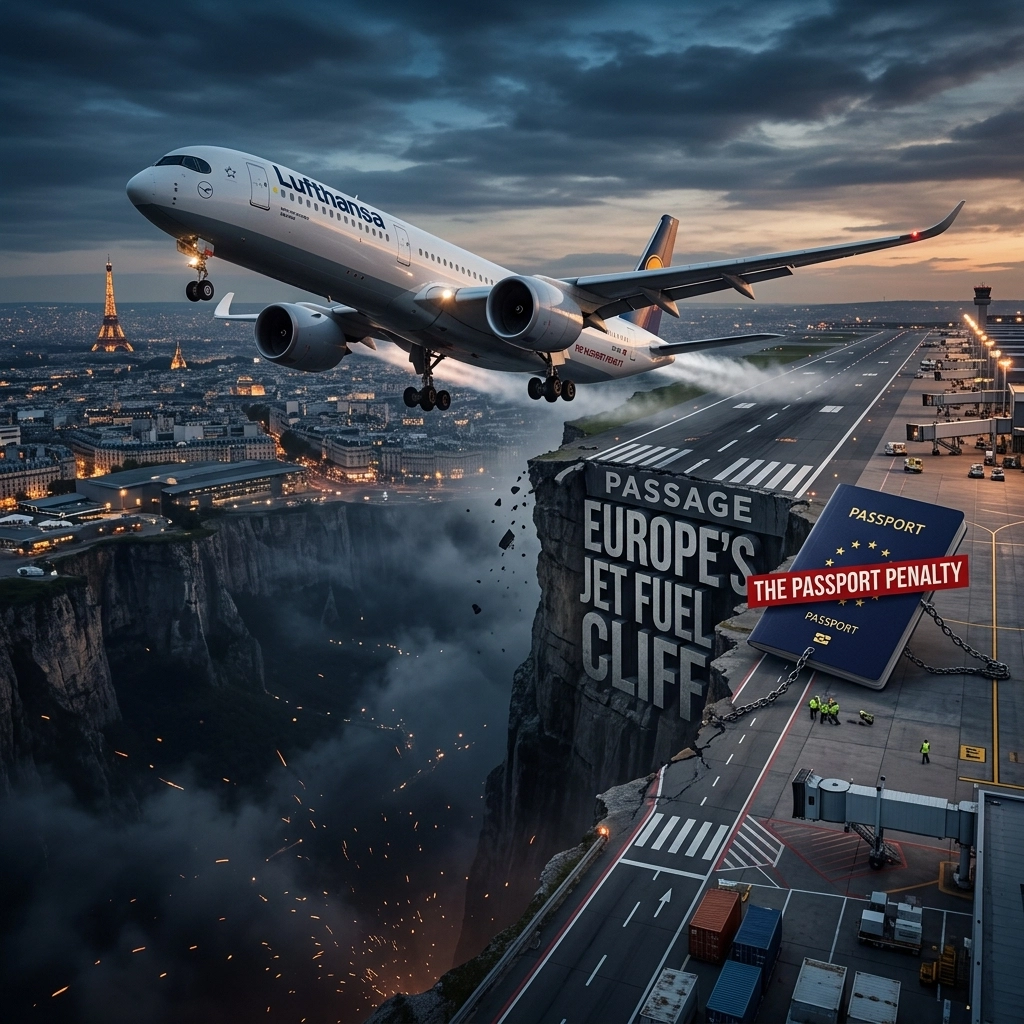
So, you finally did it. You checked the savings account, did the math on the credit card points, and decided that the summer of 2026 was going to be the year you finally took the family to see the Colosseum or grab a pint in Dublin. The war clouds over the Middle East have technically parted, it’s been over a month since the ceasefire, and you figured the "Regular Guy" could finally catch a break.
Well, I hate to be the bearer of bad news while you’re picking out travel adapters, but there’s a new tax on your summer dreams. I’m calling it the "Passport Penalty."
It’s not a fee you pay at the gate, and it’s not a surcharge from the embassy. It’s a brutal combination of sky-high ticket prices and a literal "cliff" that the European aviation industry is staring at. We aren't just talking about expensive flights anymore; we’re talking about the very real possibility that your flight might not even exist by the time you get to the airport.
The $1,000 Barrier
Let’s look at the cold, hard numbers first, because the math is getting ugly. Before the conflict in Iran kicked off, the average international round-trip fare was sitting at a manageable (if not exactly "cheap") $774. That’s the kind of number a regular guy can work with if he skips the morning latte for a few months.
Fast forward to late April 2026, and that same ticket hit an average of $1,097. That is a 42% jump.
Think about that for a second. For a family of four, you aren’t just looking at an extra couple hundred bucks. You’re looking at an additional $1,300 just to get across the Atlantic. That’s the price of your hotel for the week. That’s the "Passport Penalty" in its purest form. The price of entry has gone from "painful" to "prohibitive" for a lot of us.

The Jet Fuel Cliff: 23 Days to Impact
But here’s where it gets really spooky. Usually, when prices go up, we complain, we pay it, and we expect the service to be there. But Europe is currently facing a physical crisis that doesn't care about your credit limit.
The International Energy Agency (IEA) just dropped a bombshell: Europe, as a whole, is running on fumes. Specifically, the continent has about a few weeks' worth of jet fuel left in its strategic reserves. The IEA warned that if those stocks fall below the 23-day mark, we aren't just looking at more expensive tickets, we are looking at physical shortages.
When a gas station runs out of regular, you drive three blocks to the next one. When an airport runs out of jet fuel, the planes stay on the ground. Period.
This isn't just a theoretical "what if." We’re already seeing the first casualties of the jet fuel war. Air Canada recently announced they are pulling the plug on their service to New York’s JFK between June and October. Why? Because the surging cost of jet fuel and the logistical nightmare of securing it means the route simply doesn't make sense for them anymore.
If a major carrier like Air Canada is looking at the route between the world's financial capital and the Great White North and saying "No thanks," what do you think that means for your budget flight to Lisbon?

Booking-Risk vs. Price-Risk: The New Travel Gamble
For the regular guy, travel has always been about managing "Price Risk." You watch the fares, wait for a dip, and pounce when the price feels right. But in the summer of 2026, we’ve entered the era of "Booking Risk."
Price Risk is the fear that you’ll pay $1,100 for a ticket today and see it for $900 tomorrow.
Booking Risk is the fear that you’ll pay $1,100 for a ticket today and find out in July that the flight was canceled because the airline couldn't find enough fuel to fill the wings.
This creates a "Passport Penalty" that is psychological as much as financial. Do you lock in the $1,100 fare now to "guarantee" a seat, or do you wait and see if the ceasefire leads to lower fuel prices? If you wait, you might save $200, but you might also find that every seat is gone because airlines have slashed their schedules to save fuel.
It’s a game of musical chairs where the chairs are $1,100 a pop and the music is being played by a guy who’s running out of batteries.

Why Is This Happening Now?
You might be asking, "If the war is over, why is the fuel so expensive?"
It’s the "ratchet effect." Refining capacity for jet fuel was already tight before the missiles flew. During the conflict, insurance premiums for tankers went through the roof, and shipping routes were diverted. Even though the shooting has stopped, those logistics don't just "reset" overnight.
Refineries in Europe are struggling to keep up with the summer surge, and importing fuel from the US or Asia is costing a fortune because of the high demand everywhere else. It’s a perfect storm. The "peace dividend" we were all hoping for hasn't reached the airport yet. Instead, we’re left with the leftovers of a war-time economy: high costs and low supply.
How to Navigate the Cliff
So, what’s a regular guy to do? If you’ve already got the time off booked and the kids have their hearts set on seeing Big Ben, you’re in a tough spot. Here is how I’m looking at the math:
- The Direct Route Rule: This is the year to avoid connections if you can. Every connection is a new point of failure. If your first flight gets delayed because of a fuel shortage at a regional hub, you might miss your transatlantic leg. Direct is more expensive, but it lowers your Booking Risk.
- Watch the "Big" Carriers: Airlines like Delta, United, and Lufthansa have deeper pockets and better fuel-hedging contracts than the low-cost carriers. If fuel gets tight, the "budget" airlines will be the first to cancel flights. Sometimes, paying an extra $100 for a major carrier is just buying insurance that you'll actually leave the ground.
- The Refundable Premium: I usually never buy the "flexible" or "refundable" option because I’m cheap. But this year? That extra $50 for a refundable ticket is the only way to sleep at night. If the IEA’s "23-day cliff" becomes a reality in July, you want to be able to pull your money out fast.
- Domestic is the New International: I know, I know: you wanted the Alps. But when you look at the $4.50 national gas average (which we'll talk about in another post), even a road trip is getting pricey. However, a road trip doesn't get "canceled" by a refinery in Rotterdam.

The Bottom Line
The "Passport Penalty" is a reminder that we live in a global economy that is much more fragile than the travel brochures suggest. We’ve spent the last decade assuming that travel would just keep getting cheaper and easier. The events of the last year have proven that a "bad night over Tehran" has a long, expensive tail.
We are currently in a race against time. If European refineries can ramp up and the shipping lanes stay calm, we might dodge the 23-day cliff. But for now, the data says you should pack a little extra patience: and a lot of extra cash: if you’re planning on crossing the pond.
The dream of the European summer isn't dead, but it is currently sitting on a very expensive, very short fuse. If you're going to jump, just make sure you know where the cliff is.
Be mindful, be watchful and good luck.