



If you’ve been watching the evening news lately, you’ve probably heard a lot of cheering. The pundits are high-fiving over "cooling inflation" numbers, and the headline stats suggest that the economic dragon has finally been slayed. But then you pull into a Shell station on a Tuesday afternoon, look at the glowing numbers on the sign, and realize the "good news" hasn't reached your zip code yet.
There is a massive disconnect between the spreadsheets in Washington and the nozzle in your hand. While consumer prices supposedly rose only 3.5% annually in June, your gas tank is operating on a completely different set of physics. That’s because of the "Hormuz Premium": a tax on your life caused by 21 miles of water halfway across the world.
The World’s Jugular Vein
The Strait of Hormuz is the world’s most critical energy chokepoint. It’s a narrow stretch of water where one-fifth of the world’s oil and liquefied natural gas (LNG) passes through every single day. To put that in perspective, we’re talking about 20 million barrels of oil per day.

When the U.S. launched fresh attacks against Iran earlier this month, the market didn't just react: it flinched. We are currently seeing a disruption that is technically worse than the 1973 oil shock. Back then, it was a political embargo; today, it’s a physical blockade of the world’s jugular vein. When 20 million barrels of oil are suddenly "at risk," the price of everything you touch goes up.
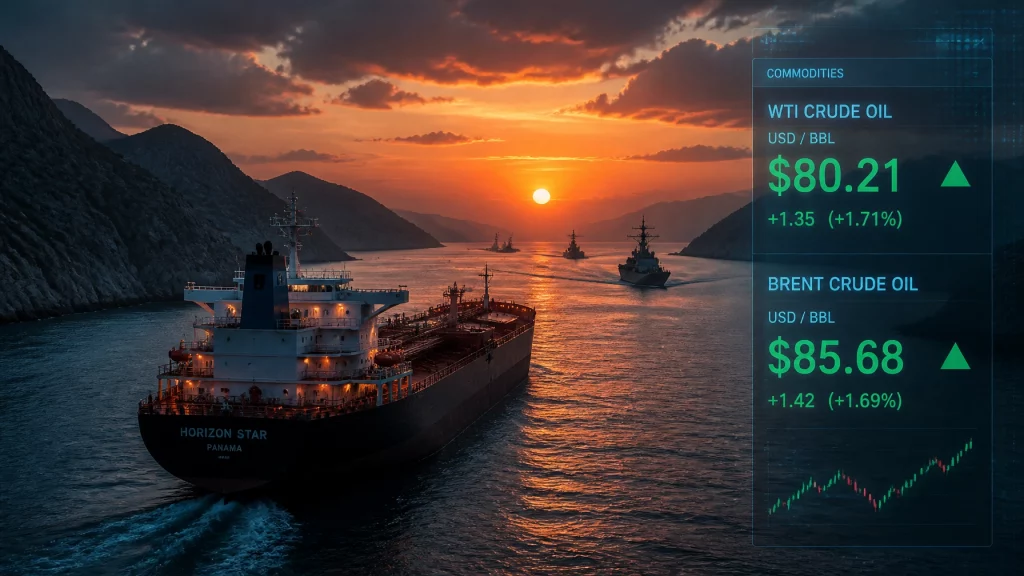
Currently, West Texas Intermediate (WTI) is sitting at $80.21, while Brent crude: the global benchmark: is hovering at $85.68. For the regular guy, these numbers might seem like abstract data points, but they are the direct DNA of your grocery bill. Oil isn't just fuel for your Ford F-150; it’s the plastic in your milk jug, the fertilizer for your corn, and the diesel for the truck that delivered both.
The IMF’s Rosy Glasses
The International Monetary Fund (IMF) recently released a report assuming the Strait of Hormuz will begin "reopening" in mid-July, with things returning to "normal" by March 2027.
If you believe that timeline, I have a bridge in Brooklyn and some oceanfront property in Arizona to sell you.
The idea that global shipping and energy markets will just "normalize" by 2027 is a classic example of bureaucratic optimism. We are looking at a three-year recovery window under the best-case scenario. In the meantime, the "Hormuz Premium" is here to stay. Even if the missiles stop flying tomorrow, the insurance rates for these tankers have skyrocketed. The cost of security, the rerouting of ships around the Cape of Good Hope, and the general "geopolitical risk" are now baked into the price of a gallon of 87-octane.

Why the Fed is Stuck in Neutral
This brings us back to the Federal Reserve. We’ve discussed before how the Fed still isn’t satisfied with inflation staying above 2%. Fed Chair Kevin Warsh is being pressed to cut interest rates to help the housing market, but he’s staring at a brick wall made of oil barrels.
The Fed can't effectively cut rates when energy prices are acting like an anchor. If they lower rates and stimulate the economy while oil is at $85, they risk a secondary spike in inflation that could dwarf the first one. For the regular guy, this means you’re getting squeezed from two sides: high interest rates on your credit cards and high prices at the pump. The "cooling inflation" narrative is a luxury for people who don't have to drive to work every day.
The NATO Connection and the Cost of Security
We recently talked about the shifting burden of global defense. This conflict is a live-fire demonstration of why global stability matters to your bank account. When the U.S. has to launch strikes to keep shipping lanes open, we are essentially paying a "security tax" in two ways: once through our tax dollars funding the military, and a second time at the pump when those same strikes cause oil prices to jump due to uncertainty.
It is a paradox of modern economics. To keep the oil flowing, we have to project power. But projecting power in a volatile region makes the market nervous, which drives up the price of the very oil we’re trying to protect. It’s a cycle that doesn't have an easy exit ramp, and the "regular guy" is the one who ultimately funds both sides of the equation.

What to Expect at the Pump
Don't expect a relief valve anytime soon. Even with the IMF’s projected "reopening," the global supply chain has a long memory. The 20 million barrels per day that were disrupted won't just reappear overnight. Inventories are low, and the "risk-off" sentiment in the market means that any small skirmish in the Middle East will result in a $5 jump in crude prices.
We are living through a fundamental re-pricing of energy. The era of "cheap and easy" is being replaced by "expensive and complicated." While the government celebrates a 3.5% inflation rate, the reality for anyone who lives in the real world is that the cost of moving from Point A to Point B has fundamentally changed.
The best thing you can do is stop listening to the rosy projections of 2027. The "Hormuz Premium" is the new normal. Adjust your budget, watch the Brent crude numbers, and realize that as long as the world's most critical shipping lane is a war zone, your wallet is on the front lines.
Be mindful, be watchful and good luck.