



Thursday, August 13, 2026
The Federal Reserve has created a strange new economy.
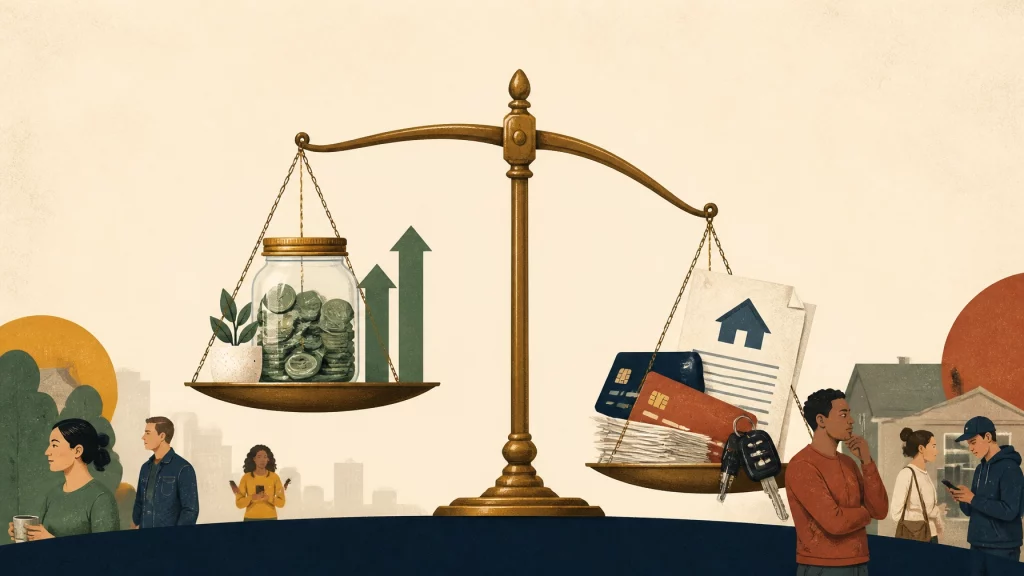
People with cash are finally being paid to keep it safe. People without cash: or people forced to rely on debt: are paying dearly for the privilege of getting through the month.
That is the great saver split.
After years of near-zero interest rates, high-yield savings accounts and money-market funds are paying roughly 4% in 2026, with some promotional offers reaching 5% on limited balances. That does not make anybody rich. It does, however, mean a household with $10,000 in emergency savings can earn roughly $400 a year before taxes without taking stock-market risk.
Meanwhile, the average credit card APR is still dramatically higher. A balance carried from one month to the next can cost 20%, 25%, or more. The same economy that pays you 4% for holding cash can charge you five or six times that amount for borrowing it.
This is not a minor difference. It is a financial canyon.
Cash has finally stopped being dead money
For most of the 2010s, keeping money in a bank savings account felt like putting it in a decorative jar. The money was safe, but the interest was almost meaningless.
The Federal Deposit Insurance Corporation’s national average savings rate was about 0.38% heading into August 2026. On $10,000, that produces approximately $38 over an entire year. A competitive high-yield savings account paying 4% produces about $400.
That is more than ten times as much interest.
The national average is so low because many large traditional banks still pay almost nothing on ordinary savings accounts. They can do this because customers are slow to move their money, and because checking-account convenience is a powerful drug. A bank may pay 0.01% on your savings while charging a monthly maintenance fee for the privilege. That is not a financial product. That is a toll booth.
Online banks and money-market funds have changed the equation. They generally have lower overhead, compete more aggressively for deposits, and pass more of the prevailing interest rate to customers.
A high-yield account is not a magic investment. Its rate can fall when the Federal Reserve cuts rates. The interest is taxable. Promotional rates may apply only to the first few thousand dollars or require direct deposit and other conditions.
Still, 4% is a meaningful return for money that is meant to remain liquid and relatively safe.
The FDIC’s national rates page is a useful reminder of the gap between average banking products and competitive ones. The lesson is simple: do not assume your bank is paying you a fair rate merely because it has your name on a statement.
The Federal Reserve is paying one side of the table
The Fed has kept its target federal funds rate at 3.50% to 3.75% in August 2026 because inflation remains above its 2% goal. Core inflation was approximately 3.4% over the 12 months ending in May, according to the Federal Reserve’s July Monetary Policy Report.
That policy is painful when you want a loan. It is helpful when you have cash.
The reason is basic financial plumbing. Banks and other financial institutions can earn more when short-term interest rates are high. They compete for deposits by offering better yields. Treasury bills, certificates of deposit, and money-market funds also become more attractive because their returns rise with market rates.
For the first time in more than a decade, ordinary savers have a reasonable place to park emergency money and earn something close to: or slightly above: the inflation rate.
That “slightly” matters. If a savings account pays 4% and inflation runs at 3.4%, the rough real return is only about 0.6% before taxes. The purchasing power of the money is still being nibbled by rising prices, but the savings account is no longer sitting there completely defenseless.
The real enemy is not modest interest. The real enemy is earning 0.38% while prices rise several percentage points.

Borrowers are paying the other side’s bonus
The same interest-rate environment that rewards cash punishes debt.
Credit cards are the clearest example. Most card rates are variable and tied, directly or indirectly, to the prime rate. With the bank prime rate around 6.75%, card issuers can charge substantial additional margins based on a borrower’s credit risk and the product itself.
A household carrying a $5,000 credit-card balance at 24% APR can pay approximately $1,200 in annual interest if the balance remains roughly constant. A household with $5,000 in a 4% high-yield savings account earns approximately $200 before taxes.
The saver earns a little lunch money. The borrower loses several car payments.
That is the split in one sentence.
The New York Fed’s Household Debt and Credit Report places total U.S. household debt near $18.8 trillion in the first quarter of 2026. Credit-card balances were about $1.25 trillion, while auto-loan balances were approximately $1.69 trillion. About 4.8% of household debt was in some stage of delinquency.
Credit-card delinquency transitions remained extremely high, at roughly 8.6% on an annualized basis. Auto-loan stress also remained elevated, particularly among borrowers with thinner finances and weaker credit histories.
These numbers are not an accusation. A family does not always borrow because it is reckless. Groceries, medical bills, vehicle repairs, childcare, and a temporary job loss can push a perfectly responsible household onto a credit card.
But once the balance is there, high interest rates turn a temporary problem into a permanent subscription.
Housing and cars are not escaping the squeeze
The borrowing penalty also shows up in large purchases.
Mortgage rates are influenced by long-term Treasury yields, inflation expectations, and the market for mortgage-backed securities. They do not move one-for-one with the Fed’s overnight policy rate. That is why a borrower can hear that the Fed is “considering cuts” while still facing a mortgage rate that makes the monthly payment uncomfortable.
A modest difference in mortgage rates can add hundreds of dollars to a monthly payment. That money does not buy a larger house, better appliances, or a nicer neighborhood. It buys the same house at a higher financing cost.
Auto loans are less dramatic but often more immediate. A higher rate on a $35,000 vehicle can add thousands of dollars over the life of the loan. Add elevated vehicle prices, insurance, registration, and maintenance, and the modern automobile starts to resemble a small family member who never stops eating.
The financial system is effectively saying: cash is welcome, but borrowed cash comes with a bouncer.
How to use the high-rate environment to your advantage
The good news is that the Fed’s weapon can become a savings tool. The strategy is not complicated, but it requires doing a few boring things consistently.
1. Move emergency money to a competitive account
Keep enough money liquid to cover an emergency: often three to six months of essential expenses, depending on job stability and household needs.
Look for a high-yield savings account at an FDIC-insured bank. Confirm the insurance coverage, withdrawal rules, minimum balance requirements, and whether the advertised rate is a temporary promotion.
Do not chase a 5% headline rate if it applies only to $500 and requires you to perform financial gymnastics every Tuesday.
2. Separate spending money from savings money
The best account for your emergency fund does not need to be the same account used for groceries and subscriptions.
A separate savings account creates friction between you and unnecessary spending. It also makes the interest visible. Watching $80 or $100 arrive each month is a small but useful psychological reward.
The point is not to become emotionally attached to an APY. Rates change. The point is to stop donating your cash to a bank that pays almost nothing.
3. Attack high-interest debt before reaching for fancy investments
Paying down a 24% credit-card balance is like earning a guaranteed 24% return, without market risk and generally without tax on the “return.” Very few investments offer that combination.
Maintain a basic emergency cushion first. Then direct extra cash toward the highest-rate debt, usually credit cards and certain personal loans.
Do not empty every dollar of savings to pay down debt and leave yourself unable to handle a $900 car repair. That merely sends the repair bill back onto the card. The goal is to build a small moat, then eliminate the expensive debt behind it.

4. Use short-term government securities for money with a deadline
Money needed in a few months or a couple of years may fit in Treasury bills, a Treasury money-market fund, or a certificate of deposit. The right choice depends on liquidity, taxes, and personal circumstances.
Treasury securities are not the same as a savings account, and they can have different rules and risks. But they are worth understanding when short-term rates are attractive. The Federal Reserve’s selected interest-rate data provides a useful view of the broader rate environment.
Money needed for a home down payment, tuition, or a vehicle should not be thrown into speculative assets merely because inflation is annoying.
5. Lock in fixed rates when borrowing
If borrowing is unavoidable, compare lenders and understand the difference between a fixed and variable rate.
A fixed-rate loan provides payment certainty. A variable-rate loan may become more expensive if market rates rise. For credit cards, the best move is usually not finding a card with a slightly less terrible rate. It is paying the balance in full or transferring it into a structured payoff plan with clear terms.
And always compare the total cost, not just the monthly payment. A low payment stretched over a long term can be an expensive disguise.

The saver split is real: but it is not permanent
High interest rates are not a moral reward for savers or a punishment reserved for careless borrowers. They are a policy tool. The Fed raises rates to slow demand and contain inflation, and the consequences spread unevenly through the economy.
People with liquid savings benefit first. People with substantial debt feel the pain first. Households living paycheck to paycheck often experience both sides at once: a little more interest on a small savings balance and a lot more interest on a car loan or credit-card balance.
That is why the practical response matters.
Keep cash earning a competitive yield. Build an emergency fund. Pay down revolving debt. Avoid borrowing for things that can wait. Use fixed rates when appropriate. Compare accounts instead of remaining loyal to a bank that has never returned the favor.
The high-rate environment is not pleasant, but it is usable. The Fed may control the weapon, but households can decide where to stand when it fires.
Be mindful, be watchful and good luck.