



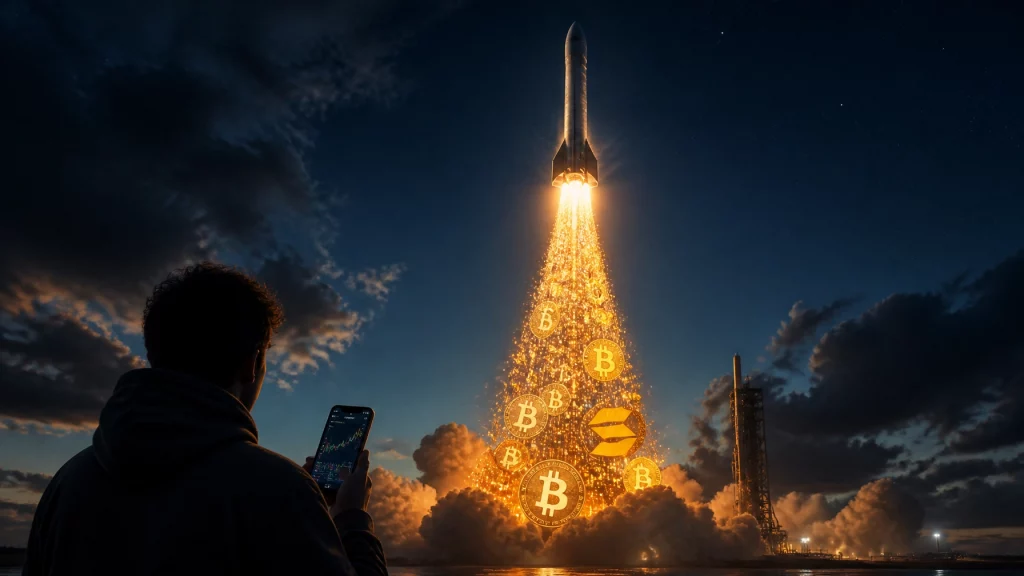
For the last few years, the narrative has been simple: Bitcoin is the "digital gold," and the crypto market is the final frontier of wealth creation for the little guy. But as we sit here in July 2026, the wind has shifted. There is a new giant sucking sound in the financial markets, and it isn't coming from a bank vault: it’s coming from a launchpad in South Texas.
The "Great Rotation" is officially here. If you’ve been wondering why your Solana portfolio looks like a deflated balloon or why Bitcoin can’t seem to find its footing despite all the institutional hype, look no further than the ticker SPCX.
Last month, SpaceX pulled off the largest Initial Public Offering (IPO) in human history, and the fallout has been a textbook example of how capital moves in a closed system. We like to think that new markets create new money, but the reality is much more mundane. Investors aren't usually finding "new" money under their mattresses; they are just moving it from one pocket to another. Right now, that money is fleeing the digital ether and piling into Elon Musk’s rocket ship.
The $2 Trillion Black Hole
Let’s look at the math, because the numbers are absolutely staggering. On June 12, SpaceX officially went public, raising $75 billion in a single day. To put that in perspective, that’s nearly three times larger than the Saudi Aramco IPO that everyone used to cite as the gold standard of big deals.
SpaceX dumped 555 million shares onto the market at an entry price of $135. By the time the closing bell rang on Day One, the stock was sitting at $161, a 19% jump that pushed the company’s market cap over the $2 trillion mark.

For the "regular guy" at home, this was billed as the opportunity of a lifetime. SpaceX actually allocated 20% of the IPO specifically to retail investors: a rare move for a company this size. Usually, the big banks and hedge funds eat the whole cake and leave the crumbs for us. This time, they let the retail crowd in on the ground floor, and the retail crowd responded by selling everything else to get a seat on the rocket.
The Great Sucking Sound: From BTC to SPCX
You don't have to look far to see where the money came from. While the SpaceX hype machine was spinning up, the crypto markets were bleeding out. We tracked 13 straight sessions of Bitcoin ETF outflows totaling a massive $4.4 billion in the weeks surrounding the IPO.
It wasn't a coincidence. Even the heavy hitters in the crypto space are admitting it. Solana Foundation president Lily Liu recently confirmed that we are seeing a massive shift of capital directly from digital assets into the SpaceX ecosystem. Why hold a speculative token when you can own a piece of the infrastructure that literally owns the sky?
This is the "Caitlin Clark effect" of the stock market. Just like we saw in our previous analysis of sports economics, capital is a heat-seeking missile. It doesn't care about "loyalty" to a tech or a coin; it chases the winner. Right now, Elon Musk is the ultimate winner, and the "shiny object" syndrome has redirected billions of dollars from the blockchain to the launchpad.
The "Pre-IPO" Madness and Tokenized FOMO
If you think the rotation only happened on the day of the IPO, you haven't been paying attention to the "Perpetual" markets. Crypto exchanges like Hyperliquid and Binance have been hosting "Pre-IPO Perpetuals" for months. We saw over $2 billion in trading volume on these platforms before the stock even existed on the Nasdaq.

The irony is thick enough to choke on. Crypto enthusiasts: the people who supposedly want to "decentralize" the world: were using crypto-native tools to speculate on a centralized, multi-trillion-dollar aerospace giant. New platforms like PreStocks and xStocks are now offering "tokenized" versions of SpaceX shares, allowing people to buy fractional pieces of the IPO using their remaining crypto balances.
It’s a feedback loop:
- Sell Bitcoin to buy SpaceX.
- Bitcoin price drops.
- Panic-sell more Bitcoin to buy the "guaranteed" winner of the SpaceX IPO.
- Rinse and repeat.
The Last Frontier of Expense (and Speculation)
In our recent deep dive into the medical industry, we talked about how certain industries become "black holes" for cash because they lack competition and drive unsustainable costs. The IPO market is starting to look the same way.
Analysts are quick to point out that these mega-IPOs don't actually create "new wealth" for the economy. They are liquidity events. They allow early investors (the VCs and Elon himself) to cash out, while the public (the regular guy) buys in at a $2 trillion valuation. It’s the ultimate game of musical chairs.
And SpaceX is just the beginning. The pipeline for the rest of 2026 is terrifying if you’re a crypto bull. Both OpenAI and Anthropic are looming on the horizon with confidential IPO filings already in the works. We are looking at another two trillion dollars of "new" equity that needs to be funded by someone.
Where do you think that money is going to come from? It’s going to come from the same place the SpaceX money came from: your Bitcoin, your Ethereum, and your "moonshot" altcoins.
The Regular Guy Verdict: Don't Chase the Tail
So, what is the play for the guy sitting at home watching his portfolio rotate from green to red?
First, understand that valuation matters. SpaceX is a phenomenal company: it has Starlink, it has the Falcon rockets, and it basically owns the satellite launch market. But at a 112x revenue multiple, you are paying for the next decade of perfection. When a company is "priced for perfection," even a small hiccup (like a failed Starship test or a regulatory delay) can cause a 30% haircut in a week.

Second, stop believing the hype that this is "new" money. Every dollar that goes into a SpaceX share is a dollar that isn't going into a small-cap stock, a mortgage payment, or a crypto wallet. The market is cannibalizing itself to fund the biggest names.
Third, look at the upcoming AI IPOs as a warning sign. If OpenAI hits the market at a $1 trillion valuation, the "Great Rotation" will turn into a full-blown exodus.
At Regular Guy Economics, we’ve always said that you need to be mindful of the incentives. The incentives for the big banks and the crypto exchanges are to keep you trading: to keep you moving your money from one "shiny object" to the next so they can clip their 1% fee on every rotation.
The smartest thing you can do is often the hardest: sit still. If you believe in the long-term utility of your digital assets, don't sell them just because Elon Musk decided to have a party on the Nasdaq. If you missed the SpaceX IPO, don't chase the $161 price tag out of FOMO.
The rockets are going up, but that doesn't mean your bank account will follow them if you’re the one paying for the fuel.
Be mindful, be watchful and good luck.