



In Part 1 of this series, we laid bare the accounting gymnastics, off-balance-sheet SPVs, and runaway capital expenditures powering the artificial intelligence gold rush. We tracked how tech giants transformed themselves from lean software-margin cash machines into heavy industrial infrastructure builders, parking billions in off-balance-sheet debt with private credit funds, insurers, and pension systems.
Now, we pull back the final layer of the onion. In Part 2, we examine how this fantasy is funded: the explosion of hyperscale corporate bond issuance, century bonds financing three-year hardware, circular vendor financing schemes, and the perilous concentration math that ties your retirement account directly to server farms.
Section 5: The Bond Market
For years, the technology sector didn't need debt. They printed cash so fast their balance sheets looked like fortresses. But when the AI capex arms race required hundreds of billions of dollars upfront, cash flow alone wasn't enough. The hyperscalers had to pivot from cash to credit.

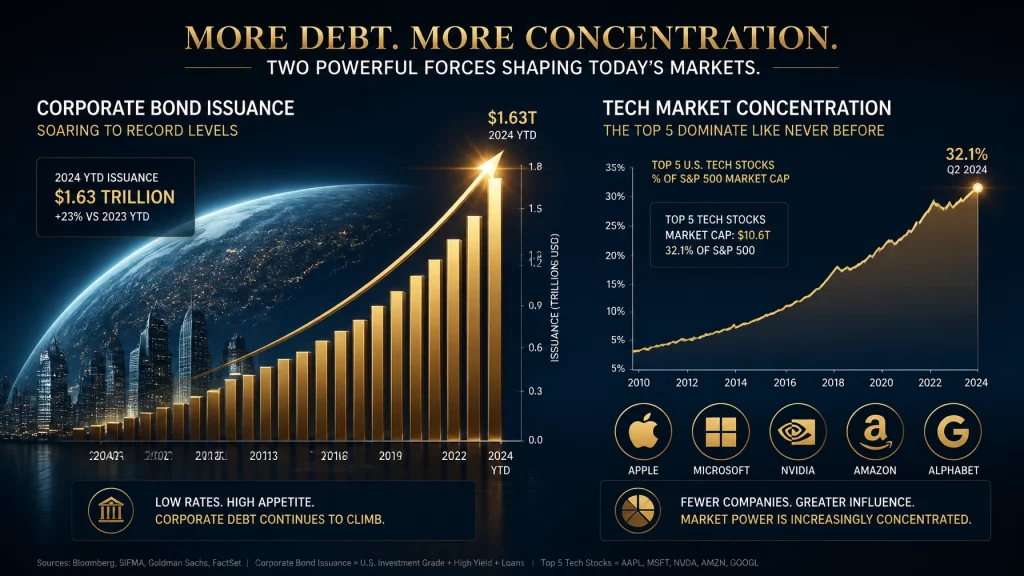
The numbers are staggering. The five big hyperscalers issued $121 billion of U.S. corporate bonds in 2025. By early June 2026, that figure had already surged to $159 billion: up a staggering 47% over the entirety of the previous year. When you factor in hardware partners like Nvidia and SpaceX, the total clears $182 billion+. Goldman Sachs estimates that total AI-related debt issuance will hit $489 billion this year.
Individual deals boggle the mind:
- Amazon locked down roughly $53 billion, including a mammoth $37 billion U.S. offering.
- Nvidia dropped a $25 billion sale in June.
- Alphabet raised $20 billion, which included a rare 100-year sterling bond.
Let that sink in: century bonds. Maturities spanning a century are being deployed to fund physical and computational assets that possess a technological life cycle of roughly three to six years. Before the ink on the bond certificate is dry, the GPUs bought with the proceeds will likely be obsolete scrap metal in a landfill. That contrast writes itself.
Concentration risk in fixed income is now matching equity markets. Tech represents 18% of total U.S. corporate debt issuance and a record 10.3% share of the investment-grade market, with non-dollar shares doubling to 30%. And the first cracks are already appearing in the masonry: bond investors are quietly demanding higher yields on Meta’s latest data center financing than they did just nine months ago. The easy money is starting to look awfully nervous.
Section 6: Circular Financing
When traditional customers run out of balance sheet capacity to buy your chips and cloud services, what do you do? If you are at the center of the AI ecosystem, you help finance them.
Nvidia’s initial $100 billion OpenAI infrastructure commitment famously collapsed, morphing instead into a $30 billion equity stake within a massive $110 billion funding round. Since then, reports have surfaced of discussions to backstop up to $250 billion in OpenAI-related data center debt and server purchases.
Let’s write about this honestly. Revenue flows in one direction, and both firms are simply doing what their corporate charters and market pressures demand. Economically, it looks far more like classic vendor financing than malicious round-tripping.
Yet, financial history offers a sobering mirror. During the late-1990s telecom boom, Lucent Technologies regularly lent money to its own telecom startup customers so those customers could turn around and buy Lucent’s fiber-optic gear: booking the loans as immediate revenue. We all remember how well that ended once the music stopped. When the vendor finances the buyer, you aren't watching organic market demand; you're watching a closed-loop ecosystem feed on its own tail.
Section 7: The Concentration Math
How did we get to a market where a handful of companies dictate the economic weather for the entire nation? Cap-weighting. Goldman Sachs expects the Magnificent Seven to deliver a staggering 46% of total S&P 500 earnings growth in 2026.

This creates the ultimate 401(k) trap. The average retail investor believes that by owning a broad index fund holding “500 companies,” they are safely diversified. In reality, over a third of their money is concentrated in just seven names.
The fragility of this setup was brutally exposed during the July stress test. A sudden wave of market skepticism: triggered in part by Beijing-based Moonshot AI releasing its Kimi K3 model: wiped $3.3 trillion off global semiconductor market capitalization in a matter of days. The PHLX Semiconductor Index (SOX) plunged 10% in a single week, tumbling straight into a bear market. When the bedrock of your index is built on a single narrative, a single algorithmic breakthrough or margin miss sends tremors through every suburban retirement portfolio in America.
Section 8: Transmission to the Real Economy
The AI infrastructure boom is no longer contained to Silicon Valley server rooms. It has embedded itself directly into the arteries of the macroeconomy through four distinct transmission channels:
- GDP Arithmetic: AI infrastructure spending is now the primary engine of growth in U.S. private investment, with computing infrastructure accounting for roughly 1.5% of GDP compared to a historical 2015–2022 average of just 0.7%.
- The Wealth Effect: Retirement accounts swing by trillions of dollars based on quarterly hyperscaler capex announcements, dictating consumer confidence and spending.
- The Credit Channel: Private credit funds, insurers, and pension systems are underwriting complex SPVs and corporate bonds, intertwining Main Street annuities with high-beta tech risk.
- Energy and Grid Strain: Power demands for data centers are driving up electricity prices and straining local municipal grids across the country.
This leads us to the most uncomfortable conclusion of all: stopping the AI boom is arguably now a recession trigger rather than a policy choice. If the hyperscalers pull back capex, GDP growth stumbles immediately. The economy has become an addict hooked on server-rack expansion.
Section 9: Falsifiable Predictions
We don’t just diagnose the madness; we put a stake in the ground. Here is what to watch in the coming quarters to test whether this thesis holds water:
- The Earnings Breadth Test: If non-AI components of the corporate economy carry more than half of earnings growth by Q3, the single-engine tech thesis weakens materially.
- Capex Guidance Cuts: Watch for the first major hyperscaler to slash 2027 capex guidance by 15% or more under investor pressure.
- SPV Downgrades: Look for rating agencies to downgrade a major data center special purpose vehicle as tenant occupancy or cash flows lag projections.
- Impairment Charges: Anticipate a multi-billion-dollar GPU impairment charge as older generation chips are written down faster than originally amortized.
Closing: What You Can Actually Do
So what is the regular guy supposed to do with this information?
Start by opening your brokerage statement. Check your fund’s top-ten holdings. If over 30% of your diversified fund sits in seven companies, you aren't diversified: you are making a leveraged bet on a single industrial transition. Next, check your bond fund or fixed-income allocation to see if you are unwittingly holding long-dated hyperscaler debt yielding pennies over Treasuries while taking on equity-like tech risk.
Bill Mundell famously argued for "Fixing Capitalism with more Capitalists." But when capital ownership is this concentrated in seven heavily indebted corporations funded by Wall Street credit, the regular guy isn't a capitalist at all. He's simply a tenant in someone else's server farm, paying for the electricity while holding the bag if the lights go out.
Be mindful, be watchful and good luck.