



Have you ever walked into a grocery store, looked at the price of a carton of eggs, and felt like you were being gaslighted by the entire evening news cycle?
You aren't alone. We’re currently living in a world where the "official" numbers tell us the economy is humming along like a finely tuned engine, while the "unofficial" reality: the one involving your bank account: feels like a car crash in slow motion.
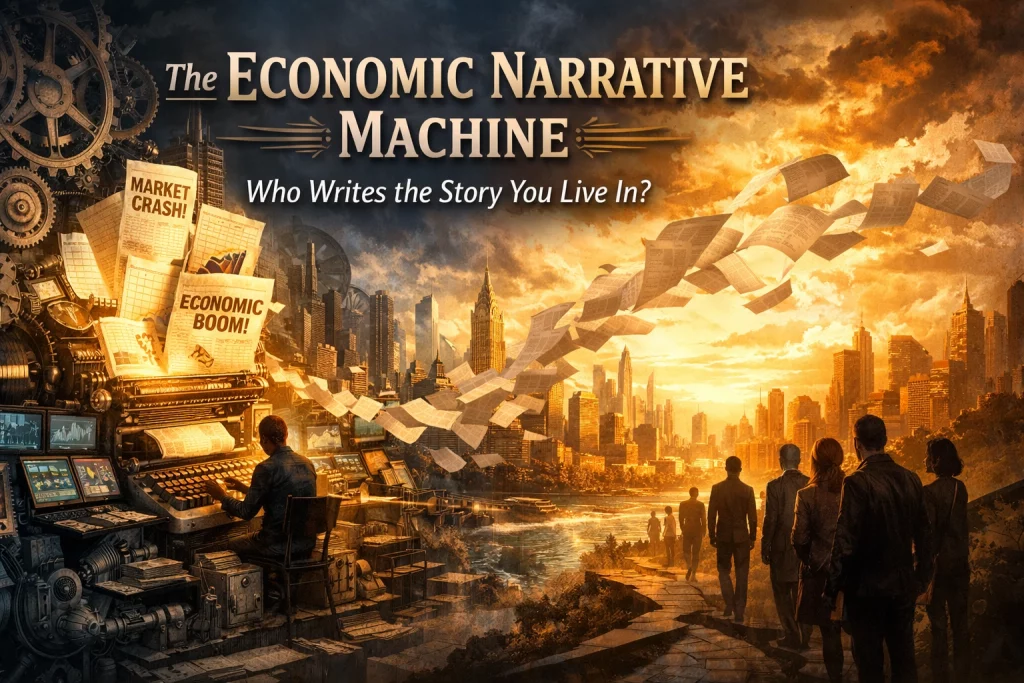
This gap between what we see and what we’re told isn't an accident. It’s the output of what we call the Economic Narrative Machine. It is a massive, decentralized storytelling apparatus fueled by policymakers, big banks, and media outlets. Its job isn't necessarily to tell you the truth; its job is to convince you of a specific version of reality that keeps the gears turning.
What Exactly is the "Narrative Machine"?
Most of us were taught that the economy is a series of cold, hard equations. Supply meets demand, prices adjust, and the "Invisible Hand" does its thing. But real life doesn't happen on a chalkboard.
The Narrative Machine is a metaphor for how macroeconomic reality is shaped by strategic communication. Think of it this way: the economy doesn't just react to what happens; it reacts to what people think is going to happen. If the Federal Reserve Chairman stands at a podium and says the word "recession" three times, the market will throw a tantrum before he even finishes his sentence.

As modern research suggests, these narratives serve as decision-making devices in conditions of uncertainty. When the "machine" tells a story: like "the soft landing is here" or "inflation is transitory": it’s trying to create a self-fulfilling prophecy. If you believe everything is fine, you keep spending. If you keep spending, the economy doesn't collapse. In this world, the story is often more powerful than the math.
Who is Writing the Script?
The problem for us "regular guys" is that we aren't the ones holding the pen. The authors of our economic story are usually the ones who benefit most from the status quo.
- The Institutions: Central banks and government agencies use "Forward Guidance" (a fancy term for storytelling) to manage public expectations.
- The Media: Headlines are designed for clicks, and nothing gets clicks like fear: or, conversely, a blind optimism that justifies a "buy the dip" mentality.
- The Algorithms: We now live in an information ecosystem where a narrative can go viral in seconds, pricing "odds" into the market based on a tweet before the actual data is even released.
When these three groups align, they create a powerful "truth" that might have nothing to do with your daily life.
Case Study: The Medical Industry Narrative
Nowhere is the disconnect between the "Official Narrative" and the "Regular Guy Reality" more obvious than in the American medical industry. This is a prime example of a runaway train that the Narrative Machine has tried to paint as "unavoidable progress."
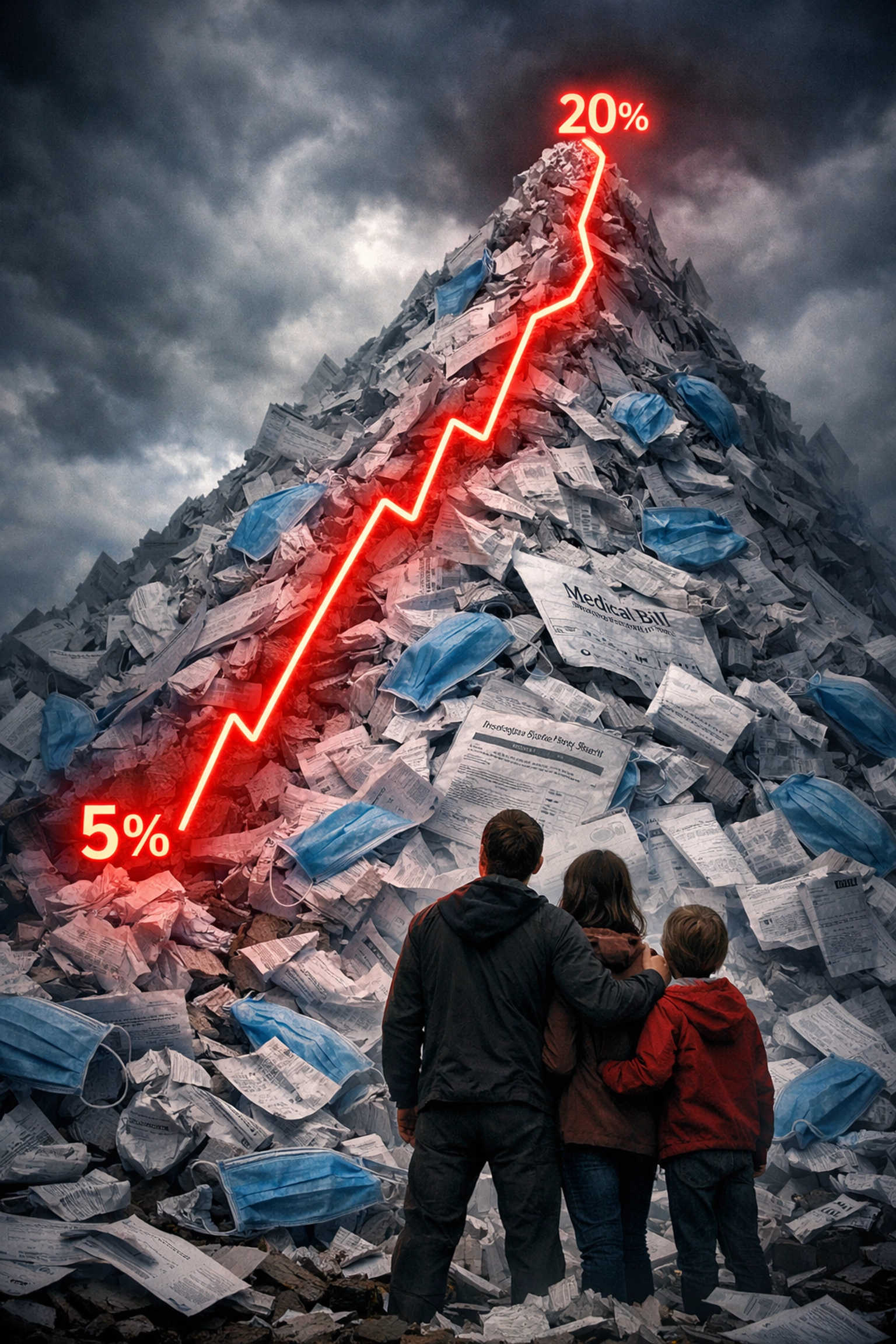
Let’s look at the numbers. In 1960, medical costs in the United States were a manageable 5% of our Gross Market Product (GDP). By 2025, that number is expected to hit a staggering 20%. Think about that. One-fifth of every dollar generated in this country is being swallowed by a system that doesn't actually seem to be making us any healthier.
Despite the trillions we pour into this sector, we’re seeing a terrifying trend: for the first time in history, our children might not live as long as we do. We have more cancer per capita, skyrocketing rates of obesity, and Type 2 diabetes is becoming a national baseline. The Narrative Machine tells us this is the "cost of innovation," but your wallet knows better.
The "story" is that we have the best healthcare in the world. The reality is that we are over-medicated, under-cared for, and burdened by a system where medicine has become a subset of predatory capitalism. Insurance companies and pharmaceutical giants argue for profits at the top of their lungs, while the spirit of medicine: healing people: gets lost in the actuarial math.
The "Optimized" World vs. The Human Body
In almost every other industry, we’ve seen prices drop as efficiency increases. Think about your TV, your laptop, or your clothes. Over the last thirty years, businesses have optimized everything. Inventories are near zero, workforces are variable, and third-party outsourcing has wrung out every spare cent.
So why has the "Health Expense" trended up every single year while everything else got cheaper?
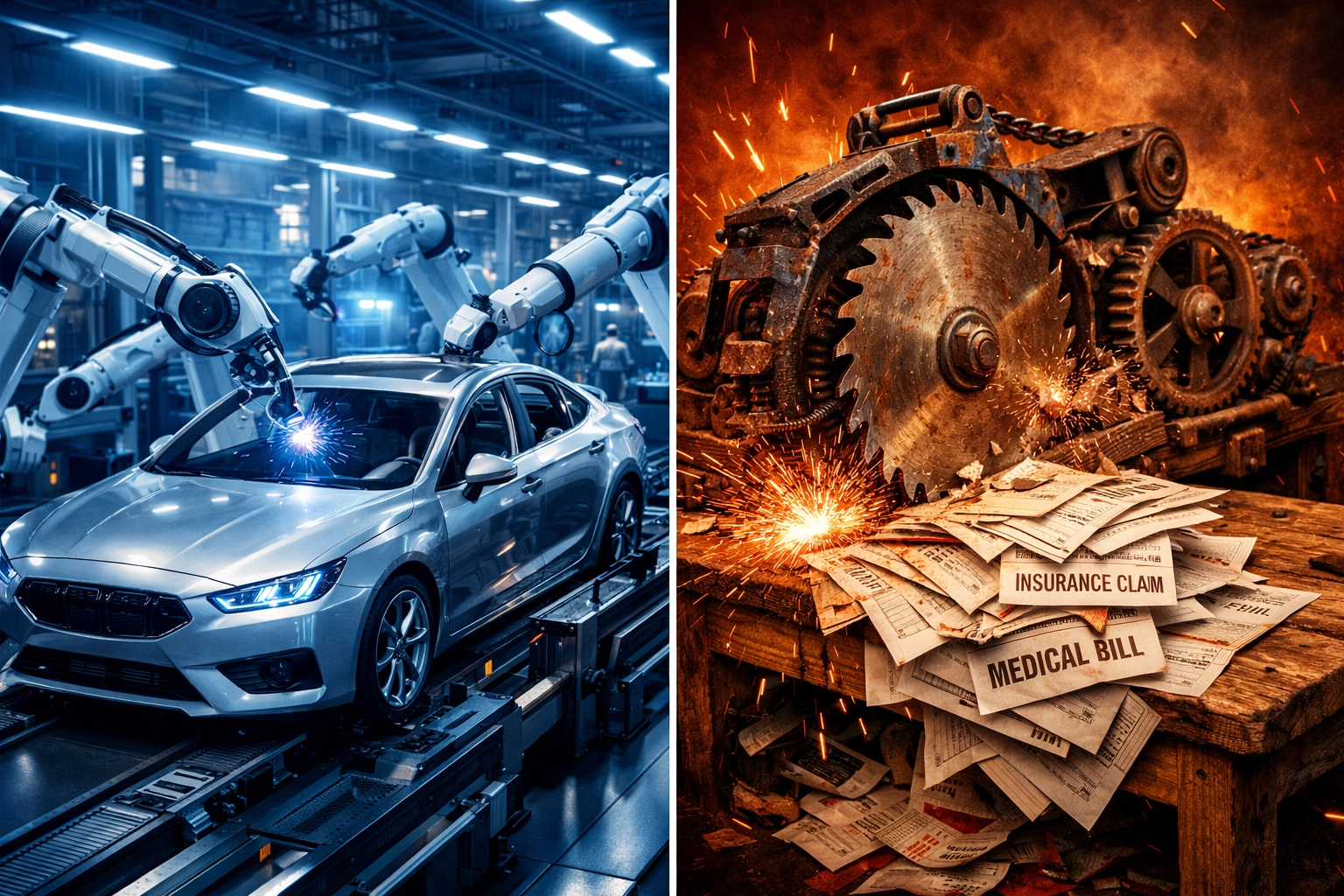
It’s because the medical narrative isn't built on a free market; it’s built on a "buzz saw of madness." Consider car insurance: it’s predictable. A car has a value, repairs have a price, and if the cost to fix it exceeds the value, the car is "totaled." There’s a limit. In medicine, there is no "totaled" value for a human life, so the pricing is infinite, and the Narrative Machine uses that emotional leverage to keep the checks flowing.
Who is Finally Casting the First Stone?
Even the titans of the corporate world are starting to realize the Narrative Machine has lied to them about healthcare costs. A few years back, the New York Times reported that Amazon, Berkshire Hathaway, and JPMorgan Chase were forming their own independent healthcare company to serve their employees. Their core premise? An effort "free from profit-making incentives and constraints."
What took them so long? They realized that healthy employees are productive employees. They realized that spending $100 on a gym membership that reduces cardiac care costs by $10,000 is just good business. They realized that investing $500 in plant-based nutrition to prevent a $50,000 colon cancer bill is a better ROI than any stock trade.
The old narrative: that we just have to pay whatever the insurance companies demand: is finally being challenged by the people who have to foot the bill.
How to Read Between the Lines
So, how do you survive in an economy where the story you're told doesn't match the one you're living? You have to become a narrative skeptic.
- Watch the incentives: When a talking head on TV says the "housing market is looking up," ask yourself: Who pays their salary? Usually, it's a company that needs people to buy houses.
- Look at the "Why," not just the "What": If gas prices drop right before an election, or if unemployment numbers are "revised" quietly three months after a big announcement, the Narrative Machine is at work.
- Focus on the micro, not just the macro: Your personal economy: your debt, your health, your savings: is the only "truth" that matters. Don't let a "bull market" narrative trick you into taking on debt you can't afford.

The Narrative Machine is powerful, but it’s not invincible. It relies on our collective belief to function. When we stop buying the story and start looking at the actual plumbing of the system: the soaring medical costs, the debt traps, the misaligned incentives: we start to take back control.
We spend one-third of our lives working. It’s about time we made sure the economy we’re working in is built on reality, not just a script written by a corporate lobbyist.
Be mindful, be watchful and good luck.