



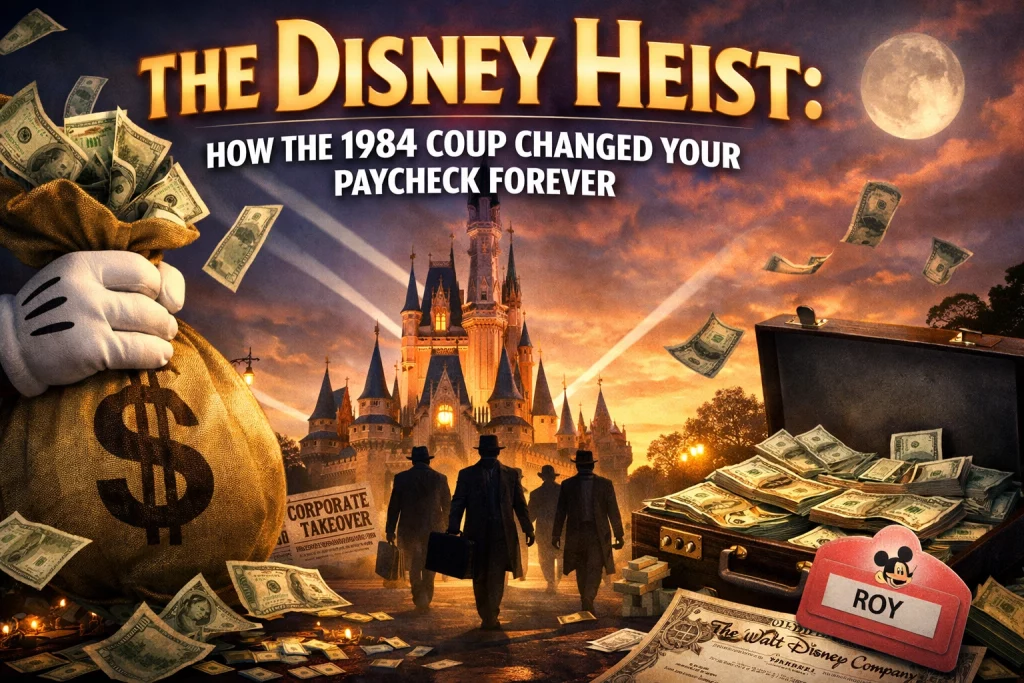
Ever wonder why your boss makes 400 times what you do? Or why, despite the company having a "record year," your annual raise barely covers a tank of gas and a Chick-fil-A sandwich?
To find the "Patient Zero" of the modern American paycheck gap, we have to travel back to 1984. It wasn't just the year of Van Halen’s 1984 or the first Macintosh computer; it was the year a group of Texas billionaires and a high-flying TV executive staged a coup at the Mouse House. They didn't just change Disney; they changed the blueprint for how every corporation in America treats its workers versus its C-suite.
This isn't just a story about Mickey Mouse. It’s a story about how the "Regular Guy" got left behind in favor of "mathematical efficiencies."
The Sharks in the Moat
By the early 80s, Disney was in trouble. The magic was fading. The stock was stagnant, and the company was run by Ron Miller (Walt’s son-in-law), who by most accounts was a nice guy but wasn't exactly a shark. To corporate raiders, Disney looked like a giant, slow-moving whale.
Enter the Bass brothers out of Fort Worth, Texas. Along with their legendary advisor Richard Rainwater, a man who basically invented the modern "private equity" playbook, they started buying up Disney stock. They weren't there because they loved Dumbo. They were there because Disney’s assets (the land, the movies, the brand) were worth way more than the stock price reflected.
They teamed up with Roy Disney (Walt’s nephew), who had a chip on his shoulder about how the company was being run. Together, they forced Miller out. But they needed a "face" for the new era. They needed someone who could talk to Hollywood and Wall Street at the same time.
They found their man in Michael Eisner, the "programming whiz" from ABC.
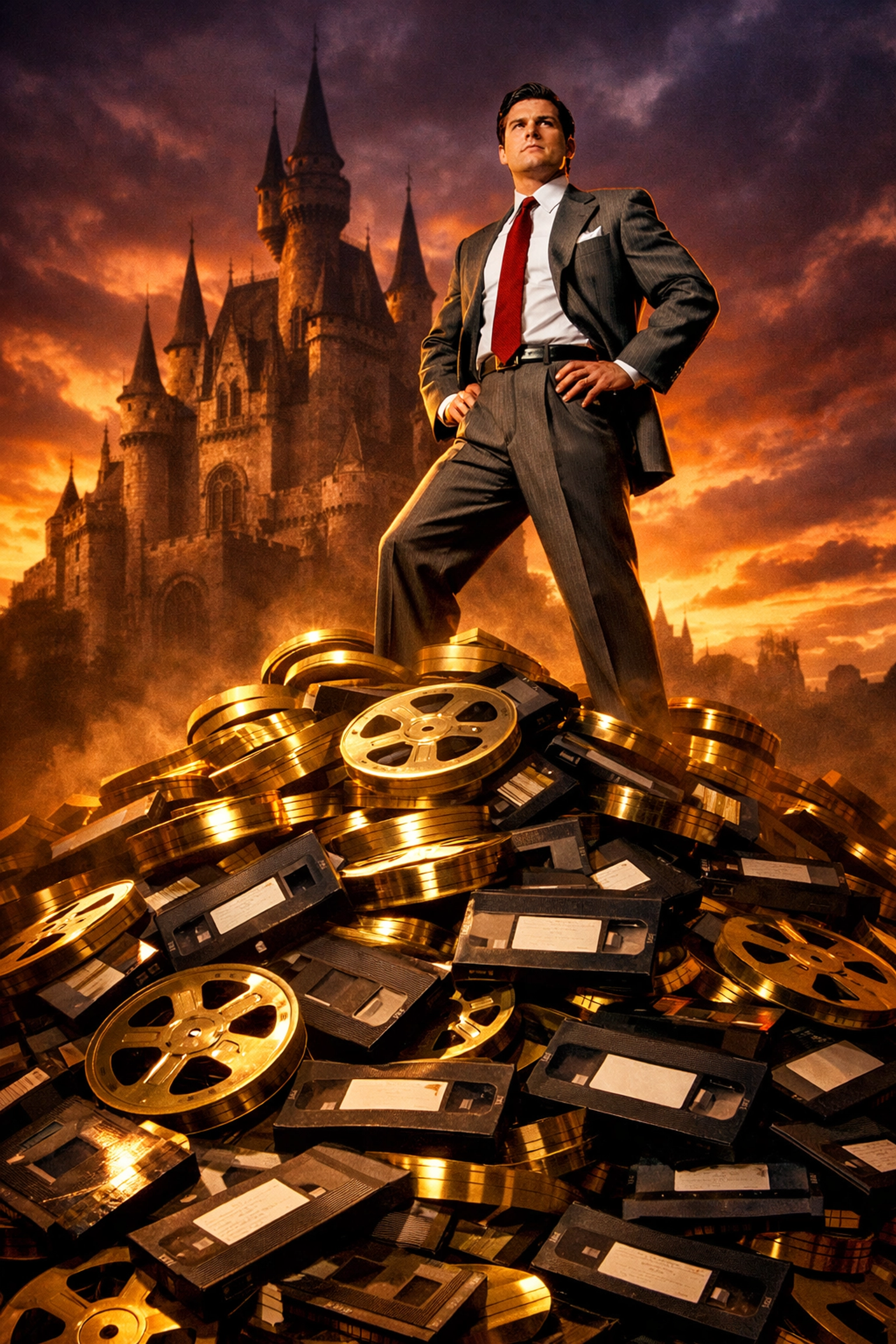
The $500 Million Man and the "Risk-Free" Option
Eisner didn't just show up for a salary. He ushered in the era of the "Mega-CEO" contract.
When Eisner took the job, he negotiated a deal that would make a lottery winner blush. The core of it was "risk-free options." Now, in the old days (pre-1980s), a CEO got a good salary and maybe some bonuses if the company did well. Eisner’s deal was different. He was given massive amounts of stock options. If the stock price went up, he became one of the richest men on the planet.
And boy, did it go up. Over his tenure, Eisner pulled in over $500 million.
Think about that for a second. Half a billion dollars for doing a job. The "Regular Guy" logic would suggest he must have been a transcendent genius, right? He must have personally drawn every frame of The Lion King while simultaneously engineering the roller coasters at Disney World.
Not exactly.
The Myth of Corporate Excellence
The narrative we’re usually sold is that Eisner saved Disney through sheer brilliance. But if you look under the hood, Eisner’s success was less about "creative genius" and more about being in the right place at the right time with a very specific set of circumstances.
First, let’s talk about Philips. The Dutch electronics giant (and others) had just perfected VHS and DVD technology. Suddenly, every household in America wanted a home library of movies.
Disney sat on a literal "Vault" of content that was already paid for. Cinderella, Snow White, Pinocchio: these were assets that had been depreciated to zero on the balance sheet decades ago. Eisner didn't have to "create" them; he just had to put them in a plastic case and sell them to the Baby Boomers who were now parents of toddlers.

It was the ultimate "low-cost, high-margin" play. It wasn't corporate excellence; it was monetizing a library to a captive audience using new tech he didn't invent.
The Shift: From Value to "Efficiencies"
This is where things got dark for the workers. Because Eisner’s wealth was tied to the share price, the goal of the company shifted. It was no longer about building a great company for the next 50 years; it was about driving the stock price up this quarter so those options could be exercised.
To drive a stock price up, you need to show higher profits. You can do that by selling more (the VHS play) or by cutting costs.
In September 1984, literally Eisner’s first day on the job: Disneyland cast members went on strike. Why? Because the company was pushing for a two-year wage freeze and trying to cut health insurance for part-timers.
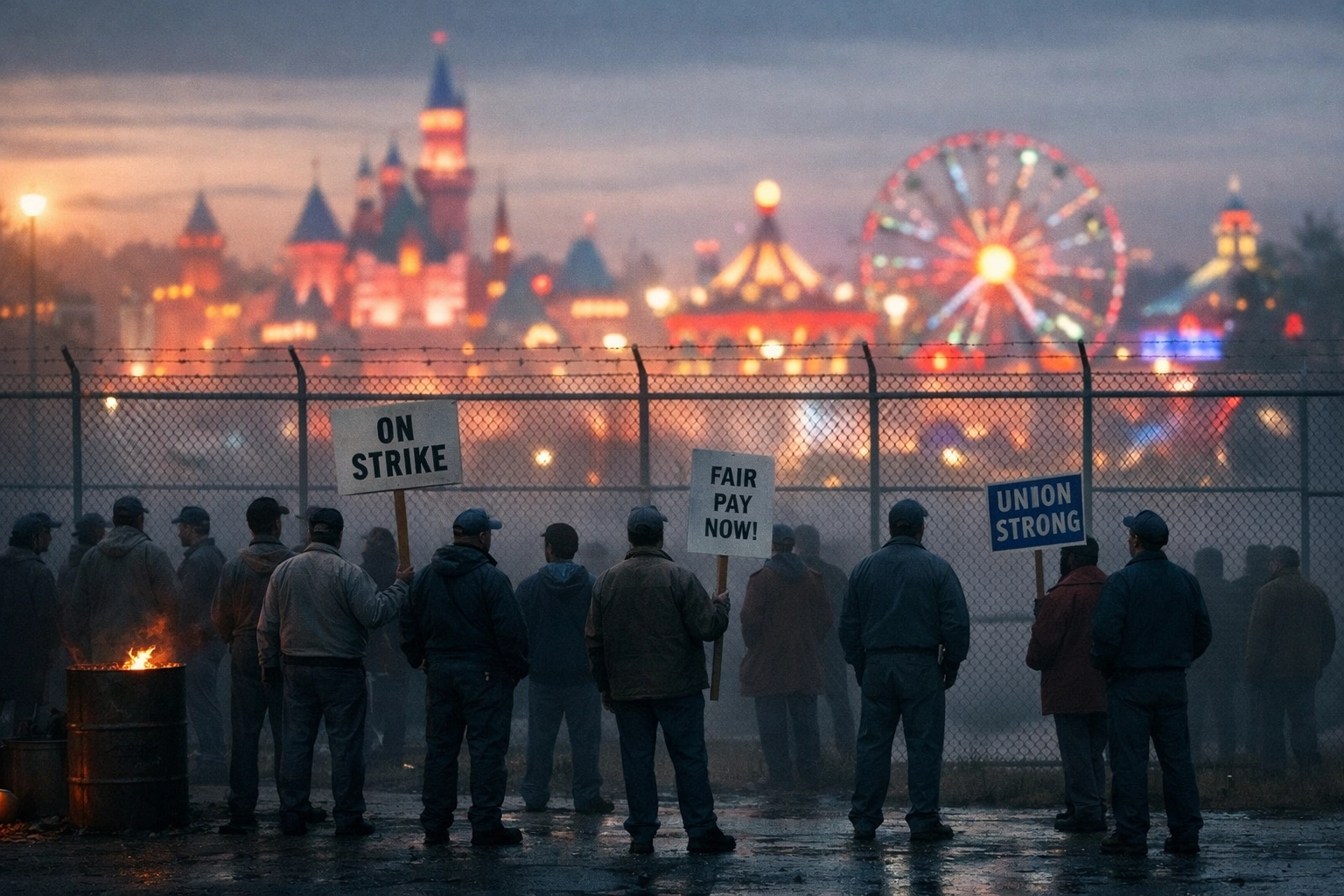
While the CEO was signing a contract that would eventually net him $500 million, the guy wearing the Goofy suit was being told there was "no money" for a raise. This was the beginning of the "systematic move for mathematical business efficiencies."
The logic changed:
- Old Logic: If the company is profitable, the workers should share in the success because they created it.
- New Logic: If the company is profitable, that money belongs to the shareholders and the executives who "optimized" the labor costs.
The Efficiency Trap
This shift changed the landscape of American business. We’ve seen it across every industry. It’s the "last frontier of expense reduction."
Take a look at the medical industry. In 1960, medical costs were 5% of our GDP. Today, we’re heading toward 20%. Why? Because medicine became part of this same "capitalism of efficiency." Everything is honed to a "zero error environment" and "process optimization," yet the actual outcome: our health: isn't getting better. We have more obesity, more diabetes, and more stress.
Just like at Disney, the "support staff" (the nurses, the doctors, the people doing the work) aren't the ones seeing the massive windfalls. The money is flowing to the people managing the "mathematical efficiencies" of the insurance and pharmaceutical marketplaces.
When companies like Amazon, Berkshire Hathaway, and JPMorgan Chase announced they were forming their own healthcare company "free from profit-making incentives," they were essentially admitting that the "efficiency" model had broken the system. They realized that a healthy, happy employee is actually more valuable than a "mathematically optimized" one who is stressed out and sick.

The Long-Term Cost of Short-Term Gains
The 1984 Disney Heist taught the corporate world that you can create massive personal wealth by focusing on short-term capital gains and share price. If you can squeeze 10% out of the labor force and 5% out of the supply chain, the stock ticks up, the options vest, and the CEO buys a third yacht.
But what happens to the brand? What happens to the "Magic"?
When you manage for a ticker symbol, you stop investing in the things that take twenty years to pay off. You stop building the "next" Disney Vault because you’re too busy milking the old one to pay for this year’s executive bonuses.
The "Regular Guy" feels this every day. You feel it when the product you buy is slightly smaller and slightly lower quality, but costs 20% more. You feel it when your "merit increase" is 2% while the CEO’s bonus is 200%.
Reclaiming the Narrative
We need to move back to a world where we classify expenses: whether it’s labor or health: as investments in human capital.
Look, I’m all for capitalism. I love a good profit as much as the next guy. But the "Disney Heist" model isn't sustainable capitalism; it's financial engineering. It’s a game played by people like Rainwater and Eisner to extract value rather than create it.
A smart company today should be doing the opposite of the 1984 playbook. They should be investing in the $100 gym membership to save $10,000 in cardiac care. They should be paying the "cast members" enough to live in the city where they work so they actually care about the customer experience.
We spend one-third of our lives working. It’s time we demanded that the companies we work for look past the next quarterly earnings report and start looking at the human beings standing behind the counter, driving the trucks, and wearing the Goofy suits.
The 1984 coup was a heist of the American dream, where the rewards of productivity were decoupled from the people who produce. It’s time we started paying attention to the math, because the math hasn't been in our favor for a long, long time.
Be mindful, be watchful and good luck.