



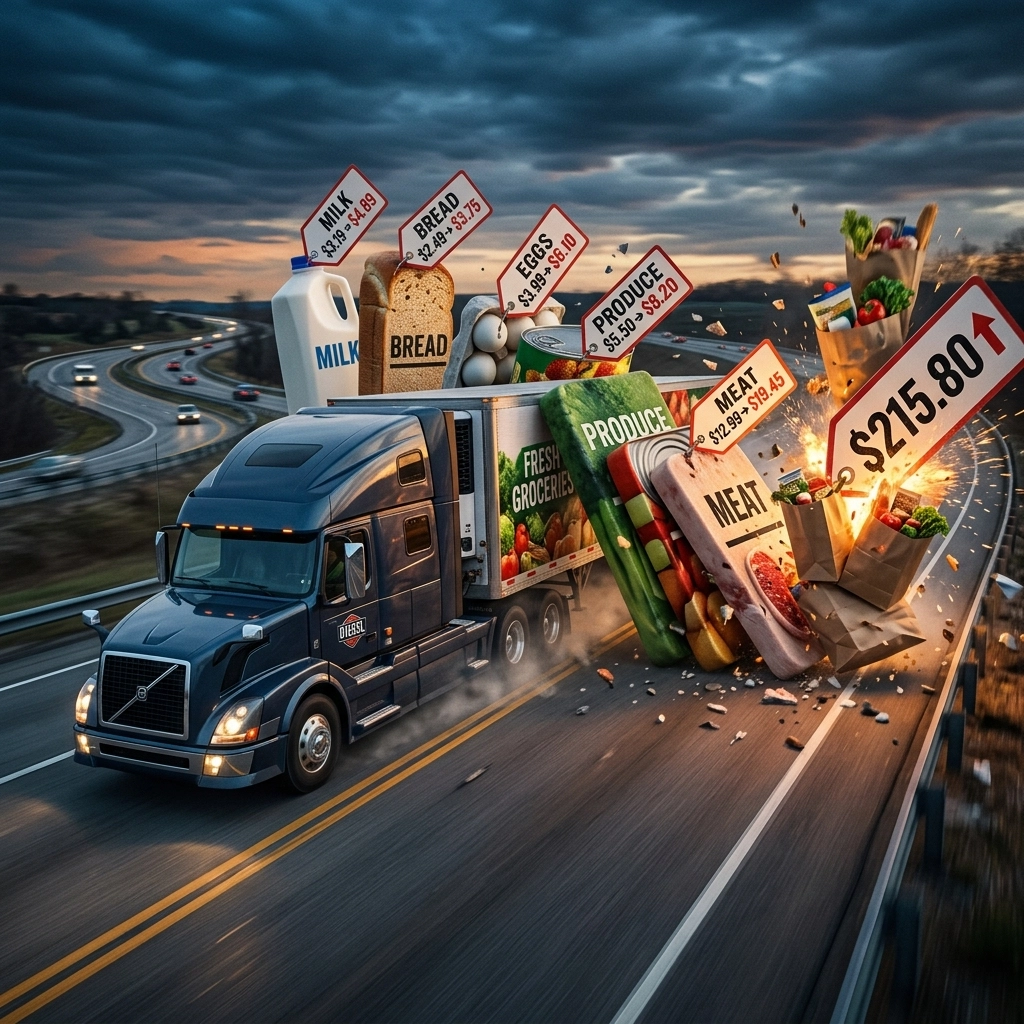
If you’ve pulled up to a gas station lately, you’ve probably seen a number on the sign that looks more like a high-score in a video game than a price per gallon. While the "Regular" unleaded price usually gets all the headlines and the angry Facebook posts, there is a quieter, much meaner number lurking at the bottom of the sign: Diesel.
As of late March 2026, diesel is averaging over $5.07 per gallon. In some places, like California, it’s already tapped $7.00. To the average guy driving a Honda Civic, this might seem like someone else's problem. "I don’t drive a truck," you might think. "Why do I care if the big rigs are paying more?"
Well, pull up a chair, because that $5.07 per gallon is the reason your weekly grocery run now feels like you're funding a small space program. This is the Diesel Domino Effect, and it’s hitting your wallet harder than any other economic force right now.
The Spark: Why is This Happening?
Before we look at the dominos, we have to look at the guy who pushed the first one. The catalyst here isn't just "corporate greed" or some vague economic ghost. It’s a geopolitical mess in the Middle East.
Specifically, we are looking at the Strait of Hormuz and the ongoing tension with Iran. Think of the Strait of Hormuz as the world’s most important windpipe. About 20% of the world’s petroleum passes through that tiny stretch of water. When things get shaky there: when tankers are threatened or diplomatic ties snap: the global oil market has a collective panic attack.
Diesel is the first to feel it because it’s the "workhorse" fuel. It’s more energy-dense than gasoline, which is why it powers the things that do the heavy lifting. When the raw cost of crude oil spikes because of a bottleneck in the Middle East, diesel prices leapfrog gasoline almost instantly.
Domino #1: The Farm (Where Your Food Starts)
The first domino falls long before your food ever sees a grocery store shelf. It falls in the dirt.
About 83% of U.S. agriculture runs on diesel. Think about that for a second. Almost every calorie you consume was made possible by a machine burning diesel. From the tractors that prep the soil in the spring to the irrigation pumps that keep the crops alive during a dry spell, and finally to the massive harvesters that bring in the yield: diesel is the lifeblood of the farm.
Here is the "Regular Guy" math: A modern high-horsepower tractor can burn anywhere from 10 to 20 gallons of diesel per hour. If a farmer is out there for a 12-hour shift, he’s burning through 150 to 200 gallons of fuel a day. When diesel jumps 30% in a few weeks, that farmer’s daily operating cost doesn't just go up a little; it explodes by hundreds of dollars per machine.
But it’s not just the machines. Fertilizer: the stuff that actually makes the corn and wheat grow: is incredibly energy-intensive to produce and transport. Research shows that grain and cereal prices usually see a secondary spike 2 to 6 months after a diesel surge because of these fertilizer costs. If the tractor costs more to run, the corn costs more to grow. Period.
Domino #2: The Truck (The Great Connector)
Once the food is out of the ground, it needs to get somewhere. This is where the second domino hits, and it hits with a thud.
18-wheelers are the literal lifeblood of the American economy. If you bought it, a truck brought it. These rigs have massive fuel tanks: often holding up to 300 gallons. A single fill-up at today’s prices is now costing drivers nearly $200 more than it did just a month ago.
Now, here is the secret most people don't realize: Trucking companies don't just "absorb" those costs because they're nice guys. Most shipping contracts include something called a "fuel surcharge." It’s basically a built-in "if-then" statement. If diesel goes above X price, then the shipping rate goes up by Y amount.
When the trucking company bills the grocery distributor, that fuel surcharge is added to the invoice. When the distributor bills the grocery store, they pass it on again. It’s a game of "hot potato" with a $200 bill, and guess who’s left holding it? You, standing in the checkout lane.
Domino #3: The Shelf (The "Heavy" Reality)
Now we get to the grocery store. Have you noticed that a bag of salad or a gallon of milk seems to be rising in price faster than a box of crackers or a can of beans? There’s a reason for that.
Fresh produce is hit the hardest by the Diesel Domino Effect for three reasons:
- Weight: Produce is heavy. It’s mostly water. Heavy things require more fuel to move.
- Speed: You can’t put lettuce on a slow-moving train and hope for the best. It has to get from California or Florida to your local store fast. Speed requires trucks, and trucks require diesel.
- Temperature: This is the big one. Perishable items move in "reefers": refrigerated trailers. These trailers have their own separate diesel-powered cooling units that run constantly to keep your yogurt from turning into a science project.
In fact, roughly 10% of the price of your salad is nothing more than the cost of moving it. When diesel prices surge, the "shipping" portion of your grocery bill can jump significantly. Recent data shows that perishables like dairy and meat usually reflect these higher costs on the shelf within just 2 to 4 weeks of a diesel spike.
Domino #4: Your Wallet (The Inflation Gap)
This is why inflation feels "fake" to most regular people. The government might put out a report saying inflation is "cooling" or sitting at a manageable 3%. But when you go to the store, your receipt says something very different.
That’s because the official Consumer Price Index (CPI) averages out a lot of things. You don't buy a new car every week. You don't buy a new refrigerator every month. But you do buy eggs, bread, and milk every single week.
When energy costs: which represent over 6% of the headline inflation calculation: spike, it creates a "regressive tax" on the average person. The wealthier you are, the less a $5 gallon of milk hurts. But for the guy working a 9-to-5 trying to feed a family of four, the Diesel Domino Effect is a direct hit to his quality of life.
It’s the reason why, even if the "economy" looks good on paper in Washington D.C., it feels like a struggle on Main Street. We are paying for the fuel of every truck we pass on the highway every time we scan our loyalty card at the register.
What Can We Do?
So, is there an escape hatch? Not a perfect one, but understanding the "domino" timeline helps.
First, recognize the lag. If diesel spikes today, you have about a two-week window before the produce and meat sections get ugly. If you have a deep freezer, that’s the time to stock up on proteins.
Second, consider the "source." Buying local isn't just a trendy thing to do; it’s an economic hedge. A farmer’s market tomato that traveled 20 miles in a pickup truck has a much smaller "diesel tax" than a tomato that traveled 2,000 miles in a refrigerated 18-wheeler.
Third, watch the news: but watch the right news. Don't worry about the stock market noise; watch the "Tanker Tracker" and the headlines out of the Middle East. If the Strait of Hormuz stays messy, diesel stays high, and your grocery bill stays "exploding."
The Diesel Domino Effect is a reminder that the world is much smaller than we think. A conflict on the other side of the globe leads to a fuel spike, which leads to a more expensive tractor, which leads to a fuel surcharge on a truck, which ends with you paying $6 for a head of Romaine lettuce.
It’s all connected. The best we can do is understand the game, watch the dominos, and try to stay one step ahead of the fall.
Be mindful, be watchful and good luck!