



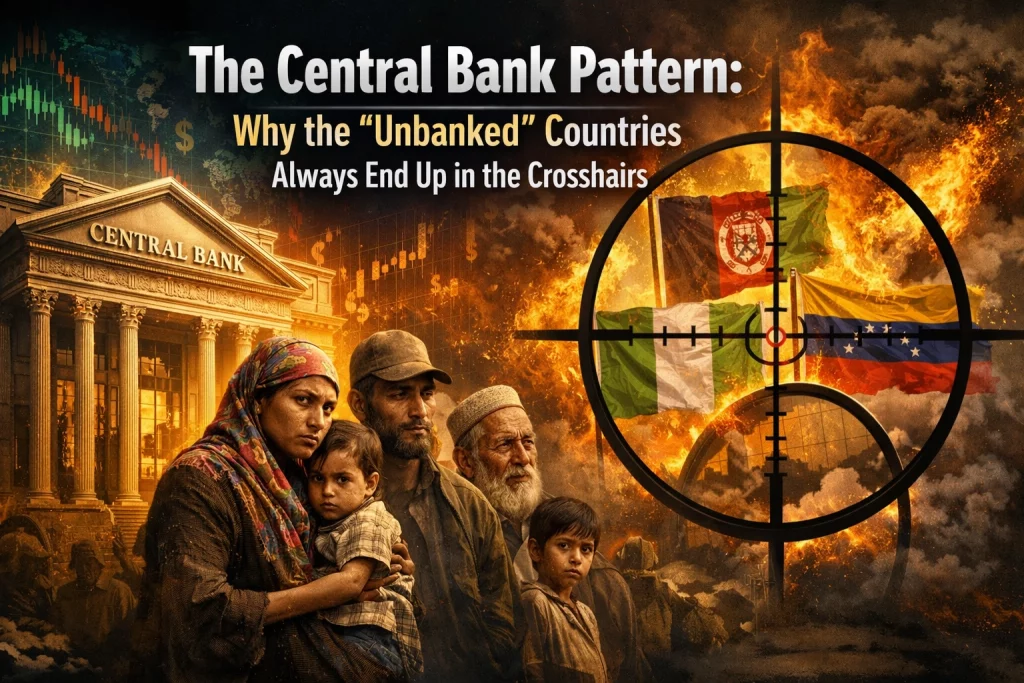
If you’ve been following the news for the last twenty-five years, you’ve seen a lot of maps with red circles on them. Usually, those circles are around countries in the Middle East or North Africa. We’re told the reasons for the "interest" in these nations range from spreading democracy to stopping weapons of mass destruction or protecting human rights.
But at Regular Guy Economics, we like to look at the plumbing. Not the speeches, not the flags, but the actual pipes that move money around the world. And when you look at the plumbing, a very weird pattern starts to emerge.
It’s a pattern that involves a very specific list of countries and one very specific institution: The Central Bank.
The "List of Seven"
Let’s rewind to the year 2001. At the turn of the millennium, if you looked at the global financial map, there were seven countries that didn’t have a central bank "integrated" with the Western-led global financial system, specifically, they weren't members of the Bank for International Settlements (BIS) or they operated outside the orbit of the U.S. Federal Reserve’s influence.
Those seven countries were:
- Afghanistan
- Iraq
- Libya
- Syria
- Iran
- Cuba
- North Korea
Now, stop for a second. Read that list again. Does it look familiar? If you’ve been paying attention to where the U.S. military or heavy economic sanctions have been focused for the last two decades, it’s basically a checklist.
In 2001, we went into Afghanistan. In 2003, it was Iraq. In 2011, Libya. Since then, Syria has been a constant battleground of proxy wars and sanctions. That leaves Iran, Cuba, and North Korea.
Is it just a massive coincidence that the countries without a "standard" central bank just happened to be the ones we ended up in conflicts with? Or is there something about being "unbanked" that makes a country a target?
Why Does a Central Bank Matter?
To a regular guy, a central bank sounds like a boring building where gray-haired men talk about interest rates. But in the world of global power, a central bank is the "on-ramp" to the global highway.
Most countries have a central bank that works in tandem with the big players. They buy U.S. Treasuries, they participate in the SWIFT payment system, and they play by the rules of the dollar-based world order. When a country doesn’t have a central bank, or has one that refuses to play by those rules, they are essentially "off the grid."
Being off the grid means the global financial system can’t easily influence your currency, track your transactions, or load you up with debt. And if there’s one thing the global economy loves, it’s debt.
The Iraq and Libya Examples
Let’s look at Iraq. Before 2003, Saddam Hussein was moving to sell Iraqi oil in Euros instead of Dollars. That’s a big no-no. Why? Because the U.S. Dollar’s strength is largely tied to the fact that everyone has to buy oil in dollars (the "Petrodollar" system). If you change the currency, you bypass the system. Shortly after the invasion, Iraq suddenly had a brand new, Western-style central bank, and the oil was back to being priced in dollars.
Then there’s Libya. Muammar Gaddafi wasn't just "unbanked" in the traditional sense; he was trying to start his own system. Reports suggest he was planning to introduce a "Gold Dinar", a pan-African currency backed by gold. Imagine a whole continent trading in gold instead of U.S. Dollars or Euros. It would have pulled the rug out from under the international banking system in Africa.
Gaddafi’s government was eventually toppled. Today, Libya has a central bank that is "recognized" by the international community, even if the country itself is still struggling to find peace.
The Focus on Iran
That brings us to the big one: Iran.
Iran has been the "white whale" for global financial planners for decades. They have a central bank, but it’s essentially cut off from the rest of the world. They are sanctioned to the teeth, kicked out of the SWIFT system, and they frequently talk about trading oil in currencies other than the dollar.
Whenever you hear talk about "attacking Iran" or "regime change," you have to ask yourself: Is this about nuclear weapons, or is it about bringing the last major holdout into the global banking fold?
Think about it. If Iran were to suddenly set up a central bank that functioned like the Fed, started buying billions in U.S. debt, and traded exclusively in dollars, would we still be talking about attacking them? Probably not. We’d probably call them a "strategic partner," just like we do with other countries in the region that have questionable human rights records but very active central banks.
The "Debt Trap" Strategy
Here is how the game usually works for the "regular guy" in these countries.
- A country is "off the grid" (No central bank/No Western debt).
- A conflict occurs (Invasion, coup, or "intervention").
- A new government is installed.
- A new Central Bank is established.
- The country starts taking out massive loans from international lenders to "rebuild."
Suddenly, a country that had zero debt to the West is now on the hook for billions. They are now "integrated." They have to pay interest. They have to play by the rules. Their sovereignty is effectively traded for a seat at the table, a table where the house always wins.
Visit http://www.regularguyeconomics.c.om to see how this kind of global debt affects your own purchasing power at home.
Is It a Conspiracy or Just Business?
We aren't here to tell you there’s a secret room of villains twirling their mustaches. Usually, it’s much simpler than that. It’s just how the machine is built.
The global economy is built on growth and debt. If a country stays outside that system, they are a "leak" in the plumbing. The people running the machine want to plug the leaks. Sometimes they use "diplomacy" (which is just a fancy word for "join us or else"), and sometimes they use the military.
It’s about control. If you control a nation's money supply, you control the nation. As the old saying goes (often attributed to the Rothschilds), "Give me control of a nation's money and I care not who makes its laws."
Why You Should Care
You might be thinking, "Hey John, I’m just trying to pay my mortgage in Ohio. Why do I care about central banks in the Middle East?"
You care because this system is expensive. It costs trillions of dollars to "bring people into the fold." That money doesn’t come out of thin air: it comes from the value of your dollar. Every time we fund a conflict or a "nation-building" project to install these financial systems, we are inflating our own currency.
We are also seeing the world start to push back. Countries like Brazil, Russia, India, China, and South Africa (the BRICS) are trying to build their own "plumbing" because they’re tired of being under the thumb of the existing one.
When you see the news about Iran, or any of the few remaining "unbanked" nations, don’t just look at the headlines about "freedom." Look at the banks. Look at the currency. Look at the debt.

The Final Tally
In 2001, there were seven.
Today, that list is much smaller. Afghanistan is back under the Taliban, but their assets are still frozen in… you guessed it, the Western banking system. Iraq and Libya are "in." Syria is a mess.
That leaves Iran as the last major piece of the puzzle in that part of the world.
Is it a coincidence? Maybe. But if you’re a regular guy looking at a map, and you see that every country without a specific type of bank keeps getting hit with "freedom," you start to realize that maybe the most powerful weapon in the world isn't a missile. It’s a ledger.
The patterns are there if you’re willing to look at them. The global financial system doesn't like vacuum. It wants every corner of the earth connected to the same grid, paying interest to the same people, and using the same currency.
When a country says "no thanks," they usually end up in the crosshairs. It happened to Iraq. It happened to Libya. And right now, the pressure on Iran is higher than ever.
Be mindful, be watchful and good luck.