



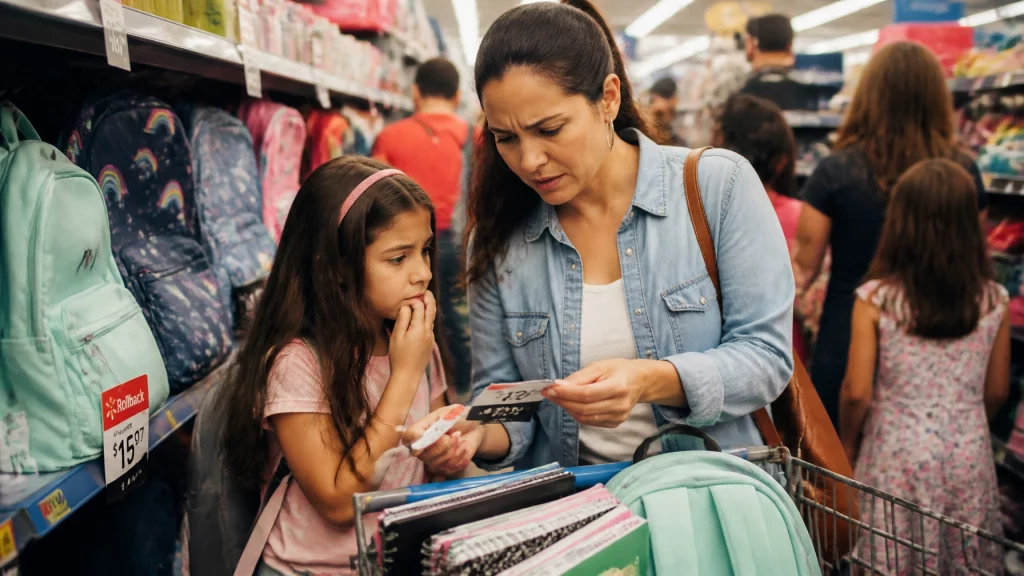
August used to be a simple rite of passage. You grabbed a standard-issue yellow pencil, a couple of wide-ruled notebooks, a fresh pack of Crayola markers, and maybe a pair of sneakers that your kid would somehow outgrow or destroy by Thanksgiving. It was predictable, manageable, and largely detached from the grander macroeconomic theatre playing out on Wall Street.
Fast forward to August 2026, and sending the kids back to class has morphed into a high-stakes financial obstacle course. According to the latest retail figures from the National Retail Federation, U.S. families with K–12 students plan to spend a record average of just over $863 per household on back-to-school gear.
Sounds like a booming consumer base flexing its purchasing power, right? Not quite.
When you scratch beneath the surface of that headline-grabbing $863 figure, you realize it is not a testament to luxury, affluence, or lavish shopping sprees. It is the inflation tax in broad daylight. Nominal spending is barely up by about $5 compared to last year: a meager 0.6% increase: while real inflation and school-specific price pressures are running circles around that number. In real terms, families are spending less because they have to, while getting significantly less for every dollar handed over to the cashier.
The Illusion of Flat Spending
Let's look at the math. When overall living costs are climbing and everyday items have absorbed years of compounding shocks, a flat or barely budged average isn't stability: it's triage. Deloitte’s data for this season shows that when adjusted for inflation, families are planning to cut back their real back-to-school spending by around 6% compared to last year. Meanwhile, specialized retail analyses indicate that the total cost of preparing a student for school has surged nearly 40% since 2019, outpacing broader consumer inflation over the same window.

Think about what sits inside that shopping cart. It’s no longer just paper and glue. Modern classrooms require digital access, tablets, specialized software fees, calculators that cost more than collegiate textbooks used to, and a revolving door of apparel that seems engineered to disintegrate after three washes. When you couple those mandatory educational tools with the lingering fallout of energy and supply chain bumps, that $863 price tag starts looking less like a budget and more like a ransom.
Parents aren't buying more; they are simply paying more for the bare minimum.
Trading Down: The Mass Merchant Migration
When households are squeezed between elevated grocery bills, sticky housing costs, and the annual school supply tax, something has to give. You can’t tell a school district that your child won’t be bringing notebooks, and you can’t show up to the first day barefoot.
So, where do households find the delta? They trim the fat everywhere else. Discretionary spending on summer vacations, family outings, and entertainment takes an immediate hit. Within the retail aisles themselves, shoppers are staging a mass migration toward mass merchants and deep-discount stores. Walmart, Target's value aisles, and dollar chains are absorbing the foot traffic as families ruthlessly hunt for generic alternatives.
Brand loyalty is officially dead when a name-brand three-ring binder costs three dollars more than the plain white alternative. Parents are delaying purchases, reusing backpacks from two years ago with the help of some heavy-duty thread, and splitting supply lists across multiple paychecks. It’s a masterclass in domestic budgeting executed around kitchen tables late at night: a reminder that while economists debate interest rate cuts in air-conditioned boardrooms, real families are managing a very different kind of ledger.

Another Tollbooth on the Road
The irony of the modern educational economy is staggering. We tell our children that education is the ultimate equalizer, the golden ticket to upward mobility, and the bedrock of a prosperous future. Yet, the literal price of admission keeps climbing behind a wall of corporate markups, tech requirements, and administrative bloat.
Every August, millions of parents face this ritualistic shakedown. It isn't malicious, but it is relentless. It reflects an economy that has perfected the art of nickel-and-diming the middle class until every transitional moment in life: from buying a car to outfitting a second-grader: comes with an unlegislated, unavoidable tax.

When you look at the big picture, the back-to-school season serves as an economic barometer for the average household. If a family has to claw back 6% of their real purchasing power just to buy pens, folders, and gym shoes, the consumer isn't thriving: they're budgeting around the bleeding.
As backpacks are zipped up and yellow buses roll down suburban streets this month, remember what that $863 actually represents. It’s not prosperity. It’s just another tollbooth on the road of living in 2026, reminding us all that keeping up with the cost of existence requires more than hard work; it requires tactical financial survival.
Be mindful, be watchful and good luck.