



If you’ve pulled into a gas station any time in the last two months, you’ve probably felt that familiar, sinking feeling in your gut. It’s the feeling of watching the digital numbers on the pump spin faster than a Vegas slot machine while your bank balance does the exact opposite.
As of this morning, Sunday, April 26, 2026, the national average for a gallon of gas is sitting at a crisp $4.06. In Los Angeles, people are staring down $6.00 a gallon like it’s a bad dream they can’t wake up from. What’s wild is that just eight weeks ago, before the U.S.–Israel strike on Iran sent the Middle East into a tailspin, we were paying a dollar less.
But here’s the kicker: For the last several years, politicians on both sides of the aisle have been shouting from the rooftops that America is finally "energy independent." They told us we’re the world’s number one oil producer. They told us we’re a net exporter. They implied that because we have the black gold under our own soil, we’re shielded from the chaos 7,000 miles away.
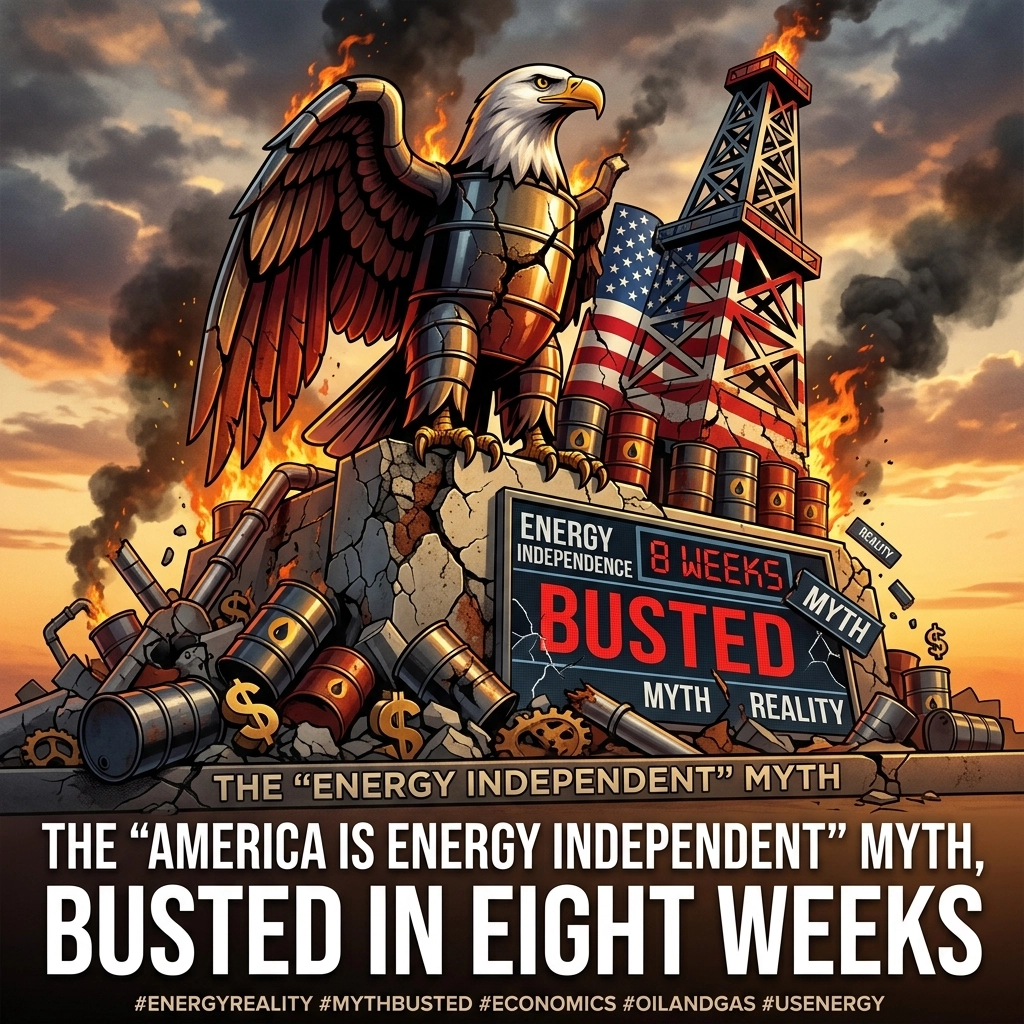
Well, it took exactly eight weeks of conflict in the Strait of Hormuz to prove that "energy independence" is a myth. It’s a slogan, not a shield. And if we’re going to survive this as regular guys trying to balance a budget, we need to understand why the "drill, baby, drill" mantra doesn't actually lower the price at your local Kroger gas bar.
The "Net Exporter" Math That Doesn't Math
To understand the myth, we have to look at the numbers. On paper, the United States is an absolute beast. In 2024 and 2025, we were pulling about 13.2 million barrels of oil out of the ground every single day. At the same time, we were exporting more energy than we were importing.
In the world of politics, that’s a "Mission Accomplished" banner. But in the world of economics, it’s a bit of a shell game.
Here is the secret the talking heads don't mention: Even though we produce 13 million barrels a day, we still import about 6 to 7 million barrels a day. Why? Because not all oil is created equal.
Imagine you’re a farmer who grows massive amounts of corn. You have more corn than you could ever eat, so you’re a "net exporter" of food. But you don't actually like corn; you want bread. To get bread, you have to sell your corn on the global market and buy wheat from someone else. If the global price of wheat triples because of a war, it doesn't matter how much corn you have in your backyard: your sandwich is going to get a lot more expensive.

The Refinery Mismatch: Why We Can't Just Use Our Own Stuff
America’s oil is mostly "light, sweet" crude (mostly from places like the Permian Basin in Texas). It’s high-quality stuff. However, most of the massive refineries on the Gulf Coast were built decades ago to handle "heavy, sour" crude: the thick, sludge-like oil that comes from places like Venezuela, Iraq, and Saudi Arabia.
It’s one of the great ironies of our economy. We pump the light stuff and ship it overseas because our refineries aren't optimized for it. Then, we turn around and import the heavy stuff from the Middle East so we can turn it into the gasoline that goes into your Ford F-150.
When the Strait of Hormuz gets dicey: which is where about 20% of the world’s oil flows: the supply of that heavy crude gets choked. Even if we ramp up production in Texas, it doesn't change the fact that our refineries are waiting for the "heavy" stuff to make the math work.
Oil is a Global Commodity (And Your Neighbor Doesn't Give Discounts)
This is the part that really busts the "drill, baby, drill" myth as a price-control lever. Let’s say an oil company in North Dakota opens a hundred new wells tomorrow. They strike it rich. They’ve got millions of new barrels.
Do you think that company is going to sell that oil to you for $2.00 a gallon just because you’re both Americans?
Not a chance. Oil is a global commodity. It’s traded on a world stage. If the global price of oil (Brent Crude) is $110 a barrel because of a war in Iran, that North Dakota company is going to sell their oil for $110. They would be sued by their shareholders if they did anything else.
Being a "net exporter" just means we have a seat at the table; it doesn't mean we get a different menu. When the world price goes up, our price goes up. Period. The only way "energy independence" would actually lower your gas bill is if we banned all oil exports and forced American companies to sell only to American consumers at a government-mandated price. And in our capitalist system, that’s about as likely as a politician giving back a campaign contribution.

The Eight-Week Reality Check
Before the conflict started in late February, the 30-year fixed mortgage rate was sitting at 5.98%. Today, it’s closer to 6.4%. Why does that matter for gas? Because it’s all tied to the same inflation risk.
When the war started, the market didn't just worry about oil supply; it worried about the cost of everything rising. When energy prices go up, it costs more to ship milk, more to manufacture shingles, and more to fly a plane. That’s why gas prices jumped $1.00 in eight weeks. It wasn't because we ran out of oil: we still have plenty in the ground. It was because the risk of a global shortage sent the global price screaming higher, and we are strapped to that rollercoaster whether we like it or not.
The "drill, baby, drill" crowd loves to suggest that we can just punch more holes in the ground and make gas $1.99 again. But we are already producing more oil than at any point in human history, and gas is still $4.06.
The Real Cost of a "Single Point of Failure"
The Strait of Hormuz is what we call a "single point of failure." It’s a narrow waterway that carries a fifth of the world’s oil, a third of its fertilizer, and a huge chunk of its liquefied natural gas.
When you hear "energy independence," you should think about diversification, not just volume. Countries, like people, get caught in the trap of thinking that because they have a lot of one thing, they’re safe. But if that one thing is tied to a global system that can be broken by a few sea mines or a drone strike, you aren't independent at all. You’re just a participant in a very volatile market.

What a Regular Guy Can Actually Do
So, if "drilling more" isn't the magic wand to lower your gas bill, what is?
- Stop Listening to the Slogans: Understand that gas prices are largely out of the President’s hands, regardless of who is in the Oval Office. It’s a global market. When someone tells you they have a "plan" to lower gas prices to $2.00 by opening federal lands, they’re either lying or they don't understand how the commodity market works.
- Watch the Dollar, Not Just the Barrel: Oil is priced in U.S. dollars. Sometimes, gas stays expensive even when oil drops because the dollar is fluctuating. Keep an eye on the broader economy.
- Efficiency is the Only Real Independence: The only way to truly be "independent" of global oil shocks is to use less of it. That doesn't mean everyone has to buy a $60,000 electric car tomorrow. It means realizing that our reliance on a single, globally-priced commodity is a massive liability for our personal finances.
We’ve spent the last eight weeks learning a hard lesson. America is a powerhouse, no doubt. We are producing more energy than ever. But as long as that energy is traded on a global exchange and our refineries are hooked on foreign "heavy" crude, we are just as vulnerable to a Middle Eastern conflict as someone living in London or Tokyo.
The myth of energy independence was a nice dream while it lasted. But at $4.06 a gallon, it's time to wake up and look at the math. We aren't independent; we're just very well-supplied victims of a global market.
Be mindful, be watchful and good luck.