



October 1, 2026
Halloween is no longer just a child in a pillowcase knocking on the neighbor’s door for miniature chocolate bars. It is now a national retail event involving imported apparel, home improvement, municipal overtime, seasonal employment, tourism, alcohol, freight, and enough plastic skeletons to suggest that the afterlife has excellent purchasing power.
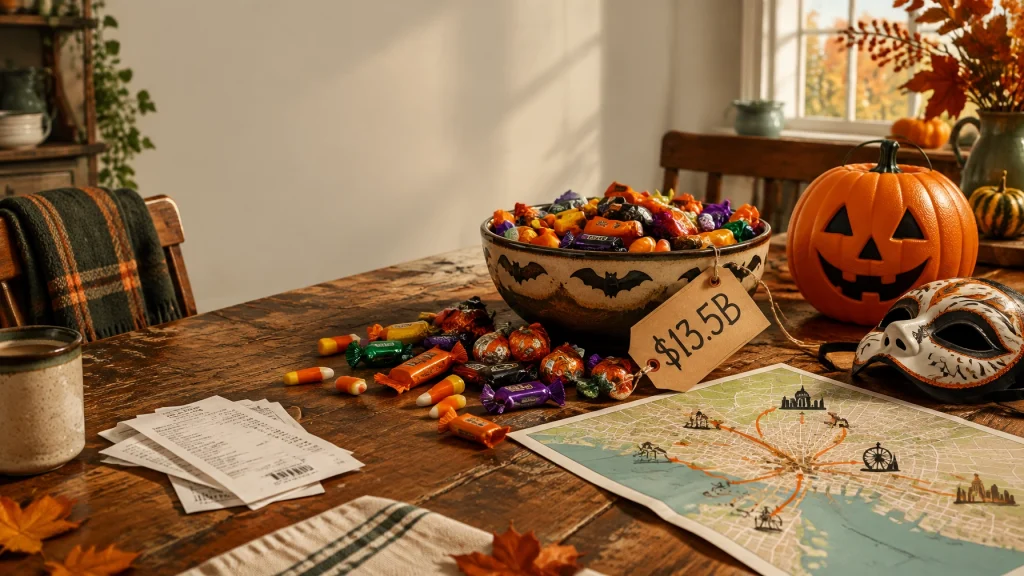
According to the National Retail Federation’s 2026 Halloween survey, Americans are expected to spend a record $13.5 billion on Halloween this year. Seventy-four percent of consumers plan to celebrate, and the average person expects to spend $115.14.
That average is about the cost of a tank of gas, depending on where you live and what you drive. It is also a useful reminder that people are still spending, even while complaining about prices. Complaining and spending are not mutually exclusive. In America, they are practically a matched set.
The interesting part is where the money goes. Candy is expected to account for $4.1 billion, costumes for $4.4 billion, and decorations for $4.3 billion. Costumes are now the largest category, while decorations have nearly caught both of them.
Halloween has become a home-improvement project with candy attached.
Candy: The bag costs more, and the bag contains less
Candy remains the most popular Halloween purchase, with 96% of celebrants planning to buy it. But the economics of the trick-or-treat bag have changed.
Candy and chewing gum prices rose 8.1% year over year in August 2026. That increase comes on top of several years of elevated food prices. The grocery aisle has delivered one of inflation’s favorite magic tricks: the same-looking bag costs more, weighs less, and contains fewer pieces.
That is shrinkflation. The package may still say “family size,” but the family now needs to be smaller.
Chocolate has an additional problem: cocoa. Wholesale cocoa prices have fallen sharply from their 2024 peaks, but retail chocolate prices have not followed them down. This is a classic example of sticky prices.
The mechanism is simple. A manufacturer buys cocoa months in advance. The candy produced with that cocoa sits in a supply chain involving factories, warehouses, retailers, and contracts. By the time the lower wholesale price reaches the purchasing department, the higher-cost inventory may still be sitting on store shelves.
Input prices can fall in a week. Retail prices often need a year, a new contract, and perhaps a small miracle.
Manufacturers have responded by raising prices, shrinking packages, and reformulating recipes. Some products use less cocoa, while consumers shift toward gummies and chewy candy. That is substitution in action: when chocolate gets expensive, shoppers move sideways to products that still deliver sweetness without requiring a second mortgage.
The cocoa supply chain also explains why supply cannot respond quickly. West African cocoa production has been hurt by disease and weather, and a cocoa tree does not respond to a price signal like a vending machine. It takes years for a new tree to begin producing meaningful quantities.
The regular-guy lesson is straightforward: compare price per ounce or price per piece, not just the bright number on the front of the bag. The bag is advertising. The unit price is testimony.

Costumes: Tariffs arrive wearing a cape
Costumes are projected to generate $4.4 billion, making them Halloween’s largest spending category. That is a remarkable development for clothing most people wear once, photograph once, and discover in a closet three years later.
Costume prices have risen because the category is heavily dependent on overseas manufacturing, particularly China. Industry estimates put costume inflation around 6% to 12%, with some segments increasing as much as 15%.
Tariffs do not float harmlessly in the atmosphere. They become part of the landed cost of a product, then move through the importer, distributor, retailer, and finally the checkout scanner. Sometimes an importer absorbs part of the duty. More often, the cost is divided among the participants and passed along to protect margins.
The timing makes Halloween especially vulnerable. Retailers cannot wait until October 28 to order costumes. Inventory generally has to arrive by late July. Miss the shipping window and the costume is not late; it is nonexistent.
That creates a narrow economic funnel:
- A retailer forecasts demand months in advance.
- A manufacturer produces the costume overseas.
- The item crosses an ocean and clears customs.
- The retailer places it in a store before the season begins.
- On November 1, unsold inventory suddenly loses much of its value.
A costume has a short shelf life. A winter coat can be sold next year. A “hot” character costume from last Halloween becomes a clearance problem with a wig.
China recently agreed to reciprocal tariff cuts covering some toys and decorations. That may help future shipments, but it will not necessarily reduce the price of the costume already hanging in the store. The inventory was ordered, shipped, and priced under the old rules.
This is tariff pass-through in its cleanest form. The exporter may receive a lower order, the importer may change suppliers, and the retailer may trim its margin. But a meaningful portion of the bill still lands on the consumer.
Decorations: Halloween becomes the second Christmas
Decorations are projected at $4.3 billion, nearly matching candy and costumes. This category deserves attention because it represents a structural change in the holiday.
Candy has a per-child cost. Decorations do not. Once the inflatable ghost is purchased, it can frighten the neighborhood again next year without demanding another payment for every child who walks past the house.
Decorations are also bought by households without children. They are a form of seasonal identity, entertainment, and neighborhood competition. The front lawn has become a public display, and the public display has a budget.
A reusable decoration is a durable good. That makes the economics different from candy. A $60 decoration used for five years costs $12 per season before storage, electricity, and the inevitable replacement of one missing stake. That is not necessarily a bad purchase.
But the category also reveals how Halloween has expanded from an evening event into a month-long retail season. More people decorate earlier, more retailers devote floor space to the holiday, and more households treat October as a reason to renovate the exterior of the home.
The pumpkin has been joined by a full construction crew.
Parties and the pop-up economy
Halloween parties bring together several profitable categories: food, alcohol, decorations, entertainment, and adult costumes. Adult costumes are particularly effective at converting a simple gathering into a series of impulse purchases.
The retail side is built around temporary labor and temporary real estate. Spirit Halloween is the famous case study. Its stores appear in vacant big-box spaces around Labor Day and disappear shortly after November 1.
The arrangement works because an empty storefront produces zero rent. A landlord may prefer six or ten weeks of short-term income to twelve months of vacancy. A temporary tenant pays less than a permanent tenant might pay, but more than an empty building pays, which is a low bar, but an economically meaningful one.
A commercial real estate analysis of Spirit Halloween’s model describes temporary leases of roughly three months, often running from mid-July through mid-November. The stores operate for only part of that period, with the extra time used for setup and removal.
The labor model is just as seasonal. Workers are hired around Labor Day, the stores operate through October, and many jobs disappear in November. This is one of the clearest examples in the economy of employment that exists for ten weeks and then vanishes from the payroll.
The same workers often return every year. That makes the labor less random than it looks. Seasonal workers build experience, managers build teams, and retailers build a temporary workforce that knows exactly how to sell a fake severed hand to a customer who did not plan to buy one.

Tourism: Salem gets the visitors, the city gets the overtime
Halloween tourism turns local history into a major seasonal economy. Salem, Massachusetts, is the clearest example.
According to Destination Salem, October 2025 brought 1.1 million unique visitors to downtown Salem. Halloween Day alone drew 96,600 visitors, up 7.2% from the previous year.
That level of activity supports roughly $140 million to $144 million in annual direct visitor spending and about 1,200 jobs, depending on the economic-impact estimate being used. Hotels, restaurants, bars, tour operators, museums, retailers, and short-term rental hosts all have reasons to appreciate October.
The city also has reasons to worry.
Police overtime, sanitation, road closures, traffic management, emergency services, barricades, and public transportation all become more expensive during the six-week rush. The private businesses collect much of the visitor spending, while the municipality absorbs many of the public costs.
That is the tourism paradox: a boom can be revenue-positive for the region while leaving the host government short of cash.
Salem has explored tools such as shuttle fees and parking surcharges to recover more of the cost from visitors. This is the fee economy at work. Instead of raising a broad tax, the city places a charge at the point of use: parking, transportation, event tickets, or convenience fees.
The visitor pays, but only if the city can figure out where to put the meter.
Salem is not alone. Sleepy Hollow, New York, has built a major Halloween tourism business. Universal’s Halloween Horror Nights turns temporary fear into a large-scale entertainment product. Haunted attractions across the country generate a substantial share of their annual revenue in a few weeks.
A haunted house may operate for six weeks and earn more during that period than many attractions make during the rest of the year. This is seasonality with a fog machine.

The K-shaped Halloween consumer
The average spending number: $115.14-hides a divided consumer.
One household buys a $60 licensed costume, a $150 decoration, premium candy, and tickets to a haunted attraction. Another household raids the closet, buys discount-store candy, and turns a cardboard box into a robot.
Both households celebrate Halloween. They do not experience the same economy.
The 2026 holiday arrives with candy prices up 8.1%, costume inflation estimated between 6% and 12%, and higher freight and labor costs working through the system. That makes Halloween an early test of the consumer heading into Thanksgiving and Black Friday.
The honest counterweight is that Halloween remains relatively cheap. A $4 bag of candy is easier to justify than a restaurant bill, a weekend trip, or a full Christmas gift list. Candy is also famously recession-resistant. The industry likes to point out that Halloween held up during 2008, and the basic logic remains sound: people may cut expensive meals before they cut a small bag of treats for the neighborhood.
Record spending is real. So is the pressure behind it.
What a regular guy can do
- Buy candy after October 31 for next year. Chocolate and gummies store well when kept cool and dry, and post-holiday discounts can be substantial.
- Use costume math. Compare the $60 licensed costume worn once with a thrift-store jacket, makeup, and a little imagination.
- Watch unit prices. The bag is not the product. The ounces and pieces are the product.
- Treat decorations as durable goods. If a decoration will be used for five seasons, calculate its annual cost before deciding whether it is expensive.
- Remember the holiday’s relative cost. Halloween is not free, but compared with Christmas, travel, or a family dinner out, it remains one of the cheaper ways to create a memorable event.
Halloween is a $13.5 billion reminder that the economy is not only factories, interest rates, and payroll reports. It is also a bag of candy that got smaller, a costume that crossed an ocean, a vacant store that found ten weeks of rent, and a city trying to collect enough parking fees to pay for the crowd.
The ghosts may be imaginary. The invoices are not.
Be mindful, be watchful and good luck.
Educational disclaimer: This article is for educational and informational purposes only. It is not investment advice, tax advice, legal advice, or financial advice. Readers should consult a qualified professional before making financial decisions.