



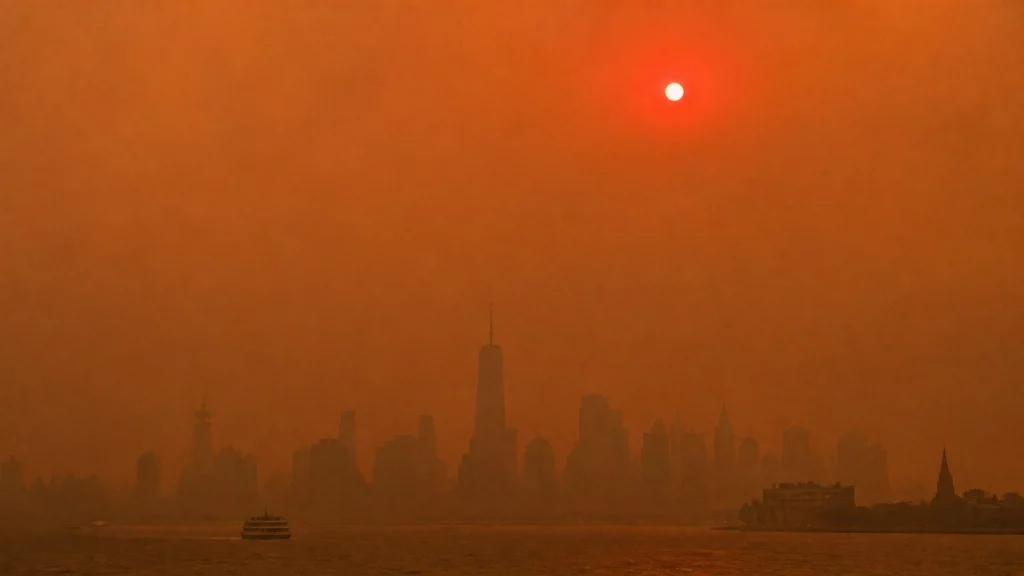
If you live in Chicago, Detroit, Philly, or New York, you don’t need a weather app to tell you something is wrong. You just need to walk outside and take a breath. It feels like the sky has been replaced by a wet, campfire-flavored blanket. As of mid-July 2026, over 120 million Americans are currently under air quality alerts, staring at a sun that looks like a bruised orange through a haze of PM2.5 particulates.
Up north, Canada is dealing with over 3,500 wildfires that have already turned 6 million acres of timber into airborne ash. But while the fires are in Ontario and Quebec, the bill is being delivered straight to the American worker.
At Regular Guy Economics, we talk a lot about "invisible taxes", the kind of costs that don't show up on a government ledger but drain your bank account nonetheless. Inflation is one. Debt bombs are another. But right now, the most expensive tax in America isn't coming from D.C.; it’s drifting down from the stratosphere in the form of hazardous smoke.
The Paycheck Hit: $125 Billion in Vanishing Wages
We usually think of air quality as a "health issue." It is, but it’s also a massive labor market disruptor. According to research from Stanford and the National Bureau of Economic Research (NBER), wildfire smoke exposure is a direct parasite on your earnings.
The math is brutal: each additional day of exposure to wildfire smoke reduces a person’s quarterly per-capita earnings by about 0.1%. That doesn't sound like much until you scale it up. Annualized across the entire U.S. economy, we are looking at roughly $125 billion per year in lost labor income. That’s 2% of the total labor income in the United States, gone, literally up in smoke.

Why does this happen? If you're an outdoor worker, construction, agriculture, logistics, you’re the first to feel it. When the Air Quality Index (AQI) hits the "Hazardous" range, jobsites shut down. Safety managers aren't just being nice; they’re trying to prevent guys from collapsing on the scaffolding. Even if you stay on the clock, your body isn't designed to run on a mix of oxygen and wood ash. Productivity craters when every breath feels like a struggle.
The Hospital Bill: $2.4 Million Per "Event"
When the smoke settles in, the ER waiting rooms fill up. A University of Maryland study found that during smoke "hot spot days," hospitals see an 18-20% surge in cardiopulmonary visits. In Maryland alone, a single multi-day smoke event cost the healthcare system an extra $2.4 million.
Now, multiply that by the 50+ EPA monitors across the Midwest and Northeast currently reading in the "Hazardous" zone. We aren't just talking about a few people with asthma reaching for their inhalers. We’re talking about a systemic shock to the healthcare system that drives up insurance premiums and out-of-pocket costs for everyone. The Joint Economic Committee (JEC) estimates the total annual cost of wildfires (including smoke-related health issues) sits between $394 billion and $893 billion. That is 2% to 4% of our entire GDP.

The Grid on Life Support
It isn't just your lungs and your wallet; it’s your light switches. The energy sector is currently caught in a pincer movement. On one side, we have record heat; on the other, the smoke is creating a logistics nightmare for the people who keep the lights on.
PJM, the regional grid operator for much of the Northeast, just issued its third federal emergency order of 2026. Why? Because the smoke makes outdoor maintenance nearly impossible for linemen and substation techs. Maintenance gets deferred, grid reliability drops, and suddenly you’re looking at a "statutory emergency" just to keep the AC running. When the grid gets stressed, prices spike. You might not see "Wildfire Surcharge" on your utility bill, but make no mistake, you are paying for it.

The "Hidden" Costs: From Corn to Cognitive Function
The damage doesn't stop at the hospital or the jobsite. There are layers to this economic onion, and they all make you cry:
- Cognitive Performance: Research shows that high levels of PM2.5 actually reduce cognitive function in indoor workers. Your office AC isn't a magical shield; those particulates get inside, and your brain slows down. That's a productivity leak that no management consultant can fix.
- Agricultural Yields: Plants need sunlight. When the sky is gray-orange for a week, photosynthesis slows down. Particulates also settle on crops, affecting quality. Your grocery bill is already high enough; we don't need a "smoke discount" on the corn harvest.
- Logistics Delays: When visibility drops, the supply chain slows down. Planes are delayed, trucks move slower, and the "just-in-time" economy starts to look more like "maybe-tomorrow."
The Regular Guy's Bottom Line
We’ve talked before about how the medical industry needs a complete overhaul because it’s a capitalist engine running on a non-capitalist track. Well, the wildfire situation is the ultimate example of a physical cost of a changing climate hitting the P&L of the American household.
You can't "opt-out" of the air. You can't hedge against a smoke plume with a diversified portfolio. This is a direct, physical extraction of wealth from the working class. It’s $125 billion stolen from paychecks and billions more diverted into a medical system that is already overstretched.
In his TEDx talk, "Fixing Capitalism with more Capitalists," Bill Mundell argues that the solution to our biggest problems is more engagement and better incentives within the market. But for the market to work, the "rules of the game" have to include the air we breathe and the physical environment we operate in. When the environment breaks, the economy follows.
We are currently paying for 2026's wildfires with our lungs, our time, and our future earnings. It’s the ultimate invisible tax, and it’s time we started looking at the smoke overhead for what it really is: a line item on your bank statement that keeps getting bigger.
Be mindful, be watchful and good luck.