



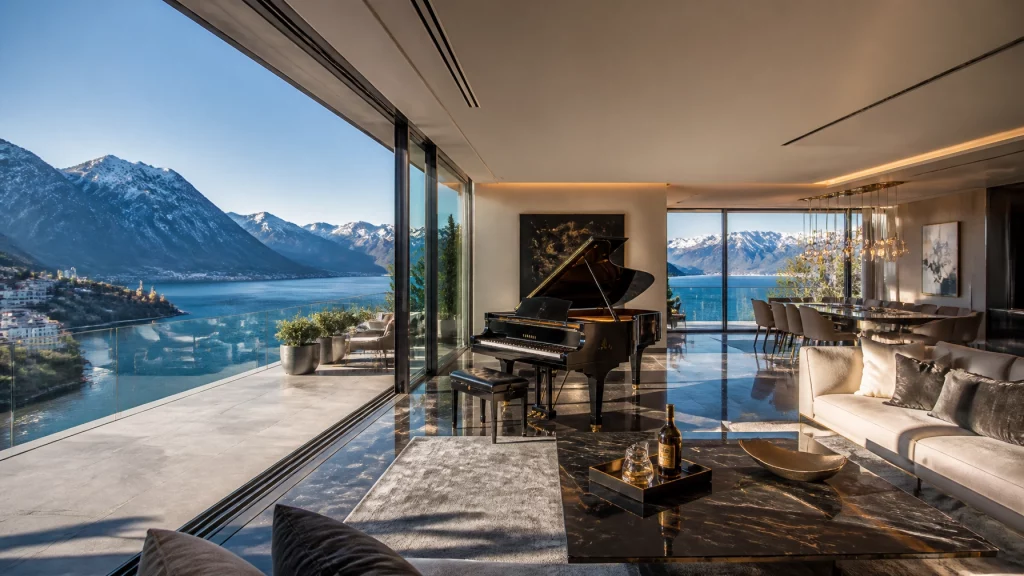
When planning a lavish European getaway, discerning travelers often look at the absolute pinnacle of hospitality. They want to know where royalty, heads of state, and tech billionaires rest their weary heads. Credit to my friend Dr. Abigail Bracha for sparking the comparison — she's the one who got me thinking about why the world's most expensive accommodations look so different depending on whether you're there by choice or by ambulance. On the other end of the spectrum, millions of Americans experience a very different kind of overnight stay: one featuring fluorescent lighting, a bed that adjusts at awkward 15-degree angles, and a roommate whose nocturnal entertainment choices lean heavily toward cable news at 3:00 AM.
Welcome to the great lodging comparison of our modern era: the ultra-exclusive Geneva penthouse versus the standard American inpatient hospital room. Both represent a staggering amount of capital changing hands for a place to sleep. But when examining the price-per-night breakdown, the amenities, and the sheer market logic, one option is an exercise in capitalism working at its absolute finest, while the other is a terrifying glimpse into a market failure wrapped in gauze.
Let’s check into both properties and look at the math.
Option A: The Royal Penthouse Suite at Hotel President Wilson (Geneva, Switzerland)

If you are looking to drop serious coin on a single night in Europe, the crown jewel is undoubtedly the Royal Penthouse Suite at the Hotel President Wilson in Geneva, Switzerland. Clocking in at anywhere from $80,000 to $100,000 per night, this is what happens when extreme wealth meets elite hospitality.
What does a cool hundred-grand get you on a nightly rate? Let’s examine the floor plan:
- 12 lavishly appointed rooms and 12 marble bathrooms.
- A sprawling 1,830-square-meter terrace providing panoramic, uninterrupted views of Lake Geneva and Mont Blanc.
- A dedicated private butler service on call twenty-four hours a day, ready to unpack your luggage, pour vintage champagne, or secure a last-minute table in the Swiss Alps.
- A Steinway grand piano for impromptu classical recitals when insomnia strikes.
- Bulletproof windows, private elevator access, and a security system that would make a sovereign nation jealous.
- A dining room capable of seating 26 guests, serviced by a private kitchen.
It is opulent, ridiculous, and unapologetically expensive. But here is the crucial economic distinction: It is entirely optional.
The Hotel President Wilson operates in a fiercely competitive free market. If their rates become too absurd, or if guests decide that a bulletproof window isn't worth eighty grand, management must adjust, innovate, or lose business to the Ritz Paris, The Dorchester in London, or Munich’s finest luxury properties. Competition keeps quality high and forces providers to actually cater to their customers.
Now, let's look at the alternative accommodation.
Option B: A Standard U.S. Hospital Room

On the domestic front, millions of Americans check into a very different type of facility each year. The average daily cost for a standard U.S. hospital room hovers around $3,086 to $3,130 per day. If an unexpected medical crisis pushes a patient into the Intensive Care Unit (ICU), those daily rates easily escalate to $4,000 to $9,000+ per day.
Remember, these are baseline room charges and basic production costs. The actual billed charges that hit the billing department can easily be two to five times higher once pharmaceutical markups, lab tests, and physician fees are stapled to the ledger. The average total inpatient stay runs roughly $16,667 before insurance adjustments or out-of-pocket deductibles eviscerate personal savings.
So, for roughly three grand a night: a price point that in many global cities could secure a five-star hotel suite with a personal concierge: what exactly are customers receiving at the local American hospital?
- A shared room separated from a stranger by a thin, cloth curtain that offers zero acoustic privacy.
- A mechanical bed that rattles when adjusted and features a remote control missing half its buttons.
- A television that often requires a separate daily rental fee or a credit card swipe.
- Cuisine affectionately known throughout the industrialized world as "hospital food": a mysterious gray meatloaf paired with lukewarm gelatin.
- A relentless symphony of beeping monitors, flashing call buttons, and fluorescent overhead lights that ensure sleep is strictly prohibited.
- A nocturnal roommate who may or may not be watching cable news at maximum volume while nurses clomp down the hallway in squeaky rubber shoes.
The value gap is nothing short of staggering. If someone is going to shell out thousands of dollars for a night away from home, basic consumer logic dictates they should at least get the grand piano and the view of Mont Blanc, not a roommate named Gary snoring through an oxygen mask.
The Core Disconnect: Free Markets vs. Captive Markets

The comedic framing of comparing a Geneva penthouse to an ICU room highlights a deeply serious macroeconomic reality: the profound disconnect between what "luxury" costs in a functional market versus what "necessity" costs in a broken, heavily cartelized market.
When a hotel charges $100,000 a night, it does so because consumers willingly trade capital for extraordinary value, exclusivity, and service. The hotel has to compete for every dollar. It must innovate, pamper, and impress.
When a hospital charges $3,000 a day for a bed next to a vending machine, it faces zero meaningful market competition. Patients do not price-shop emergency appendectomies on Kayak.com while clutching their side in agony. There is no open marketplace where consumers can review competing ICUs based on room service quality or thread count.
Instead, the American medical system operates as a captive market. Insurance middlemen, pharmaceutical giants, and hospital networks form an administrative juggernaut designed to extract maximum value from human misfortune. Costs trend upward year after year regardless of service quality, while administrative overhead swells and bedside care gets squeezed.
Time to Rethink the Madness
It is high time to recognize that the medical industry in its current state is less about healing and more about financial extraction. When basic shelter and care during an illness costs as much as a royal European holiday: without even a fraction of the comfort: the system is broken at its core.
True reform will not come from more regulatory bureaucracy or complicated insurance mandates. It will come when consumers, employers, and regular citizens demand transparency, direct pricing, and real market competition in health and wellness. Until then, remember that if anyone is paying luxury prices, they deserve at least a butler who pours champagne: not a nurse handing over a bill with a copay that requires a second mortgage.
Be mindful, be watchful and good luck.