



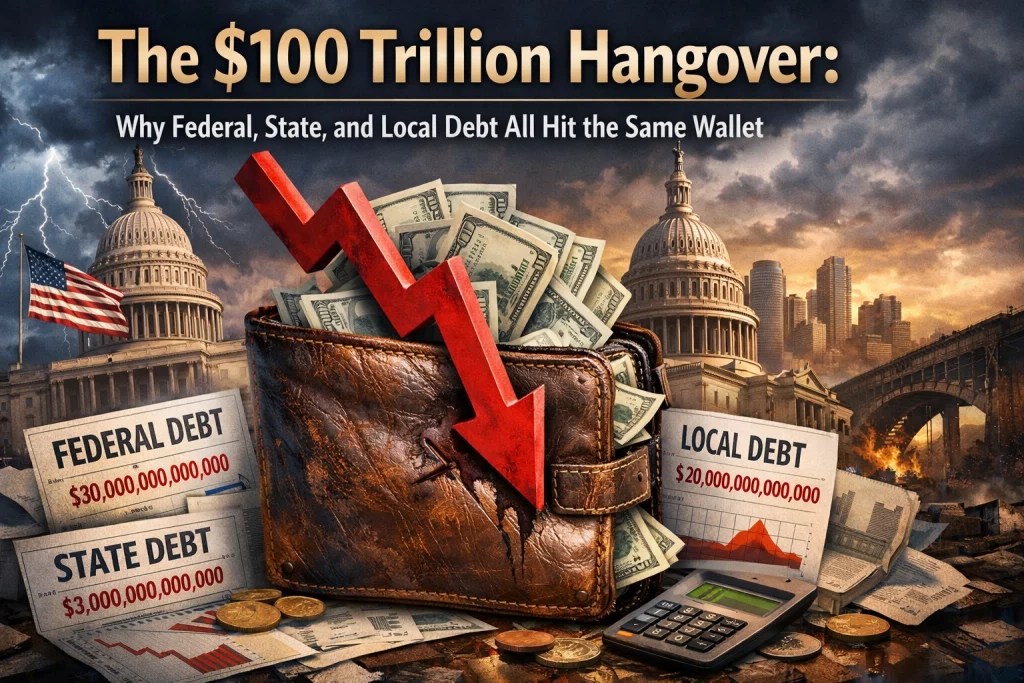
Let's talk about something nobody wants to discuss at dinner parties: debt. Not your credit card debt or that car loan you're still paying off, I'm talking about the big stuff. The kind of debt that makes your personal financial mistakes look like rounding errors.
We've got federal debt, state debt, local debt, and municipal debt. They all sound like different problems, right? Like they're neatly categorized in separate buckets managed by different people. Here's the punchline: they all come from the same wallet. Yours.
The Federal Debt Mountain
Let's start with the elephant in the room, federal debt. As of right now, we're sitting at over $38 trillion in national debt. That's trillion with a "T." To put that in perspective, if you spent $1 million every single day since Jesus was born, you still wouldn't have spent $1 trillion. We're at 38 of those.

But wait, it gets better. The federal government is currently borrowing about $43.5 billion per week. That's not a typo. Every seven days, another $43.5 billion gets added to the pile. The Congressional Budget Office projects that by 2036, just ten years from now, the national debt will hit $64 trillion, with annual deficits ballooning to $3.1 trillion per year.
And here's where the math really stops mathing: we're now paying over $1 trillion annually just in interest on this debt. Not paying it down. Not making progress. Just interest. That's like paying the minimum payment on a credit card that never gets smaller.
The State and Local Debt Nobody Talks About
Now here's where everyone's eyes glaze over, but stay with me because this is where it gets wild.
While everyone focuses on that $38 trillion federal number, we conveniently forget about state debt (roughly $1.3 trillion), local government debt (another $2 trillion), and the unfunded pension liabilities that states and municipalities owe their workers (estimates range from $4 to $6 trillion depending on who's doing the counting and how optimistic they're feeling).
Add in municipal bonds, county obligations, school district debt, and all the other governmental IOUs floating around, and you're easily adding another $10-15 trillion to the pile when you count unfunded liabilities honestly.
So let's do some napkin math:
- Federal debt: $38 trillion
- State debt: $1.3 trillion
- Local government debt: $2 trillion
- Unfunded pension liabilities: $5 trillion (being generous)
- Other municipal and governmental obligations: $3-5 trillion
Grand total? Somewhere north of $50 trillion in actual debt, with the real number likely approaching $100 trillion when you include all unfunded future obligations.
The One Wallet Problem
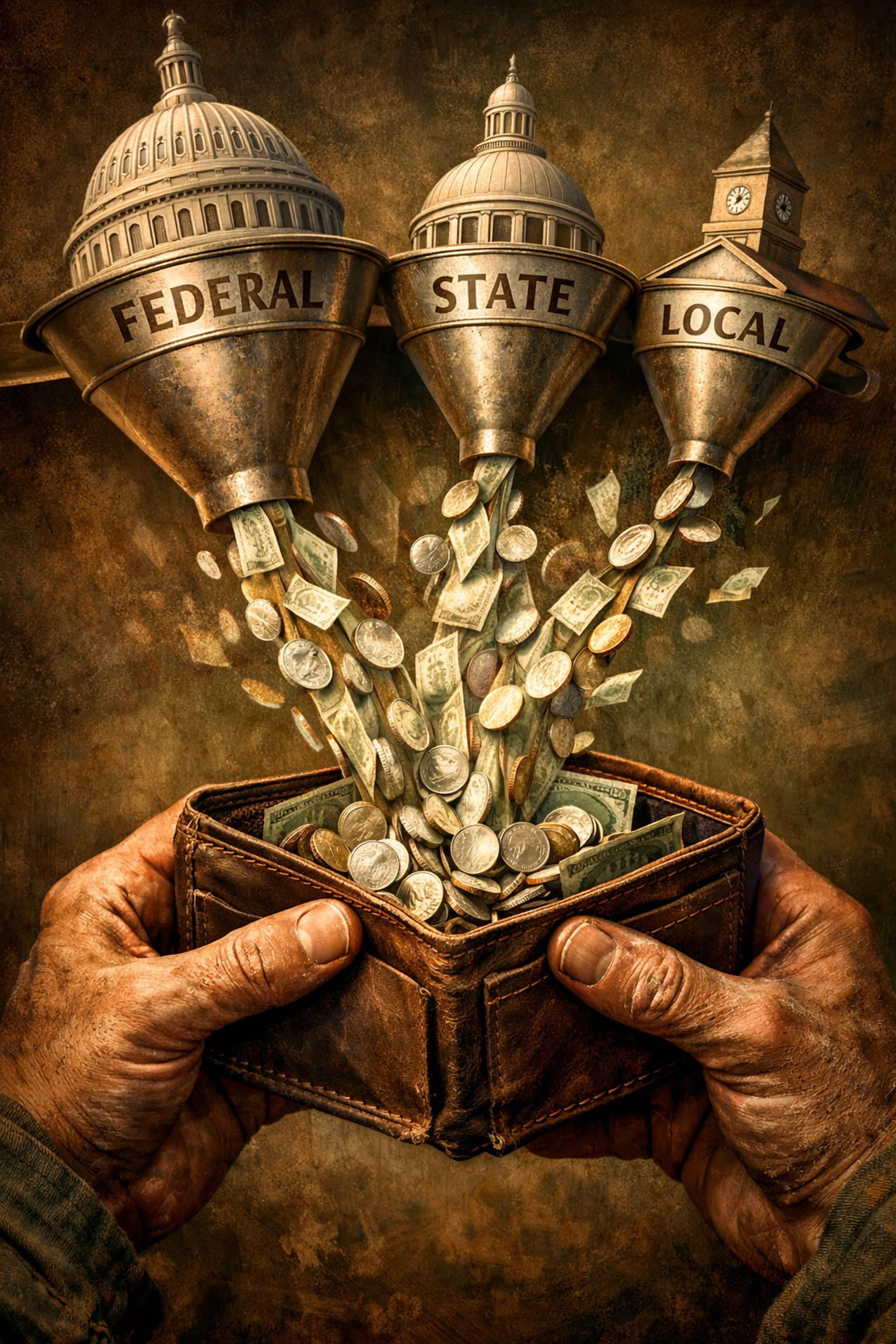
Here's the thing that politicians love to ignore: these aren't different buckets of money. There isn't a "federal taxpayer" and a separate "state taxpayer" and another "local taxpayer."
It's you. It's all you.
When the federal government needs money, they either tax you or borrow money that you'll pay back later (with interest). When your state needs money, they tax you or issue bonds that… you guessed it… you'll pay back later with interest. When your city needs money, they raise property taxes or issue municipal bonds that you'll pay back. With interest.
You're being hit from three different directions, but it's all coming from the same place: your paycheck, your property, your purchases, your wallet.
It's like having three different credit cards but only one bank account to pay them all from. Sure, the statements come from different companies, but when they're all due on the first of the month, you're still scrambling to cover all three from the same pile of cash.
The Math Isn't Mathing
Let's put this in Regular Guy terms. The U.S. GDP, the total value of everything we produce in a year, is about $28 trillion. Our total governmental debt obligations are approaching $100 trillion when you count everything honestly.
That means we owe roughly 3.5 times what we produce in an entire year. All of us. Working every day. For a whole year. And we'd still only pay off about a third of it.

But it gets worse (doesn't it always?). We're not even trying to pay it down. The federal deficit alone for 2026 is projected at $1.9 trillion. That means we're going $1.9 trillion MORE in debt this year, and that's before any "emergency spending" or "unforeseen circumstances" that always seem to pop up.
At the state and local level, pension obligations are coming due as baby boomers retire, infrastructure is crumbling and needs repair, and nobody wants to be the politician who raises taxes or cuts services to actually deal with the problem.
The Interest Rate Trap
Remember when interest rates were basically zero? Those were the days. The average interest rate on federal debt has jumped from 1.552% five years ago to 3.362% now. That might not sound like much, but when you're talking about $38 trillion, every percentage point matters.
Here's the brutal math: if rates go up just one more percentage point across all that debt, we're paying an additional $380 billion per year just in interest. That's more than we spend on veterans' benefits. That's more than NASA's budget times twenty.
And the states? Many locked in low rates when times were good, but those bonds eventually mature and need to be refinanced. At higher rates. Which means higher payments. From the same wallet.
Can We Actually Pay This Back?
Short answer? No. Not under current conditions.
Long answer? Also no, but with more explaining.
To actually pay down $100 trillion in debt, we'd need to run massive surpluses every year for decades. That means collecting way more in taxes than we spend. When's the last time that happened? The late 1990s, briefly, and we're talking about the federal government alone, not the combined weight of all governmental debt.

We're not even in the ballpark of running surpluses. We're running trillion-dollar deficits and the projections show them getting bigger, not smaller. Social Security and Medicare obligations are growing as the population ages. Infrastructure needs investment. And nobody, Democrat or Republican, wants to be the person who tells voters that services need to be cut by 40% and taxes need to double to fix this mess.
The math simply doesn't work. You can't borrow your way out of debt, and you can't grow your way out when the debt is growing faster than the economy.
Why This Matters to You
You might be thinking, "Okay, but how does this affect me right now?" Fair question.
First, every dollar spent on interest payments is a dollar that doesn't go to roads, schools, or any service you actually use. At the federal level alone, we're spending more on interest than on kids' education, scientific research, and infrastructure combined.
Second, this debt will eventually require higher taxes, reduced services, or both. There's no magic money tree. The bill comes due eventually, and it's your kids and grandkids who'll be stuck with the tab.
Third, high government debt can lead to inflation (hello, recent years) as governments try to inflate away their obligations. Your savings lose value while the debt becomes easier to service in nominal terms.
The Uncomfortable Truth
The uncomfortable truth is that we've made promises we can't keep and borrowed money we can't pay back. We've done it at the federal level, at the state level, and at the local level. And we've all pretended that these are separate problems with separate solutions.
They're not. They all hit the same wallet: yours: and the math stopped mathing a long time ago.
Nobody wants to have this conversation because the solutions are painful. Cut spending dramatically? Political suicide. Raise taxes massively? Also political suicide. Default on obligations? Economic catastrophe. Inflate it away? You're still paying through the debasement of your savings.
We're not facing a crisis tomorrow or next week. This is a slow-motion train wreck that we can all see coming but nobody seems willing to stop. We just keep adding more cars to the train and hoping the tracks hold.
The $100 trillion hangover is real, it's growing, and eventually someone's going to have to deal with it. That someone is probably you, your kids, or your grandkids. The math is the math, whether we want to face it or not.
Be mindful, be watchful and good luck.