



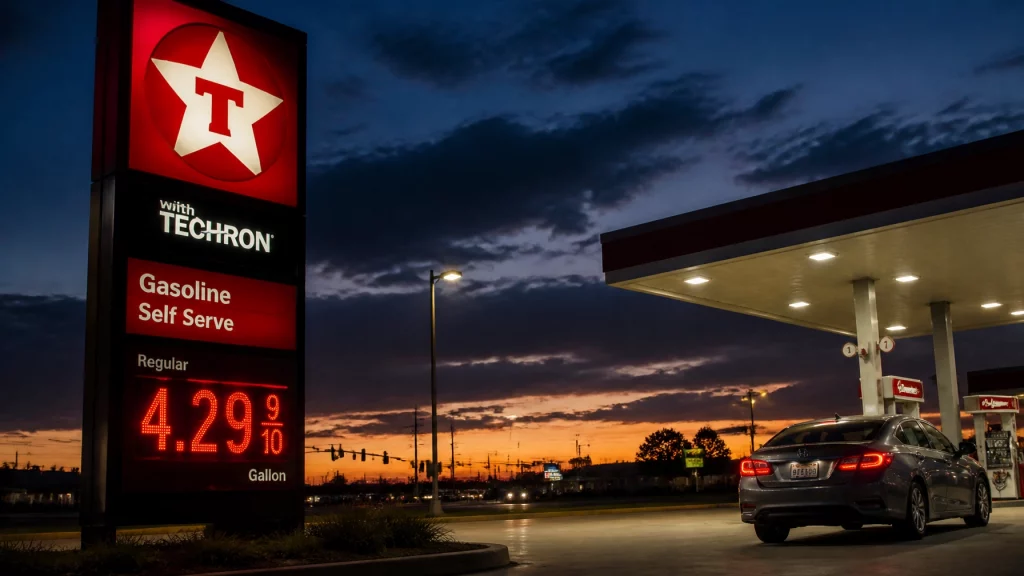
If you have tried to pack up the sedan for a final weekend getaway or simply calculated your monthly commuting costs lately, you probably felt that familiar, sinking sensation in your stomach every time you rolled past a gas station sign.
We are living through a peculiar brand of economic whiplash. For months, financial television pundits and central bank cheerleaders have been promising us that inflation is cooling, supply chains are healed, and the American consumer is back on solid footing. Yet, every time you turn the ignition, fill your tank, or pay for a delivery, reality punches you straight in the wallet. Brent crude has been stubbornly holding above $100 a barrel, WTI is sitting comfortably north of $92, and national gas averages are pressing hard against the $4.10 mark (with states like California and Washington paying well past five bucks).
Welcome to the $100 oil hangover. It is loud, it is expensive, and it is quietly rewriting every household budget in America.
The Ghost in the Tank: What is the "Hormuz Premium"?
To understand why your summer road trip feels like a financial penalty, you have to look past the local Shell or Chevron station and gaze across the globe toward the Strait of Hormuz.

Global energy markets are currently paying a hefty "Hormuz Premium." As geopolitical tensions flare in the Middle East and shipping chokepoints face ongoing disruptions, major financial institutions have had to radically revise their baselines. Barclays recently pushed its Brent forecast up to $100 a barrel, explicitly citing the prolonged stalemate in maritime trade through the Strait. The U.S. Energy Information Administration (EIA) notes that inventories have drawn down aggressively, locking in triple-digit crude as a baseline for much of the spring and summer.
What does that actually mean in plain English? It means roughly $15 to $30 of every single barrel of oil you are paying for right now isn't the cost of extraction, refining, or distribution. It is pure, unadulterated geopolitical panic baked into the futures market.
Wall Street analysts can debate risk premiums and futures curves all they want from air-conditioned Manhattan boardrooms, but regular people bear the brunt at the pump. History tells us that roughly every $10 sustained move in crude oil translates directly into a 20 to 30-cent jump at the retail pump once refining margins and distribution kick in. When you combine a baseline of $60 oil with a $100+ war-risk regime, you are looking at an invisible tax of nearly a dollar extra on every single gallon of gasoline.
The Family Road Trip vs. The Ledger
There is a uniquely American tradition of loading the kids, the dog, and a cooler of lukewarm Capri Suns into the car for a summer road trip. Families try to squeeze in one last memory-making excursion before the school bells ring and the autumn grind begins.

Only this year, the math doesn't work. When a fill-up costs $75 to $90 instead of $45, the spontaneous weekend getaway turns into a line-item veto. Families aren't just cutting back on leisure travel: they are scaling back on basic mobility.
And that brings us right back to the central lie we are being fed about consumer resilience. The establishment loves to point to strong headline spending numbers and declare that the consumer is unstoppable. But spending more dollars doesn't mean people are buying more goods; it often means they are simply paying more for the exact same amount of survival. When fuel eats a larger slice of your paycheck, something else has to give.
For more insights on how debt and monetary policy drive these pressures, check out our deep dive over at Regular Guy Economics.
It’s Not Just the Pump: The Invisible Freight Tax
If you think you are safe from the $100 oil hangover because you drive a hybrid, take the subway, or work from home, think again. Energy is the underlying blood of the entire global economy. Every single item on a grocery shelf, every Amazon brown box dropped on your porch, and every local service call carries an invisible freight surcharge.

Diesel prices track right alongside crude. When diesel surges, long-haul trucking companies, cargo ships, and rail networks pass those soaring transportation costs down the supply chain. By the time a box of cereal or a fresh head of lettuce makes it from an agricultural valley in California or a manufacturing hub in the Midwest to your local supermarket aisle, it has absorbed fuel price hikes at every single handoff.
This is why grocery bills refuse to come down, no matter how many times government officials talk about disinflation. You cannot have $100 oil without expensive logistics, and you cannot have expensive logistics without everyday goods draining your checking account. It is a cascading domino effect that hits working-class and middle-class households hardest.
The Fed’s Cornered Rookies
All of this brings us crashing back to the macroeconomic stage and the recent fireworks at the Federal Reserve.
While everyday Americans try to navigate $4-plus gas and sticky grocery inflation, the central bank finds itself trapped in a geopolitical and economic vice. When inflation refuses to lie down because energy commodities remain stubbornly elevated, rate-cut fantasies evaporate. Central bankers cannot slash interest rates to rescue cooling housing markets or sluggish job numbers when crude oil is threatening to ignite a secondary wave of inflation.
The economic commentary coming out of the recent Federal Open Market Committee (FOMC) meetings: marked by sharp internal dissents and a fractured consensus: proves that even the architects of our monetary system know they are walking a tightrope over an active volcano. They spent years telling us inflation was "transitory," and now they are staring down a stubborn commodity cycle that refuses to bend the knee to econometric models.
Time to Wake Up
The $100 oil hangover isn't a temporary summer storm; it is a symptom of a broader structural reality. Global energy chokepoints are fragile, fiscal spending remains out of control, and monetary authorities are out of easy bullets.
For regular folks trying to make ends meet, the solution isn't waiting for politicians to offer temporary holiday gas tax gimmicks that get swallowed up by refinery margins within a week. The solution is understanding how these global gears grind against your personal finances, protecting your savings, and refusing to buy into the fairy tales of painless economic recovery.
Keep your eyes open, watch your budget closely, and don't let the noise at the pump catch you off guard.
Be mindful, be watchful and good luck.
If you want to keep up with more unfiltered economic analysis, commentary, and community discussions, visit our contact page or explore our shop at Regular Guy Economics.