



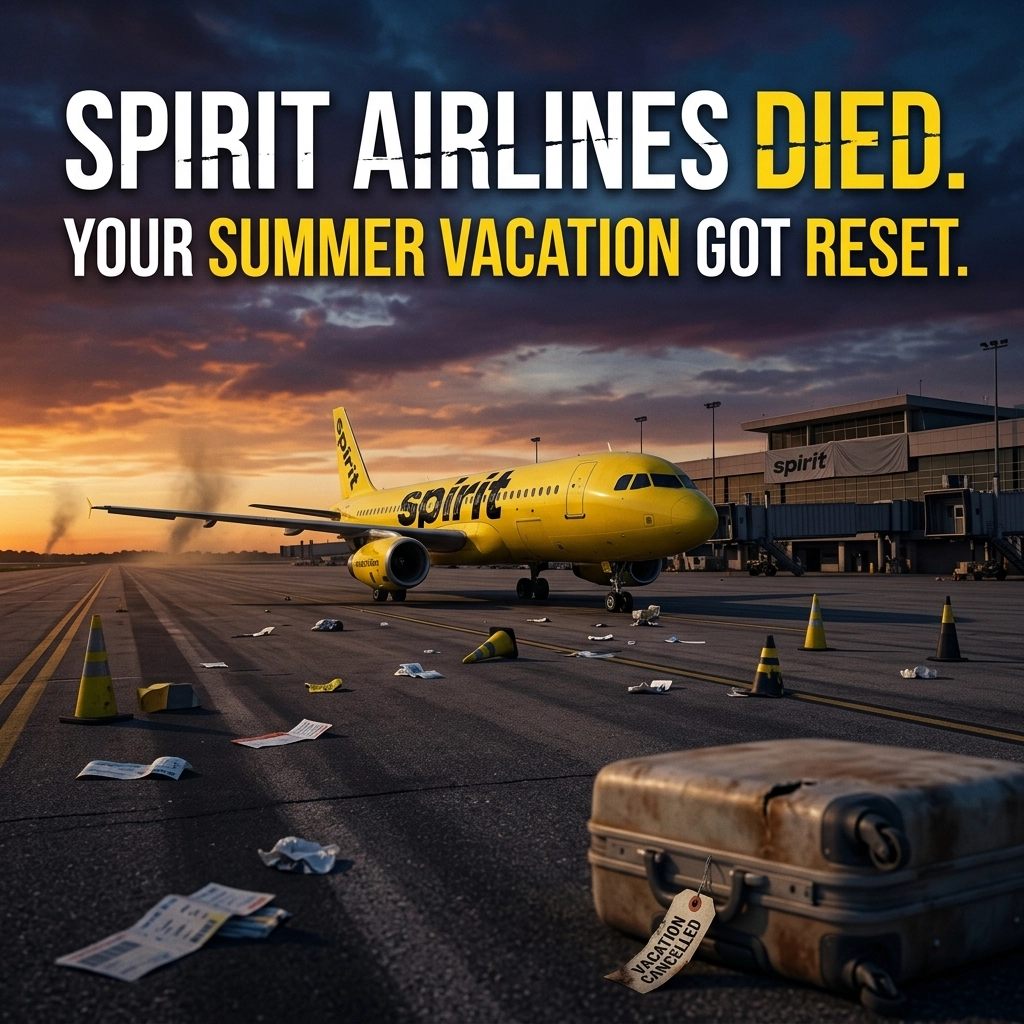
If you were planning on cramming your family into a bright yellow plane this July, paying $40 for a seat the size of a postage stamp, and somehow making a trip to Florida work for under a grand, I’ve got some bad news. The "yellow bird" has officially been grounded.
On May 2nd, 2026, at 3:00 a.m., Spirit Airlines finally gave up the ghost. After two bankruptcies in two years and a failed last-ditch bailout attempt with the administration, the doors locked for good. Roughly 17,000 employees are out of work, and millions of "Regular Guys" who rely on ultra-low-cost carriers are currently staring at their vacation spreadsheets with a growing sense of dread.
This isn’t just about one airline going belly up. This is the final nail in the coffin for the "Cheap Summer" era. Between the collapse of budget competition and the ripples of the 2026 Iran war hitting the fuel pump, your summer vacation just got a massive, uninvited price hike.
The Fuel Wall: Why Spirit Finally Cracked
Spirit’s business model was always a high-wire act. They operated on razor-thin margins, betting that they could keep planes full enough to offset the fact that they were practically giving tickets away. But that model requires one thing above all else: cheap jet fuel.
The 2026 conflict in the Middle East blew that requirement out of the water. Jet fuel prices have surged over 70% since the hostilities began. When you're a legacy carrier like Delta or United, you have a bit of "fat" in your pricing to absorb some of that. When you’re Spirit, and your brand is built on $49 fares, you can’t exactly double your prices overnight without losing your entire customer base.
The bailout negotiations failed because the math simply didn’t work anymore. With the Strait of Hormuz operating at a fraction of its normal capacity, the energy market is in a tailspin. Spirit was the canary in the coal mine, and the canary didn't just stop singing, it fell off its perch and hit the floor.
The "Before and After" Vacation Budget
Let’s look at what this actually means for a family of four trying to get from, say, Chicago to Orlando for a week in July. This is where the "Regular Guy" math gets painful.
The 2025 Budget (The "Good Old Days"):
- Flights (Spirit): $600 (4 people at $150 round trip)
- Bags: $160 (Two checked bags, tight packing)
- Rental Car/Gas: $450
- Hotel: $1,200
- Total: $2,410
The 2026 Budget (The Post-Spirit Reality):
- Flights (United/Delta): $1,600 (Competition is dead; prices are "normalized")
- Bags: $240 (Bag fees at the majors just jumped again)
- Rental Car/Gas: $650 (Gas is at $4.45 and climbing)
- Hotel: $1,550 (Energy surcharges and labor costs)
- Total: $4,040
That’s a 67% increase for the exact same trip. For most families, that $1,600 difference is the difference between going to the beach and staying home to run the sprinkler in the backyard.

Why the "Big Three" Aren't Feeling Your Pain
With Spirit gone, the remaining airlines (United, American, Delta) have zero incentive to keep prices low. In the world of economics, we call this a reduction in "market contestability." In regular guy terms, it means they’ve got you over a barrel.
United already warned that they might cut 5% of their less profitable routes. Why? Because they can. They don't have to worry about a low-cost competitor swooping in and stealing those passengers with a $99 deal. And it's not just the tickets. Have you checked bag fees lately? Delta, JetBlue, and United all bumped their fees the moment they saw Spirit wobbling. They know you have nowhere else to go.
The Road Trip Trap: $5.50 Diesel and the Logistics Squeeze
"Fine," you say. "I’ll just drive. We’ll pack the SUV, grab some snacks, and hit the interstate. I'm not paying $400 for a seat."
It’s a classic move, but the math is catching up to you there, too. National average gas prices hit $4.45 last weekend. But the real killer isn't the regular unleaded you're putting in your Ford Explorer: it’s the $5.50 diesel that every truck on the road is burning.
Diesel is the lifeblood of the American economy. Everything you consume on your vacation: the burgers at the restaurant, the clean sheets at the hotel, the sunscreen at the CVS: got to its destination on a truck burning that $5.50 diesel.

When fuel prices rise like a rocket, businesses don’t just eat that cost. They pass it on to you in the form of "service fees," "resort surcharges," and higher menu prices. The hotel has to wash your towels, which requires electricity and water (utility rates are up due to fuel) and linens delivered by a logistics company that just added a 15% fuel surcharge.
The "road trip" version of your vacation might save you on airfare, but the "destination inflation" is going to eat those savings before you even check in.
Rockets and Feathers: Why Relief Isn't Coming Soon
You might hear on the news that there's an April 8th ceasefire in place or that the EIA projects $3.00 gas by the end of the year. Don't hold your breath.
Central-bank economists have a phrase for this: fuel prices "rise like rockets and fall like feathers." When oil spikes, the gas station at the corner raises its prices within hours to protect its ability to buy the next shipment. But when oil prices drop? Those prices float down slowly, like a feather in a light breeze. It takes 1-2 months for "relief" to actually hit your wallet.
For your summer vacation, the rocket has already launched. Even if the war ended tomorrow and the Strait of Hormuz opened up fully, the "feather" won't hit the ground until long after you've already paid for your July hotel stay and August flights.

The New Strategy for the Regular Guy
So, what do we do? Do we just cancel summer?
Not necessarily. But the days of "winging it" on a budget are over. If you want to survive the Summer of '26 without putting your 401(k) on a credit card, you need a new playbook:
- The "Staycation" Pivot: It sounds like a cliché from 2008, but local travel is the only way to dodge the fuel surcharge ripple effect.
- Lock In Everything: If you see a price today for a hotel or a flight that you can live with, book it. In this environment, "waiting for a deal" is a losing strategy. The deals died with Spirit.
- Watch the Logistics: Look for vacation spots that aren't at the end of a long supply chain. Islands and remote mountain resorts are going to have the highest "import" costs for food and fuel.
- Audit Your Rewards: Now is the time to burn those credit card points or frequent flyer miles you’ve been hoarding. Their value is actually higher now because the cash price of travel has spiked so aggressively.
Spirit Airlines was the "Regular Guy's" ticket to a world he otherwise couldn't afford to visit. Its death is a signal that the economy is tightening its belt, and it's asking you to do the same. The "labor squeeze" we’ve been talking about isn't just about jobs: it’s about the cost of the movement of people. And right now, movement is getting very, very expensive.
Be mindful, be watchful and good luck.