



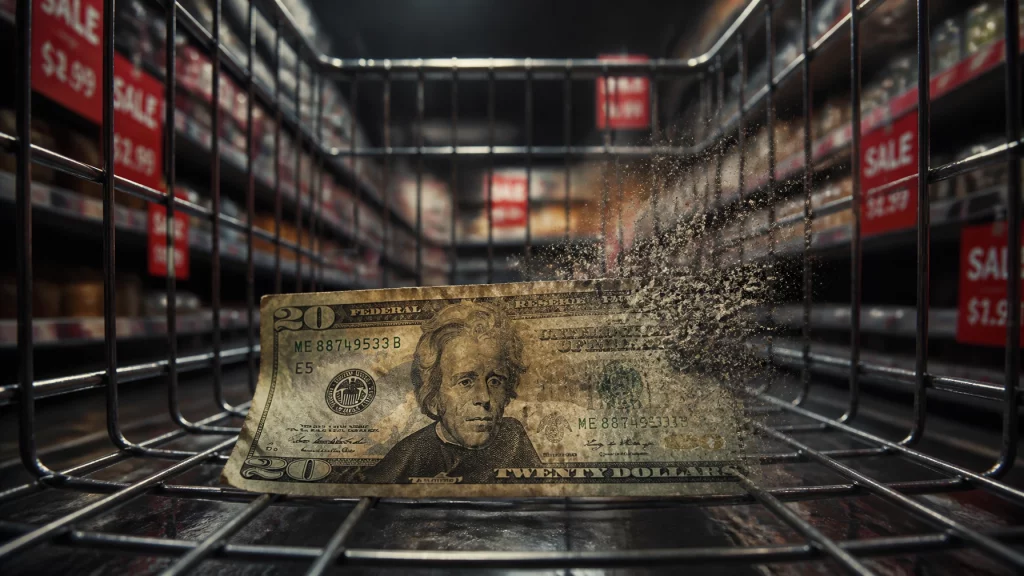
There was a time, not so long ago, when a twenty-dollar bill felt like a serious piece of currency. It was the "walking around" money that could solve most minor problems. If the fridge was looking a bit bare on a Tuesday night, twenty bucks was your ticket to a full grocery bag: milk, eggs, a pound of ground beef, a loaf of bread, and maybe even a treat for the kids.
Fast forward to June 2026, and that same twenty-dollar bill feels more like a five. It’s the ghost of a currency, haunting the checkout aisles of America. While the official reports might suggest that inflation has "cooled," the cumulative damage of the last five years has effectively killed the purchasing power of the $20 bill. It hasn't just lost its edge; it has lost its identity.
That matters more than the economists would like to admit. The death of the $20 bill is not just about arithmetic. It is about a psychological threshold, a social threshold, and a class threshold. For decades, a twenty was the minimum unit of comfort for the middle class. It covered a modest lunch. It covered a quick pharmacy run. It covered a pizza pickup, a tip, and maybe enough left over for a two-liter. It gave people the feeling that they still had a little room to breathe.
That breathing room is gone.
The Historical Erosion of the $20 Bill
A lot of people know prices are higher. Fewer people stop and think about what the same green piece of paper used to do in different decades. That’s where the story gets ugly.
In 1980, a $20 bill could buy a startling amount of everyday life. Average gasoline was about $1.19 a gallon, so twenty dollars could buy nearly 17 gallons of gas. A gallon of milk was around $2.16, which means a twenty could buy about 9 gallons. A loaf of bread was roughly 50 cents, so that same bill could buy about 40 loaves. Ground beef was commonly in the neighborhood of $1.60 to $1.90 per pound, meaning a twenty could bring home around 11 to 12 pounds of hamburger. A movie ticket averaged around $2.69, so a twenty bought the ticket, popcorn money, and still had change to jingle in a pocket.
In 1990, the twenty was still respectable. Gas averaged about $1.16 a gallon, so twenty dollars still bought around 17 gallons. Milk was roughly $2.78 a gallon, meaning about 7 gallons for twenty bucks. Bread came in around 70 cents a loaf, so the twenty bought around 28 loaves. Ground beef hovered around $2.10 to $2.30 per pound, so around 9 pounds of meat still came home. Even a fast-food run did not require a small loan from the Federal Reserve.
In 2000, the wear and tear started to show, but the bill still had muscle. Gas averaged around $1.51 a gallon, giving about 13 gallons for twenty dollars. Milk was around $2.79, so the same seven gallons still worked. Bread had moved closer to $1.72 a loaf, bringing the buying power down to about 11 or 12 loaves. Ground beef was around $2.50 to $2.80 per pound, so the twenty bought roughly 7 to 8 pounds. A movie ticket averaged $5.39, so two people could still go out without the wallet feeling mugged.
By 2010, the bill was tired but not yet on life support. Gas averaged about $2.84 a gallon, so twenty bought only about 7 gallons. Milk was roughly $3.32, so the twenty brought home about 6 gallons. Bread was near $1.98, making it about 10 loaves. Ground beef ran around $3.00 to $3.40 per pound, so the buying power fell to around 6 pounds. Even then, though, a twenty could still handle an ordinary errand without generating a stress rash.
Now look at 2026. Gas in many places hovers around $3.40 to $3.80 a gallon, which means a twenty buys around 5 to 6 gallons if the pump is feeling charitable. Milk often lands around $4.00 to $4.50 for a gallon. Bread commonly runs $2.50 to $3.50. Ground beef has regularly lived in the $5.50 to $7.00 per pound neighborhood depending on fat content and geography. A movie ticket around many markets is $11 to $15, meaning that the old “grab a twenty and head out” mindset is now comedy material.
Here is the plain-English version: the $20 bill did not just lose value. It lost social usefulness. It used to be enough money to participate in ordinary American life. Now it often just gets a person through the opening round.
The Five-Year Grocery Gap
To understand why the Regular Guy feels like he’s losing ground even when he gets a raise, it helps to look at the grocery cart. Not a fantasy basket cooked up in a university office. Not some "substitution-adjusted" fairytale where steak quietly becomes beans and somehow nobody is supposed to notice. The real cart. The cart with proteins, cereal, toilet paper, and the basic nonsense required to keep a household running.
In early 2021, a standard survival kit at the grocery store looked something like this:
- 1 Gallon of Milk: ~$3.50
- 1 Dozen Large Eggs: ~$1.50
- 1 lb Ground Beef: ~$4.00
- 1 Loaf of Bread: ~$2.50
- 1 Box of Family Size Cereal: ~$3.80
- 1 Pack of Paper Towels: ~$4.50
- Total: $19.80 (Change back from your twenty).
Today, in 2026, that same shopping list tells a horror story. Ground beef has been one of the nastier problem children in the grocery aisle, and coffee, orange juice, fresh produce, and packaged basics have all taken turns beating up the household budget. Eggs have swung wildly thanks to avian flu and supply shocks, but the broader point remains the same: families are spending a lot more money for a lot less comfort.

The total for that 2021 list now hovers closer to $28.50. That is a 44% jump in five years. Your twenty-dollar bill is no longer a ticket to a full bag; it’s a down payment on a light snack.
And that is just the short list. Here is what the full grocery basket math looks like when the store trip resembles actual human life instead of a statistical trick.
A fuller 2021 basket vs. a 2026 basket
A reasonable middle-class basket in 2021 might have looked like this:
- 1 gallon whole milk — $3.50
- 1 dozen eggs — $1.50
- 1 lb ground beef — $4.00
- 2 lbs chicken breasts — $6.00
- 1 lb bacon — $5.50
- 8 oz shredded cheese — $2.50
- 32 oz plain yogurt — $2.75
- 1 loaf bread — $2.50
- 1 box cereal — $3.80
- 1 lb rice — $1.20
- 1 lb pasta — $1.30
- 24 oz pasta sauce — $2.00
- 15 oz canned beans — $0.90
- 16 oz peanut butter — $2.00
- 15 oz coffee — $4.50
- 52 oz orange juice — $3.50
- 3 lbs apples — $4.00
- 1 bunch bananas — $1.50
- 5 lb potatoes — $3.00
- 1 head lettuce — $1.75
- 1 lb tomatoes — $2.00
- 1 pack paper towels — $4.50
- 12 double-roll toilet paper pack — $6.50
2021 total: about $70.20
Now roll the cart through 2026 and watch the register turn into a slot machine for the wrong side of town:
- 1 gallon whole milk — $4.25
- 1 dozen eggs — $3.00
- 1 lb ground beef — $6.75
- 2 lbs chicken breasts — $7.50
- 1 lb bacon — $7.00
- 8 oz shredded cheese — $3.25
- 32 oz plain yogurt — $3.50
- 1 loaf bread — $3.00
- 1 box cereal — $4.99
- 1 lb rice — $1.80
- 1 lb pasta — $1.75
- 24 oz pasta sauce — $2.75
- 15 oz canned beans — $1.25
- 16 oz peanut butter — $2.75
- 15 oz coffee — $7.00
- 52 oz orange juice — $4.75
- 3 lbs apples — $5.25
- 1 bunch bananas — $1.95
- 5 lb potatoes — $4.00
- 1 head lettuce — $2.50
- 1 lb tomatoes — $2.75
- 1 pack paper towels — $6.00
- 12 double-roll toilet paper pack — $8.50
2026 total: about $93.29
That is an increase of roughly 33% on a basic family basket, and in many markets it is worse than that. Coastal cities, high-tax states, and neighborhoods with limited competition can make these numbers look almost nostalgic. The cart went from seventy bucks to the low nineties without adding steak, cookies, frozen pizza, or anything remotely fun. That is the sort of increase that quietly rearranges household behavior.
When food rises that much, people do not just “adjust.” They downgrade proteins. They skip snacks. They stop buying brand names. They stop saying yes to the school fundraiser. They decide the produce section can wait until next week. That is how inflation crawls out of a chart and into the human nervous system.
The Shrinkflation Hall of Fame
If rising prices were the only problem, at least the math would be honest. But inflation rarely shows up alone. It brings a shady cousin named shrinkflation that smiles for the camera while sneaking product out the back door.
Shrinkflation is the old corporate magic trick: keep the sticker price about the same, quietly reduce the amount inside, and hope shoppers are too busy or too tired to notice. The package art gets brighter. The label gets a little more cheerful. Sometimes it even says “New Look!” which is corporate for “less stuff, same insult.”
Take cereal. Family-size cereal boxes have famously slimmed down. A box that used to weigh around 19.3 ounces now comes in closer to 18.1 ounces in some varieties. If the shelf price goes from $3.99 to $4.99 while the contents fall from 19.3 oz to 18.1 oz, the unit cost jumps from about 20.7 cents per ounce to about 27.6 cents per ounce. That is not a tiny increase. That is about a 33% effective increase per ounce. The box is thinner, the wallet is lighter, and the cartoon mascot still looks pleased with himself.

Then comes the shrinkflation hall of fame, where some of the greatest hits of consumer disrespect deserve a little spotlight:
-
Ice cream: the old half-gallon was 64 ounces. Then many brands moved to 56 ounces. Then a lot of them slid to 48 ounces. If a tub cost $5.99 at 64 oz, that is about 9.4 cents per ounce. At 48 oz for $6.49, the unit cost becomes 13.5 cents per ounce. That is roughly a 44% increase per ounce while many people still casually call it “a half-gallon.” It is not. It is a memory of a half-gallon.
-
Orange juice: a standard carton used to often be 64 ounces. Then 59 ounces became common. Then 52 ounces showed up as the new normal. If orange juice went from $3.99 for 64 oz to $4.75 for 52 oz, the unit price climbed from 6.2 cents per ounce to about 9.1 cents per ounce. That is roughly a 46% increase per ounce. Same breakfast table, smaller carton, bigger bill.
-
Coffee: ground coffee containers that used to be 16 ounces often slipped to 13 ounces, 12 ounces, or 11 ounces depending on the brand. If a can moved from 16 oz at $5.99 to 12 oz at $7.49, the price per ounce rises from 37.4 cents to 62.4 cents. That is a brutal 67% effective jump. Nothing says “good morning” like getting mugged before the first sip.
-
Toilet paper: this category deserves a trophy for sheer creativity. The roll count stays the same, the package size looks similar, but the sheets per roll quietly shrink. A 12-roll pack that once totaled over 4,200 sheets can become a 12-roll pack with something like 3,800 to 4,000 sheets depending on brand and “mega roll” marketing. If the price rises from $6.50 to $8.50 while total sheet count also falls, the unit cost can jump well over 35% to 40% without changing the headline roll count. That is shrinkflation wearing a fake mustache.
-
Cereal bars, chips, crackers, and snack bags: these products have been running the same scam for years. Boxes contain fewer bars. Bags hold fewer ounces. Crackers sit in larger trays with more dead air than actual food. Consumers are now paying premium prices for packaging and atmosphere.
The trick works because people shop fast. They recognize the box, not the ounces. They recognize the brand color, not the sheet count. The brain says, “same product,” while the label quietly whispers, “not even close.”
Skimpflation: Same Size, Worse Stuff
Then there is skimpflation, the even uglier cousin. This is when the size stays about the same, the price stays high or rises, and the quality gets tossed in the ditch.
This is not about ounces. This is about ingredients.
Manufacturers facing higher costs have two choices: charge more or cheapen the formula. Increasingly, they do both, because apparently greed likes backup plans.
A few common skimpflation moves deserve mention:
-
Cocoa butter swapped for palm oil or other cheaper vegetable fats. Real chocolate products rely on cocoa butter for texture and flavor. When companies move toward palm kernel oil, soybean oil, or other cheaper fillers, the melt, taste, and mouthfeel all change. The bar may still look like chocolate, but it eats like disappointment.
-
Real cheese replaced with "pasteurized process cheese product." That phrase is not poetry. It is an accounting decision. Plenty of frozen foods, crackers, snack packs, and prepared meals use cheese blends, oils, starches, and emulsifiers to imitate the real thing. The package might still show a happy cheese pull. The ingredient list is less cheerful.
-
Ice cream becoming “frozen dairy dessert.” That little wording shift is one of the great weasel moves in grocery history. Real ice cream has fat and ingredient standards. “Frozen dairy dessert” is often a lower-quality formulation with more air, more gums, more stabilizers, and less of the good stuff.
-
Fruit drinks replacing juice with water, concentrate blends, and sweeteners. The front label still shows oranges exploding with joy. The back label reveals that a chemist and a cost accountant had a long lunch together.
-
Meat products padded with broths, fillers, or textured substitutes. Chicken strips, deli products, and freezer-aisle proteins can preserve the familiar look while quietly cutting the actual meat quality. A seasoned, breaded, pumped-up product is still technically dinner, but only in the same way cardboard is technically fiber.
-
Sugar, oils, and flavoring changes in sauces and snacks. More corn syrup, more gums, more artificial flavoring, less actual food. That is the skimpflation playbook.
So now the average shopper gets hit from three directions at once:
- higher sticker prices,
- smaller package sizes,
- lower product quality.
That is not normal inflation. That is the full corporate grand slam.
Why the "Official" Numbers Feel Like a Lie
You’ve heard the pundits on the news: "Inflation is back down to 2 or 3 percent!" To the average person trying to feed a family, that sounds like a cruel joke. The reason for this disconnect is simple: the Consumer Price Index, or CPI, is a measure of the rate of change, not the total cost.
If a steak goes from $10 to $20 in three years, and then stays at $20 for a year, the "inflation rate" for that fourth year is 0%. The economists celebrate, but the guy at the butcher counter is still paying double what he did three years ago. The prices aren't coming back down; they are just stopping their vertical climb. We are living on a high plateau of expense, and our $20 bills are breathless from the hike.
There is another problem. Official inflation data can struggle to capture what households actually feel in real time because consumers live in cash registers, not formulas. Some categories drop for a few months, some rise, some shrink, and some get worse in quality while the label barely changes. The person in aisle seven is not computing seasonally adjusted annualized percentages. That person is deciding whether coffee is now a luxury item.
USDA and BLS data in 2026 have shown exactly this kind of uneven pain. Overall grocery inflation has looked modest on paper in some months, but categories like ground coffee, ground beef, orange juice, and parts of fresh produce have stayed stubbornly elevated. Meanwhile, restaurant prices have continued running hot compared with the old normal, which means the “just grab dinner out” option is also getting kneecapped.
When you factor in that restaurant prices have climbed much faster since 2021, the pressure on the household budget becomes a vice grip. For more on how these macroeconomic trends hit the kitchen table, you can check out the latest episodes on the Regular Guy Economics Podcast.
The Psychology of the $20 Bill
This part matters more than people realize.
The $20 bill has long served as a mental spending anchor. Behavioral economists talk about mental accounting and price thresholds because people do not experience money as pure math. They experience it in chunks, symbols, and emotional categories. A twenty has traditionally been one of the most important chunks in American life.
It has been the default bill for:
- lunch money,
- the casual ATM withdrawal,
- the emergency cash in the glovebox,
- the bill handed to a teenager for gas,
- the amount tucked into a birthday card,
- the amount carried for “just in case.”
That psychological threshold matters because it acts like a private definition of affordable. When everyday tasks move from “under twenty” to “over twenty,” the brain does not interpret it as a small percentage change. The brain interprets it as crossing a line.
A sandwich, chips, and drink used to be a “ten-dollar problem.” Then it became a fifteen-dollar problem. Once it becomes a twenty-two-dollar problem, the brain says, that is not casual anymore.
That is why the death of the $20 bill feels bigger than the death of, say, the $17.43 purchasing unit. Nobody emotionally budgets in $17.43. People budget in twenties. The threshold is social and psychological.
Crossing those thresholds changes behavior:
- people hesitate longer before buying,
- people feel ripped off faster,
- people become more price-sensitive,
- people downgrade quality more aggressively,
- people pull back from little pleasures because the numbers now look insulting.
This is one reason inflation lingers in public anger long after the official rate declines. The emotional damage remains. Once an entire class of purchases moves out of the “easy yes” category, consumers stop feeling middle class, even if their paychecks technically rose.
The Psychological Toll of the Fading Dollar
There is a psychological weight to watching your money evaporate. It changes how people interact with their communities. When a $20 bill can’t buy a decent lunch and a coffee, people stop going out. They stop tipping as much. They buy the "yellow label" generic brands not because they want to, but because the math demands it.

That change spills over into everyday social behavior.
Tipping culture gets distorted
The death of the $20 bill has been brutal for tipping culture. A twenty used to cover a modest meal and tip at a diner. Now the entrée alone may inhale most of it. A haircut, a coffee run, food delivery, takeout screens asking for 22%, and counter-service tip prompts have all collided with weaker bill power.
That means people do one of three things:
- tip less,
- feel guilty,
- stop participating.
None of those outcomes is healthy.
Workers in service industries feel the squeeze because customers are stretched. Customers feel ambushed because every transaction now comes with a digital tip guilt trip. The result is social friction where there used to be routine generosity.
Charity and church giving take a hit
Small-dollar generosity also suffers. The five-dollar bill and the twenty-dollar bill used to be the standard casual charity tools. A twenty in the Salvation Army kettle. A twenty in the church plate. A twenty to help the neighbor’s fundraiser. A twenty for the school raffle. Those gestures felt meaningful but manageable.
Now a $20 donation still matters to the recipient, but it feels less manageable to the giver because that same bill may represent lunch, half a tank of gas in a small car, or a couple of basic grocery items. Inflation quietly squeezes civil society by shrinking the pool of easy generosity.
That is how a macro problem becomes a neighborhood problem.
Small transactions stop being small
The middle class used to live in a zone of low-friction spending. Coffee, a pizza, a kid’s field-trip fee, a quick birthday gift, a bag of dog food, a pharmacy pickup, a casual lunch with a friend. These were not budget meetings. These were normal life.
Now many of those “small” transactions are twenty-dollar-plus transactions, or thirty-dollar-plus transactions once tax and tip pile on. The old everyday category is being reclassified as a planned expense. That changes the rhythm of life. It makes people more cautious, less spontaneous, and more isolated.
We are seeing the death of the "middle" of the grocery store. People are either buying the absolute cheapest survival rations or, if they have the means, opting for ultra-premium goods. The middle-class staples: the brands our parents recognized: are being squeezed out by their own rising costs and shrinking sizes.
The Broader Economic Signal
The death of the $20 bill is more than a pricing annoyance. It is a warning light for the middle class.
When a basic unit of everyday currency stops functioning in everyday life, it means one of two things:
- wages have not kept up with reality,
- prices have outrun the structure of normal household economics.
In modern America, both are true in different ways. Wage growth has existed, yes, but much of it has been devoured by housing, insurance, food, healthcare, childcare, and interest costs. So households may look whole on paper while feeling poorer in practice. That is because their money has lost flexibility.
Flexibility is the heart of middle-class life.
The poor live with constant hard constraints. The wealthy live with strategic choices. The middle class historically lived with enough slack to absorb surprises. The $20 bill symbolized that slack. If the kid needed lunch money, if the dog needed food, if the house needed lightbulbs, if the family wanted takeout after a long day, a twenty handled it.
When that slack disappears, middle-class life becomes a string of tiny negotiations:
- skip the fruit or skip the snacks,
- tip 20% or buy the extra gallon of milk,
- donate to the fundraiser or fill the gas tank,
- buy the better coffee or buy the generic detergent.
That is not abundance. That is managed decline with better branding.
It also signals something larger about trust. People can tolerate inflation for a while if they believe it is temporary. They can tolerate expensive luxuries. What they do not tolerate well is the steady destruction of ordinary affordability. Once the public begins to feel that basic social participation is becoming too expensive, the economic mood darkens. That mood eventually shows up in politics, savings behavior, consumer confidence, family formation, and community stability.
The death of the $20 bill says the middle class is losing its buffer.
What’s Left for the Regular Guy?
The death of the $20 bill is more than just a pricing adjustment; it’s a signal that the era of "cheap everything" is over. We are entering a period where value must be hunted. This means looking at unit prices: the cost per ounce, per sheet, per pound: rather than the big number on the tag. It means recognizing that a "New Look!" on a package is often corporate code for "Less Inside!" It means reading ingredient labels because size cuts are bad enough, but quality cuts are the double insult.
It also means understanding that this is not just a grocery story. It is a social story and a class story. A dollar that buys less food also buys less generosity, less spontaneity, less dignity, and less room for mistakes. That is the real reason people are angry. Not because they cannot do math, but because they can.
The dollar may be collapsing in value, but awareness does not have to collapse with it. Understanding that the game has changed is the first step in surviving it. The old twenty-dollar bill used to be a small pocket-sized vote of confidence in ordinary American life. In 2026, it barely gets through the first inning.
That is not just inflation. That is a message.
Be mindful, be watchful and good luck.