



September 30, 2026
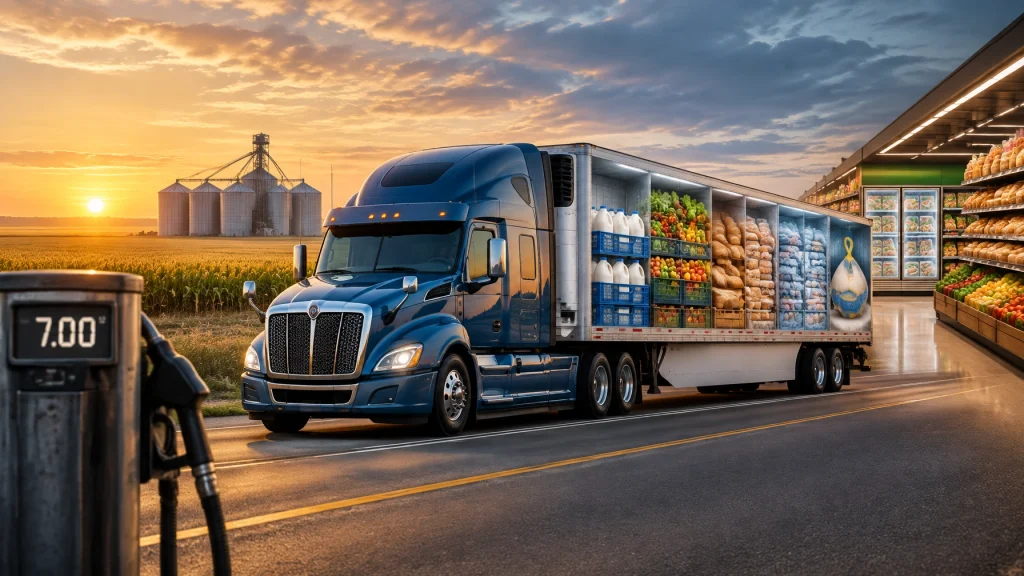
Seven-dollar diesel is no longer a hypothetical headline. It is already the price in parts of California, Washington and Hawaii. The national average is not yet $7: the Energy Information Administration’s September 28 reading was $6.382 per gallon, down slightly for the first time in twelve weeks after peaking near $6.53 in mid-September.
That distinction matters. The national average is in the mid-sixes, while some truckers are paying well above $7. The trajectory, however, is obvious enough: expensive diesel is spreading through the machinery that grows, processes, transports and refrigerates American food.
Gasoline averaged $4.465 per gallon for regular gasoline on September 28. Diesel is a different animal. It has risen from roughly $3.60 to $3.70 a year ago, nearly doubling, and the increase is arriving with a delay at the grocery store.
The calm grocery numbers from this summer are the rear-view mirror. Food at home was flat in August and up 2.2% year over year. The diesel spike is now in the pipeline behind those numbers. The October 14 CPI report is where some of that pipeline may begin appearing.
Diesel is not gasoline
Gasoline mostly moves passenger cars. People can sometimes postpone a trip, combine errands or drive less when the price rises.
Diesel powers the industrial skeleton of the country. Trucks, trains, barges, farm equipment, irrigation pumps, construction machinery and refrigerated trailers all depend on it. A trucking company cannot simply decide to skip fuel this week. The freight still has to move, and the milk still has to arrive cold.
Diesel is also a distillate. It comes from the same barrel as products such as jet fuel and heating oil. When the distillate market tightens, pressure spreads across several industries at once.
The current shortage is being worsened by Gulf diesel and gasoil exports falling to roughly one-quarter of pre-war levels since the conflict began in February. Refineries need extensive repairs, not merely security guarantees. Even a reopening of the Strait of Hormuz would not instantly refill empty storage tanks or restore damaged refining capacity.
That is why analysts expect elevated prices and tight supply to persist into 2027. The White House has broadened an emergency supply push, but energy infrastructure does not respond like a light switch. It responds like an old truck in January: eventually, but not on anyone’s preferred schedule.
How the fuel surcharge reaches the shelf
Truckers generally do not absorb the entire diesel increase. Freight contracts use fuel surcharges tied to weekly DOE/EIA diesel benchmarks. The line-haul rate may be fixed for 30 to 90 days, while the fuel component adjusts more quickly.
That creates a lag:
- Diesel rises.
- The carrier’s surcharge increases.
- The shipper pays more to move the product.
- The distributor and retailer absorb or pass along the cost.
- The shelf tag changes later.
Retailers also dislike repricing every day. They work through promotions, inventory cycles and contracts. So the grocery bill does not immediately reflect the fuel bill.
Refrigerated products take the hardest hit because a reefer trailer burns fuel not only to move down the highway, but also to keep the cargo cold. Frozen freight requires even more energy because the trailer is maintaining a much lower temperature.
That surcharge is a tax nobody voted for. It does not appear as “diesel tax” on the receipt. It simply appears as a higher price for milk, chicken, vegetables or ice cream.

The two-variable rule: value density and temperature
There is a simple way to understand which products are most exposed.
The first variable is value density: how much a truckload is worth relative to its weight and volume. A truckload of electronics can be worth millions. A truckload of bottled water is mostly water.
The second variable is temperature: whether the product needs a refrigerated or frozen cold chain.
The cheaper, heavier and colder the product, the more diesel is inside the price.
Research from Texas A&M’s Transportation Institute puts transportation at roughly 14% to 21% of retail milk prices, compared with approximately 3% to 7% for beef and 2% to 6% for bread. Diesel pass-through estimates run about 5% to 18% for milk, 6% to 18% for beef and 2% to 6% for bread.
Those are not promises about the exact price change at your local store. They are a map of exposure.
Ten foods that reveal the diesel problem
1. Milk
Milk is the worst case among the basics. A gallon weighs about 8.6 pounds, most of it water, and it must be collected, processed, transported and sold under refrigeration.
Milk is heavy, low in value density and cold from farm to refrigerator. Transportation can represent 14% to 21% of its retail price, and diesel pass-through can run 5% to 18%.
Milk is likely to move early and visibly when diesel costs rise. The product does not have much shelf life, and nobody delays buying it for three months because the price is inconvenient.
2. Eggs
Eggs are refrigerated, fragile and generally regional, but they still require frequent delivery. They cannot be stacked as aggressively as canned goods, and damaged pallets are not exactly a profitable logistics strategy.
A pallet of eggs is a low-value, high-cube, temperature-controlled load. That is three strikes against it before the truck leaves the warehouse.
3. Fresh chicken and ground beef
Fresh chicken and ground beef move through a cold chain with limited shelf life. Beef’s transportation share may be only 3% to 7% of the retail price, but diesel pass-through can reach 6% to 18% because refrigerated margins are thin.
Ground beef is particularly exposed because it is processed for quick sale. A steak can sit longer under controlled conditions. Ground beef has a shorter clock.
4. Leafy greens and salad
Leafy greens are the extreme case. Much of the nation’s lettuce and salad production comes from California and Arizona, then travels long distances in refrigerated trucks.
Romaine is mostly water, has a short shelf life and occupies valuable refrigerated space. A truckload of greens is worth far less than a truckload of electronics while burning similar fuel to cover the same distance.
Distance plus temperature plus low value density is the ugly combination.
5. Bananas
Bananas are imported, moved through ports and transported under controlled conditions to manage ripening. Diesel costs enter the price before the fruit clears customs.
They are relatively inexpensive by the pound, heavy in aggregate and dependent on a carefully timed distribution system. The banana does not understand geopolitics, but it does understand logistics.
6. Coffee
Coffee provides the useful counterexample. Green coffee beans are imported and still require roasting and domestic distribution, but coffee has high value density. A truckload is worth substantially more per pound than a truckload of milk or bottled water.
Coffee prices can still rise, but its inflation is more likely to be driven by commodity prices, currency movements and crop conditions than by the final domestic truck ride.
7. Soda and bottled beverages
This is the purest “shipping water” category in the store. Soda and bottled water are heavy, low value per pound and shipped continuously because people keep buying them.
Distributors have limited flexibility. The truck must move the product, and the product cannot be made lighter without removing the product. Beverage pricing is therefore highly sensitive to fuel surcharges.
8. Bread and baked goods
Bread is shelf stable and relatively light, so transportation is only about 2% to 6% of its retail price. Direct diesel pass-through should be smaller than for milk.
But bread has an inbound supply chain. Wheat moves to mills, flour moves to bakeries, and finished bread travels through daily delivery routes. Fuel also affects the farm machinery that plants and harvests the grain.
The loaf is not a diesel disaster, but it is not diesel-free.
9. Frozen foods, including ice cream
Frozen food may be the most fuel-intensive category in the store. Frozen trailers must hold a lower temperature than ordinary refrigerated trailers, and the cold chain cannot be broken without damaging the product.
Ice cream is the extreme. It is mostly air and water, sells at a moderate price and cannot thaw on the way to the freezer aisle. It is a cold, bulky product with limited tolerance for logistical mistakes.
10. Thanksgiving turkey
Thanksgiving turkey is seasonal, heavy and urgent. Birds are being harvested and distributed now for a holiday only about six weeks away. They are frozen or deep-chilled and shipped in a compressed window.
The freight locked in today helps determine the price seen in November. Holiday baking adds another layer: eggs, butter, milk and other dairy inputs must also reach stores during the same seasonal rush.
Turkey may not be the only item getting more expensive, but it is the item most likely to remind shoppers that a holiday meal is also a logistics project.

Farmers are squeezed from both ends
The farm side is the same basic story as the Nitrogen Noose. Farmers pay more for fertilizer, fuel, repairs, hauling and equipment. They sell commodities into markets where buyers largely set the price.
A manufacturer may add a surcharge to an invoice. A farmer usually cannot add a diesel line item to a global commodity price. The producer is a price taker on both ends: expensive inputs going in, uncertain prices coming out.
Diesel is not the only input. Food prices also reflect weather, labor, packaging, commodity markets and the dollar. August’s relatively calm grocery data deserves an honest mention. Diesel is a multiplier on those forces, not the entire story.
What can a regular guy do?
Do not panic-buy frozen food. It is not cheaper to store once it is sitting in a home freezer, and home freezers are not free to operate.
Instead:
- Watch the unit price, not just the sticker price.
- Buy some shelf-stable, high-value-density items when prices are reasonable.
- Shift toward products that are lighter, less temperature-sensitive and less dependent on long-haul refrigerated freight.
- Compare store brands, especially for beverages and packaged goods.
- Expect fresh perishables to show the shock before coffee, canned goods or other dense products.
- Remember that the truck, not necessarily the farmer, is driving this round of increases.
The central mental model is simple: heavy, cheap and cold means diesel is a larger part of the price. Light, valuable and shelf stable means the fuel share is smaller.
The national diesel average is $6.382, not $7. But seven-dollar diesel is already real in several states, and the national supply chain is paying attention. With storage tanks draining and refinery repairs taking time, elevated fuel costs may remain part of the grocery economy into 2027. Even a Hormuz deal would not repair the system overnight.
Be mindful, be watchful and good luck.
This article is for educational purposes only and is not investment advice. Readers should consult a qualified financial professional before making financial or investment decisions.