



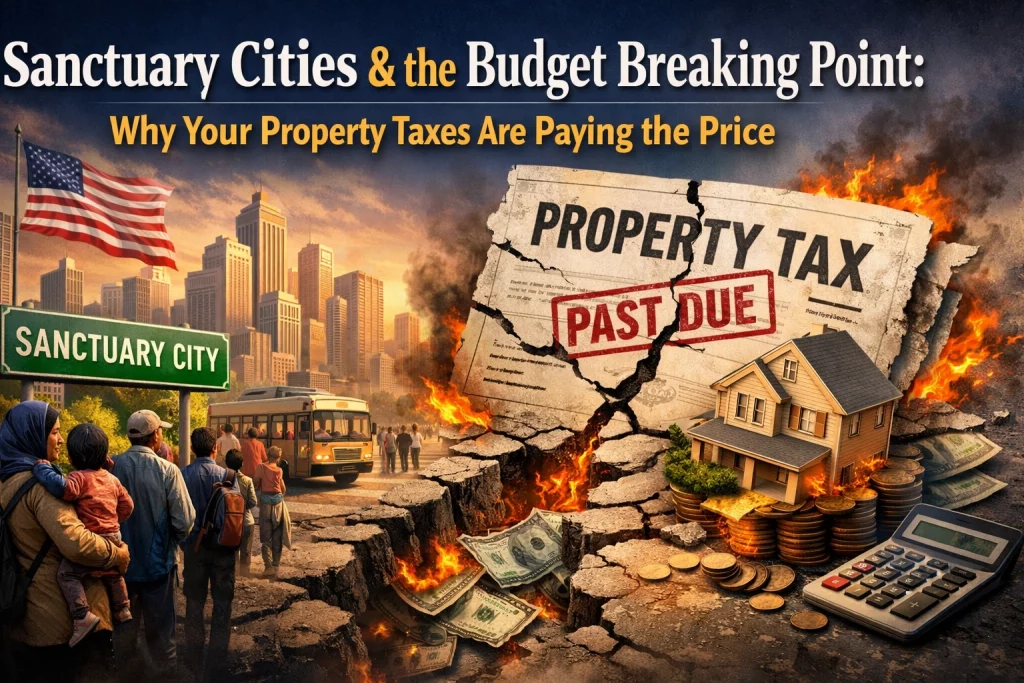
Let’s sit down and talk about your kitchen table for a second. Specifically, let’s talk about that blue or white envelope that shows up once or twice a year, the one from the county assessor. If you’ve opened yours lately, you probably didn’t celebrate. In fact, you might have checked to see if they accidentally added an extra zero to your property tax bill.
At Regular Guy Economics, we like to keep things simple. We don’t care about the political grandstanding or the 24-hour news cycle shouting matches. We care about the math. And right now, the math for state and local budgets is looking like a horror movie.
One of the biggest plot twists in this movie is the fiscal reality of "sanctuary city" policies. Whether you agree with the sentiment behind them or not, these policies have a price tag. And since local governments can’t print money like the folks in D.C., that price tag is being handed directly to you, the property owner.
The Math of the "Unfunded Mandate"
When a city declares itself a sanctuary, it’s making a policy choice. But in the world of economics, every choice has an opportunity cost and a direct cost. Over the last few years, we’ve seen a massive influx of individuals into major urban hubs, think New York, Chicago, Denver, and Los Angeles.
These cities provide "safety net" services: emergency housing, healthcare, legal aid, and schooling for children. Here’s the kicker: these are often "unfunded mandates." That’s a fancy way of saying the city decided to do something, but they didn’t have a pot of gold waiting to pay for it.

When a city like New York spends billions on hotel stays for migrants, that money isn't falling from the sky. It’s being diverted from other things, or it’s being added to the total amount of revenue the city needs to "extract" from its residents.
Why Federal Funding is a House of Cards
You might think, "Doesn’t the federal government help out with this?" Well, sometimes. But as we’ve seen in the headlines leading into 2026, federal funding is a fickle friend.
There is a constant tug-of-war between the feds and sanctuary jurisdictions. If the federal government decides to withhold grants for community development, law enforcement, or infrastructure because a city isn't cooperating with immigration enforcement, that creates a "budget hole."
Research shows that federal funds can make up more than a third of a state’s budget in places like California. If even a small percentage of that gets held up in court or slashed by an executive order, the local budget starts to bleed. When the city or state has a shortfall, they only have a few levers to pull:
- Cut services (unpopular).
- Raise sales tax (hits the poor hardest).
- Raise property taxes (the "reliable" old faithful).
The Property Tax "Easy Button"
Why do local politicians love property taxes? Because you can’t hide your house in an offshore bank account. If you own a piece of dirt and a structure on it, the government knows exactly where to find you.
Real estate taxes are the primary engine for local funding: schools, fire departments, and local roads. But as the "sanctuary" costs mount, those funds get stretched thin. To keep the schools running while also funding emergency shelters and expanded city services, the "millage rate" goes up. Or, even more sneakily, the "assessed value" of your home suddenly skyrockets even if you haven't painted a single wall.
For the regular guy, this is a double whammy. You’re already dealing with "The Office Vacancy Trap": where empty skyscrapers mean the city is losing commercial tax revenue. To make up for the empty offices and the rising costs of sanctuary policies, the city turns its eyes toward your suburban driveway.

The Ripple Effect: It’s Not Just Homeowners
If you’re a renter, don't think you’re off the hook. This isn't just a "rich homeowner" problem. When a landlord’s property tax bill jumps by $2,000 a year, they don't just eat that cost out of the goodness of their heart. They pass it on.
Your rent goes up because the "carrying cost" of the building went up. This contributes to the overall cost-of-living squeeze that’s making it harder for the average family to get ahead. It’s a cycle:
- Step 1: City adopts expensive social policies.
- Step 2: Federal funding gets caught in political gridlock.
- Step 3: The budget develops a multi-billion dollar "hole."
- Step 4: Property taxes are hiked to plug the hole.
- Step 5: Rents rise, and small business owners (who often pay property taxes as part of their commercial leases) have to raise prices.
A Perfect Storm of Expenses
We have to look at this in the context of everything else. As we’ve discussed before, we are living through an era of "Budget Breaking Points."
Infrastructure is crumbling after 35 years of "we'll fix it later." Medical costs are projected to hit 20% of the GDP. We are spending more on interest on our national debt than we are on our own defense. When you add the specific, localized costs of sanctuary city policies to this pile of debt, you get a situation where something has to give.
In 1960, the government didn't need to take such a massive bite out of your paycheck or your property value because the "overhead" of the country was lower. Today, the overhead is massive. Every new policy, no matter how well-intentioned, adds a layer of bureaucracy and expense.

The "Regular Guy" Reality Check
So, what does this mean for you? It means you need to stop looking at property taxes as a "neighborhood" issue and start looking at them as a "policy" issue.
When you hear about a $5 billion budget shortfall in a major city, you shouldn't just shrug it off. You should realize that $5 billion is a bill that will eventually be mailed to every property owner in the state.
We’ve seen states like Wisconsin and Minnesota recently seeing significant levy increases as they try to keep pace with rising costs. Whether it’s school funding, infrastructure, or the social services associated with sanctuary status, the "Regular Guy" is the one who ends up as the ultimate backstop for the government’s checkbook.
Breaking the Cycle
Is there a way out? It starts with transparency. We need to demand that local governments show the actual cost of these policies. Not the "vague" estimates, but the hard math.
We also need to look at how we classify expenses. Just as we need to reclassify medical costs as "health expenses" and focus on outcomes, we need to look at municipal budgets and ask: "Is this spend creating a healthier, more prosperous city, or is it just a Band-Aid on a broken system?"
If we keep using property taxes as an "ATM" to fund every new social experiment or emergency, we are going to reach a point where homeownership: the cornerstone of the American Dream: becomes a liability instead of an asset.
Final Thoughts
The trend is clear: state and local budgets are under more pressure than they’ve been in decades. The combination of declining commercial tax revenue (thanks to the work-from-home revolution) and rising costs from sanctuary policies is creating a "pincer movement" on your wallet.
The government is great at spending money; they just aren't very good at finding it. Unless, of course, they’re looking at your house.
Keep an eye on those assessment notices, and more importantly, keep an eye on the city council meetings where these "sanctuary" budgets are being drafted. The math has to work for everyone, not just the politicians looking for a good headline.
Be mindful, be watchful and good luck.