



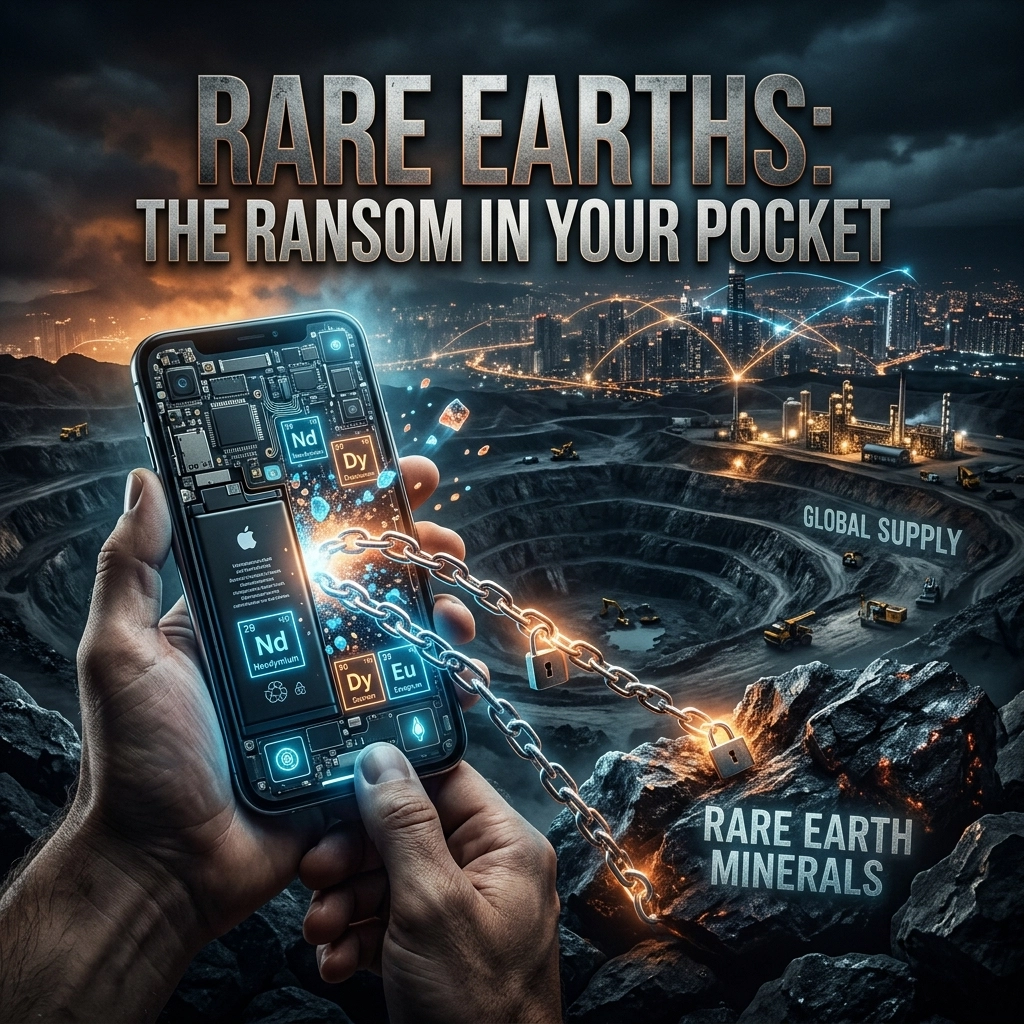
If you’re reading this on a smartphone, you are currently holding a tiny piece of geopolitical leverage in the palm of your hand.
I’m not talking about the software or the flashy camera. I’m talking about the stuff inside: the magnets, the screens, and the vibrating motors. Most of that tech is powered by a group of elements called "rare earths." And right now, those elements are effectively being held for ransom.
Today is Saturday, May 2, 2026. We are officially 192 days away from a date that could determine whether your next car costs $40,000 or $70,000, and whether your electric bill stays manageable or goes through the roof. That date is November 10, 2026.
That’s when the "Busan Truce": the fragile trade agreement between the Trump administration and Beijing: is set to expire. And if we don't get a renewal, the "permission slip" for our high-tech lifestyle might just get revoked.
The Monopoly You Didn’t Know You Were Paying For
Let’s get one thing straight: rare earth elements (REEs) aren’t actually that rare. They’re found all over the Earth’s crust. You could probably find some in your backyard if you dug deep enough and had a PhD in chemistry.
The "rare" part comes from the fact that they are rarely found in high enough concentrations to make mining them easy. But the real kicker: the part that should keep you up at night: isn't the mining. It's the processing.
Currently, China controls between 85% and 90% of the world’s rare earth processing.
Think about that for a second. Even if we dig the stuff out of the ground in Australia, Mountain Pass in California, or anywhere else, we almost always have to ship it to China to get it "cleaned" and turned into useable magnets or alloys.
It’s like having a world where everyone grows wheat, but only one guy owns the only mill on the planet. You can grow all the grain you want, but if that guy decides he doesn’t like you, you aren't eating bread.

Why Should the "Regular Guy" Care?
I know, I know. "Rare earths" sounds like something for scientists or hedge fund managers. But here is why it hits your wallet:
- Your Smartphone: Those tiny speakers and the haptic engine that makes your phone buzz? Rare earth magnets.
- Your AC Unit: Modern, energy-efficient air conditioners use permanent magnet motors to keep you cool without draining the power grid.
- Electric Vehicles (EVs): An EV uses about 10 times more rare earths than a gas-powered car. If the supply chain snaps, the "EV revolution" becomes an "EV hallucination."
- Wind Turbines: Those massive blades turning in the breeze? They’re packed with neodymium and dysprosium. No rare earths, no green energy.
Every time you turn on a light or check your texts, you are essentially using a product that requires a "permission slip" from Beijing.
The Ticking Clock: The Busan Truce
Back in 2024, after a series of escalating "chip wars" and export bans, the U.S. and China signed the Busan Truce. It was a classic "let’s agree to disagree so we don't collapse the global economy" deal. It kept the flow of processed rare earths moving into the U.S. in exchange for certain concessions on high-end semiconductors.
But that deal was written with an expiration date: November 10, 2026.
We are now less than 200 days away from that deadline. In the world of international trade, 200 days is a heartbeat. If the truce lapses without a replacement, we aren't just looking at a "trade war." We are looking at a "supply blackout."
What Happens to Prices if the Truce Lapses?
If November 10 rolls around and there's no new signature on the paper, the "Ransom" gets called in. Here is what that looks like for the regular guy:
The EV Price Hike
The magnets used in EV motors are the single biggest consumer of processed rare earths. If China throttles the supply: which they’ve done before (ask Japan about 2010): the cost of producing an EV motor could triple overnight. You could see a $5,000 to $10,000 "geopolitical surcharge" added to the sticker price of every new electric car.
The Home Appliance Ripple
It’s not just cars. High-efficiency washing machines, refrigerators, and HVAC systems rely on these materials to meet the energy standards we’ve all grown used to. If manufacturers can’t get the magnets, they have to go back to older, less efficient tech. That means your appliances get more expensive to buy and more expensive to run.
The Smartphone "Upgrade" Crisis
You think $1,200 for a phone is a lot now? Wait until the supply chain for the screen phosphors and tiny magnets gets squeezed. We could see the return of the "luxury smartphone," where only the top 1% can afford the latest tech, while the rest of us are nursing five-year-old handsets.

Why Can’t We Just Build Our Own Plants?
This is the question I get asked most. "John, if we know they have a monopoly, why don't we just build our own processing plants?"
The answer is the "Three E's": Expense, Environment, and Expertise.
- Expense: Building a rare earth processing facility costs billions. It’s not like opening a dry cleaner. You need massive infrastructure and specialized chemical baths.
- Environment: Processing rare earths is a dirty, nasty business. It involves a lot of acid and creates radioactive waste (thorium). In the West, getting the permits to handle that kind of waste takes a decade. In China, they just get it done.
- Expertise: China has been focusing on this since the 1980s. Deng Xiaoping famously said, "The Middle East has oil, China has rare earths." They have the scientists and the refined processes that the rest of the world is still trying to replicate in a lab.
We are trying. There are plants coming online in Texas and Utah, but they aren't ready to handle 90% of the world's demand yet. We’re in a race where the other guy started 40 years ago, and we just tied our shoes.
Scenario Planning: November 11, 2026
What does the day after the deadline look like? Let’s look at the three most likely paths:
Scenario A: The Quiet Renewal
Cooler heads prevail. The U.S. agrees to ease some tech restrictions, and China agrees to keep the rare earths flowing. Prices stay stable, but we remain 100% dependent on Beijing. We breathe a sigh of relief, but the ransom note is still in the drawer.
Scenario B: The Lapse (The "Wait and See")
The deadline passes without a deal, but neither side pulls the trigger immediately. Prices start to creep up on "uncertainty" alone. Speculators hoard magnets. You start seeing "temporary price adjustments" on your Amazon cart. It’s a slow-motion car crash.
Scenario C: The Escalation
China decides to use the "Nuclear Option." They announce an immediate ban on processed rare earth exports to any "unfriendly" nation. This is the nightmare scenario. We’d see a stock market heart attack, manufacturing lines freezing from Detroit to Silicon Valley, and a sudden, sharp spike in the cost of anything with a circuit board.

The Bottom Line
Rare earths are the invisible glue of the 21st century. We’ve spent the last 30 years building a high-tech world on a foundation that we don't actually own.
As we tick closer to November 10, the "ransom" in your pocket is going to become a lot more visible. Whether it's the price of a new laptop or the cost of cooling your home this summer, the geopolitical game being played over these 17 elements is going to define your cost of living for the next decade.
We’ve spent a long time ignoring the "made in" labels on the components inside our devices. But as the Busan Truce nears its end, those labels are about to become very, very expensive.
We need to stop thinking of these materials as "commodities" and start thinking of them as "national security." Because right now, our entire way of life is running on a permission slip that’s about to expire.
Be mindful, be watchful and good luck!