



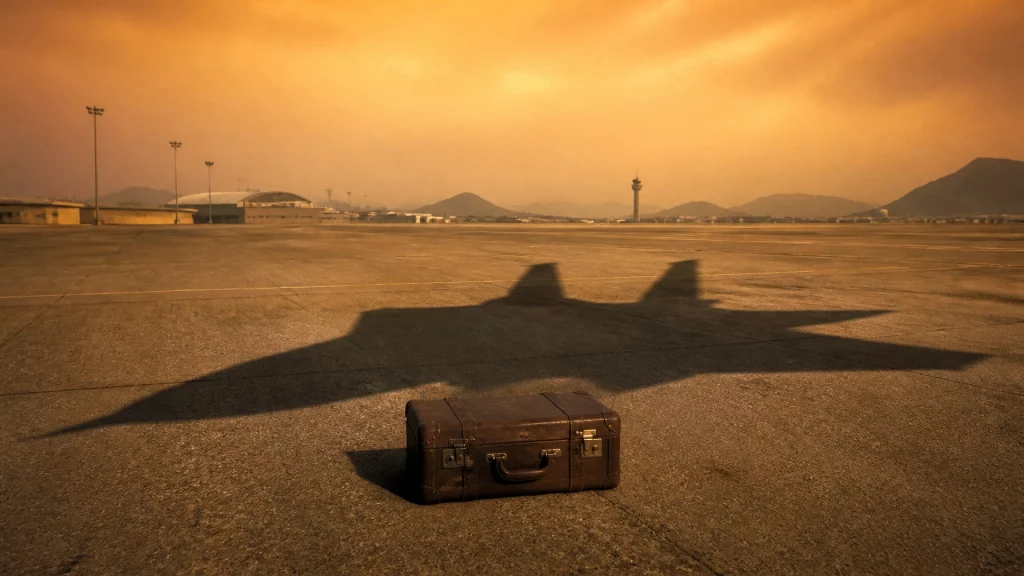
Well, friends, it’s officially late May, and usually, this is the time of year when we’re all arguing over who gets the window seat and whether we can really afford that third gelato in Rome. But here we are in 2026, and the "Regular Guy" is looking at his bank account, looking at the news, and then looking at a plastic inflatable pool in the backyard with a deep sense of resignation.
If you’ve checked flight prices in the last forty-eight hours, you probably thought there was a glitch in the app. A 26% jump in airfare doesn't just happen because people like traveling; it happens when the world’s gas tank catches fire. The "Summer of our Discontent" has arrived, and it’s brought a $5-a-gallon guest to the party.
Between the "Saturday Squeeze" we saw at the pumps earlier this month and the ongoing madness in the Middle East, your dream vacation didn't just get more expensive, it effectively got deleted. Let’s dive into the math of why your boarding pass now costs as much as a used Honda Civic.
The "War Premium" is the New Baggage Fee
For decades, we’ve enjoyed relatively cheap movement. You could hop a flight across the pond for a few hundred bucks if you timed it right. But that era was built on a house of cards called "stable energy."
Right now, the Strait of Hormuz, the world’s most important windpipe for oil, is feeling like a noose. With Iran and the current regional conflict tightening the grip on shipping lanes, crude oil hasn't just ticked up; it has exploded. We’re seeing oil prices sit comfortably (for the sellers, at least) above $100 a barrel, and jet fuel is following suit with a vengeance.
Airlines aren't charities. When it costs them 40% more to fill up the wings of a Boeing 787, they aren't going to eat that cost. They’re going to pass it directly to you, usually wrapped in a fancy name like a "fuel surcharge" or "seasonal adjustment." In reality, it's just a War Tax on your tan.

The Death of the Global Hub
For the last ten years, the smart way to travel was to fly through the "Mega Hubs", Dubai, Doha, or Abu Dhabi. They were the shiny, chrome-plated crossroads of the world. But in the Summer of '26, those crossroads have become "No-Fly Zones."
With thousands of flights canceled across the Gulf due to security threats and missile activity, the global air network has been snapped like a dry twig. Planes that used to take the direct route from Europe to Asia are now taking the long way around, adding three or four hours of flight time. More time in the air means more fuel burned, and more fuel burned means, you guessed it, more money out of your pocket.
We’ve seen reports of last-minute tickets from London to Sydney hitting nearly $20,000. That’s not a typo. That’s the price of "I need to get home and there are no seats left." It’s a supply-and-demand curve that has gone vertical. You can read more about how these resource crunches affect everything from food to tech over at our Farms vs Servers breakdown.
Enter: Plan B (The Staycation)
So, if the flight to Greece is off the table, what’s a Regular Guy to do? Enter "Plan B." We are seeing a massive pivot toward domestic travel and "staycations."

The trend for Summer '26 is "Hyper-Local." People are swapping the Mediterranean for the Great Lakes and the Alps for the Appalachians. Domestic rail is seeing a surge in bookings as people realize that a train ticket, while not exactly fast, doesn't require five gallons of jet fuel per minute to stay aloft.
But even Plan B has its own set of economic hurdles. If you decide to load up the SUV and drive to the coast, you’re hitting the "$5 Gallon" wall. National gas prices are kissing $4.80 and showing no signs of slowing down. It’s a pincer movement on your wallet: you can’t fly because it’s too expensive, and you can’t drive because… well, it’s also too expensive.
The BBQ Tax and the Saturday Squeeze
Let’s talk about the backyard. Surely, a nice BBQ is the ultimate budget-friendly move, right? Not so fast.
As I mentioned in my last update, the "War Premium" doesn't just hit the gas tank; it hits the grill. Beef is up 20%. Brats and sausages are up nearly 30%. Why? Because fertilizer is an energy-intensive product. When oil spikes, fertilizer spikes. When fertilizer spikes, corn (feed) spikes. When feed spikes, your burger gets a surcharge.
It’s what we call the "Saturday Squeeze." You go to the grocery store on a Saturday morning, see the price of a pack of steaks, and suddenly that dream of a neighborhood cookout starts to look like a black-tie gala event. Everything is connected. You can’t move a cow, a car, or a plane without burning something, and right now, the stuff we burn is being priced like liquid gold.

How to Navigate the Madness
As much as I’d love to tell you there’s a secret hack to get $200 flights to Paris right now, I’d be lying. And at Regular Guy Economics, we don't do that. We tell it like it is.
If you absolutely must travel this summer, here is the Regular Guy’s guide to survival:
- Book Yesterday: If you see a price that doesn't make you faint, take it. The volatility in the Middle East means a price could double overnight based on one single headline.
- Avoid the Hubs: Don't even look at routes through the Gulf right now. Stick to "safe" corridors, even if they have a layover in a boring city.
- Check the Refund Policy: With the new 2024/2025 DOT rules, you’re entitled to cash refunds for major delays. Use that to your advantage. Don't accept a voucher that might be worthless if the airline goes bust.
- Embrace the "Pivot": Maybe 2026 isn't the year for the "Bucket List" trip. Maybe it’s the year to finally see that state park three hours away.

The Bottom Line
Economics is often just the study of how people react to bad news. The bad news is that geopolitical instability has rewritten the rules of summer. We are moving back to a world where international travel is a luxury, not a given.
It’s frustrating. We work hard, we save up, and then some guy in a uniform halfway across the world decides to close a shipping lane, and suddenly our "Relaxing July" is replaced by "Stressful June." But understanding the why is the first step to not letting it drive you crazy.
We are living through a period where all dollars are effectively debt, and that debt is being called in by the reality of energy costs. The "War Premium" is a bill we all have to pay, whether we like it or not.
So, if you see me in my backyard this July, sitting in a plastic pool with a luke-warm domestic beer, know that I’m not sad. I’m just being an economist. I'm avoiding the 26% hike and the $5 gas. I'm taking the "Plan B" and waiting for the madness to subside.
Be mindful, be watchful and good luck.