



I’ve been watching the American economic engine for over forty years, and if there is one thing I’ve learned, it’s that there is no such thing as a free lunch. Every time a politician or a high-priced consultant tells you they’ve found a "win-win" scenario that defies the basic laws of math, you should probably check your pockets.
Back in the early 90s, we were sold a dream called NAFTA (the North American Free Trade Agreement). The pitch was simple, shiny, and ultimately devastating: if we lowered the barriers and let the "free market" do its thing, we’d all get rich. We’d trade our dusty, loud, "old-fashioned" factories for a high-tech, service-oriented utopia. We’d get cheaper goods at the store, and Mexico would get a boost.
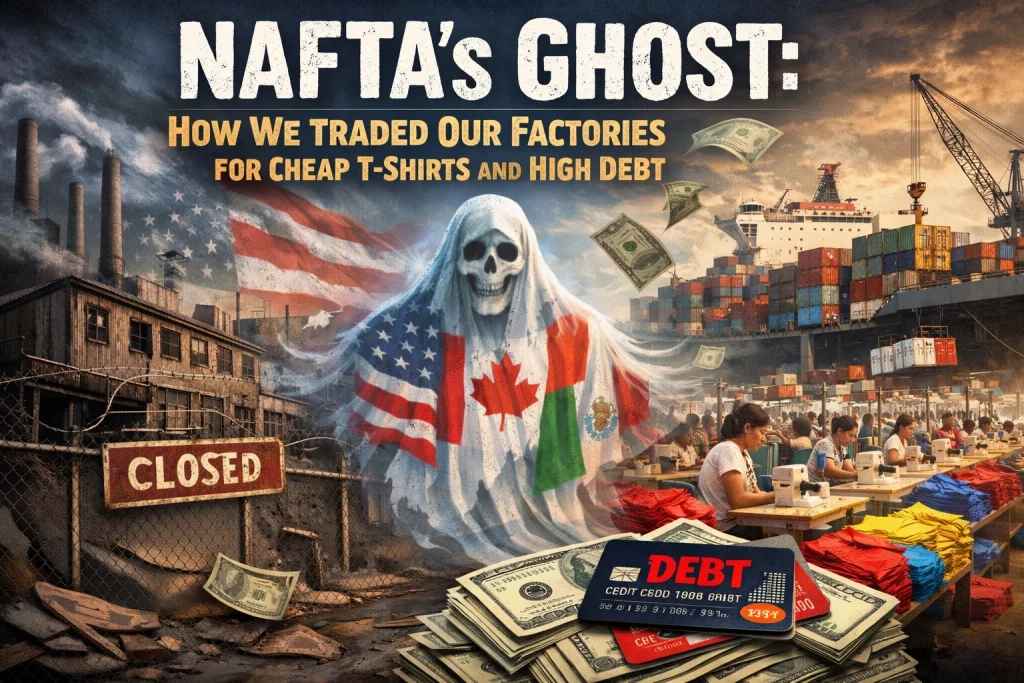
It sounded like a tidy trade. But thirty years later, looking at the hollowed-out skeletons of manufacturing towns across the Midwest and the skyrocketing balance on the average American’s credit card, it’s clear we didn't just trade goods. We traded our stability for a handful of "Made in Anywhere But Here" t-shirts and a mountain of debt we can’t climb over.
The Great Disappearing Act
Let’s look at the math, because the math doesn't care about campaign slogans. Between 1994 and 2010, the U.S. manufacturing sector went through a meat grinder. We went from about 17.2 million manufacturing jobs down to 11.4 million. That is nearly six million paychecks, good, solid, "buy a house and put your kids through school" paychecks, that simply evaporated.
Now, the experts will tell you that manufacturing output actually went up during that time. They’ll point to robots and "productivity gains." And sure, automation played a part. But you can’t tell me that moving the production of everything from auto parts to electronics across the border didn't leave a massive hole in the American middle class.
When a factory closes in a small town, it isn't just the 500 people on the assembly line who lose out. It’s the local diner, the hardware store, the schools, and the spirit of the community. We traded the "multiplier effect" of a factory, where one job creates five others in the community, for the "subtraction effect" of a big-box store where the profits are funneled back to a corporate headquarters 2,000 miles away.

The $5 T-Shirt Trap
The seductive part of the deal was the price tag. Who doesn't want a cheaper t-shirt? Who doesn't want a flat-screen TV that costs less than a week’s worth of groceries? We were told that the "consumer surplus", the money we saved by buying cheap imports, would more than make up for the lost wages.
But here is the "Regular Guy" reality: You can’t buy a $5 t-shirt if you don't have a $30-an-hour job.
When we offshored our manufacturing base, we traded high-productivity, high-wage labor for low-productivity, low-wage service work. We replaced the guy making steel with a guy delivering sandwiches or folding those cheap t-shirts at the mall. The math doesn't work. The gap between what we used to earn and what we earn now is a chasm that has swallowed the American Dream whole.
We got the "low prices," but we lost the income to pay for them. So, how did the average family keep the lights on and the fridge full while their real wages were flatlining for decades?
The Credit Card Patch
This is the part of the story that rarely gets told in the history books. To bridge the gap between our shrinking paychecks and our desire to maintain a middle-class lifestyle, we turned to plastic.
Since the mid-90s, household debt has exploded. We’ve used credit cards, home equity lines, and student loans to paper over the fact that our economy stopped producing real value for the people at the bottom and middle. We didn't get richer; we just got better at borrowing.
Think of it like this: If you lose a high-paying job and take one that pays half as much, you have two choices. You can sell your house and live in a tent, or you can start swiping the Visa. For thirty years, America chose the Visa. We "maintained" our standard of living by borrowing from our future selves.

We traded the security of a manufacturing paycheck for the "convenience" of a revolving credit line. And because that debt comes with interest, interest that goes straight to the big banks, the "cheap" goods we bought from overseas ended up being the most expensive things we ever owned. That $5 t-shirt, when paid off over three years at 22% interest, isn't a bargain. It’s an anchor.
The Hollowing Out of Middle America
If you drive through the heart of this country, you see the "ghosts" of this trade-off everywhere. You see the empty plants with broken windows and the Main Streets where the only things thriving are dollar stores and payday lenders.
This is the "hollowing out" of America. When you remove the productive engine of a society, the part that actually makes things, you're left with a shell. We became a nation of consumers instead of creators. We became dependent on global supply chains that are as fragile as a house of cards, all so we could save a few pennies on a toaster.
The social cost has been even higher than the economic one. The dignity that comes with skilled labor, the apprenticeship programs that gave young people a path, and the stability of a 30-year career at the local plant, all of that was traded away. In its place, we got the "gig economy," where you’re your own boss until the algorithm decides you’re not.
The Forty-Year Perspective
Having watched this play out since the 1980s, I can tell you that this wasn't an accident. It was a choice. It was a choice to prioritize "efficiency" and "shareholder value" over people and communities.
We were told that "a rising tide lifts all boats." But as it turns out, if your boat is anchored to a factory that just moved to another country, the rising tide just drowns you. The "new economy" promised us tech jobs for everyone, but the reality is that not everyone is going to be a software engineer in Silicon Valley. Most people just want to show up, do a hard day’s work for a fair day’s pay, and know that their job will be there tomorrow.

We are now living in the aftermath of that 30-year experiment. We are seeing a resurgence of interest in "onshoring" and "buying American," but it’s hard to rebuild a house once you’ve sold all the tools and the lumber. The skills are gone, the infrastructure is rusted, and the capital has moved on to the next "emerging market."
Was It Worth It?
If you ask the people in the boardroom if NAFTA was a success, they’ll show you a spreadsheet of record profits and tell you "yes." But if you ask the regular guy in Ohio, Michigan, or Pennsylvania, you’ll get a very different answer.
We traded our factories for cheap t-shirts and high debt. We traded our independence for a fragile global system. We traded the future of our children for the convenience of the present.
The math is finally catching up to us. You can’t run an economy on debt and consumption forever. Eventually, someone has to make something. Eventually, the bill comes due. We are currently standing at the counter, and we’re realizing we don’t have enough in the account to cover the cost of those "cheap" imports.
It’s time to stop chasing the ghost of "efficiency" and start looking at the reality of our neighbors. We need to stop pretending that a retail job is the same as a manufacturing job. We need to realize that the most expensive thing you can buy is something that costs you your livelihood.
Be mindful, be watchful and good luck.