



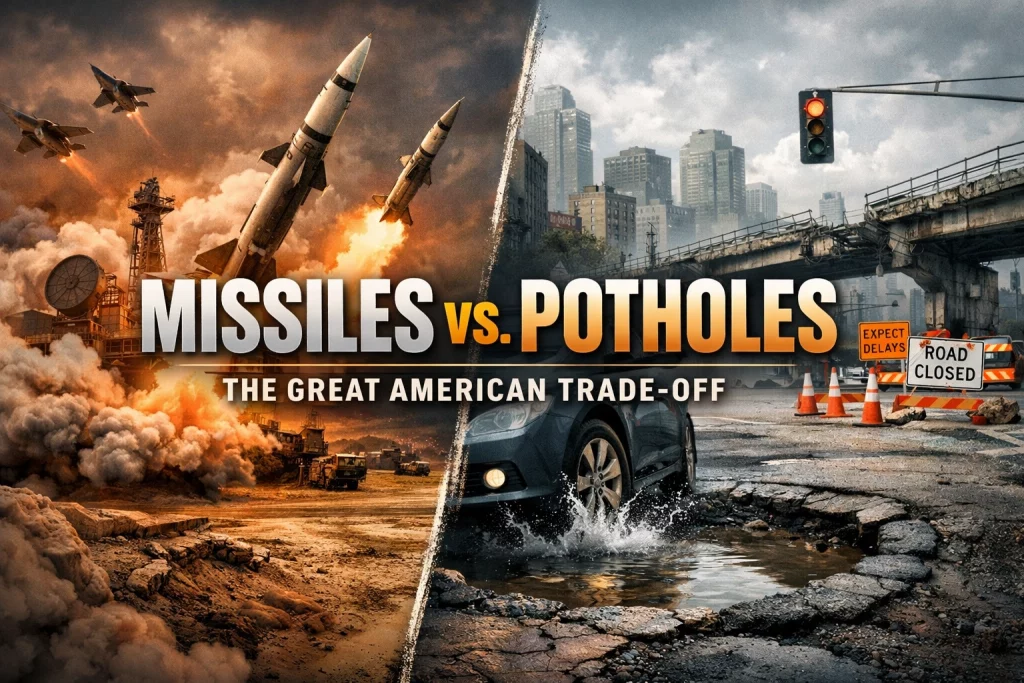
You know the feeling. You’re sipping your lukewarm gas station coffee, trying to navigate the 7:45 AM crawl, and then it happens. Thump. Your front-left tire finds that one crater on Elm Street that the city has "scheduled for repair" since the Obama administration. Your coffee is now on your lap, your alignment is officially a memory, and you’re looking at a $400 repair bill you didn’t budget for.
Then you get home, turn on the news, and hear that the U.S. defense budget is officially crossing the $1 trillion mark for 2026.
It’s the classic "Guns vs. Butter" debate, but for the modern Regular Guy, it feels more like "Missiles vs. Potholes." We are currently living in a country that can put a kinetic kill vehicle through a window from three miles away, but we can’t seem to keep the asphalt smooth on the way to the grocery store.
As we look at these numbers, it’s worth asking: where is the ROI for the guy behind the wheel?
The Price of a Bang
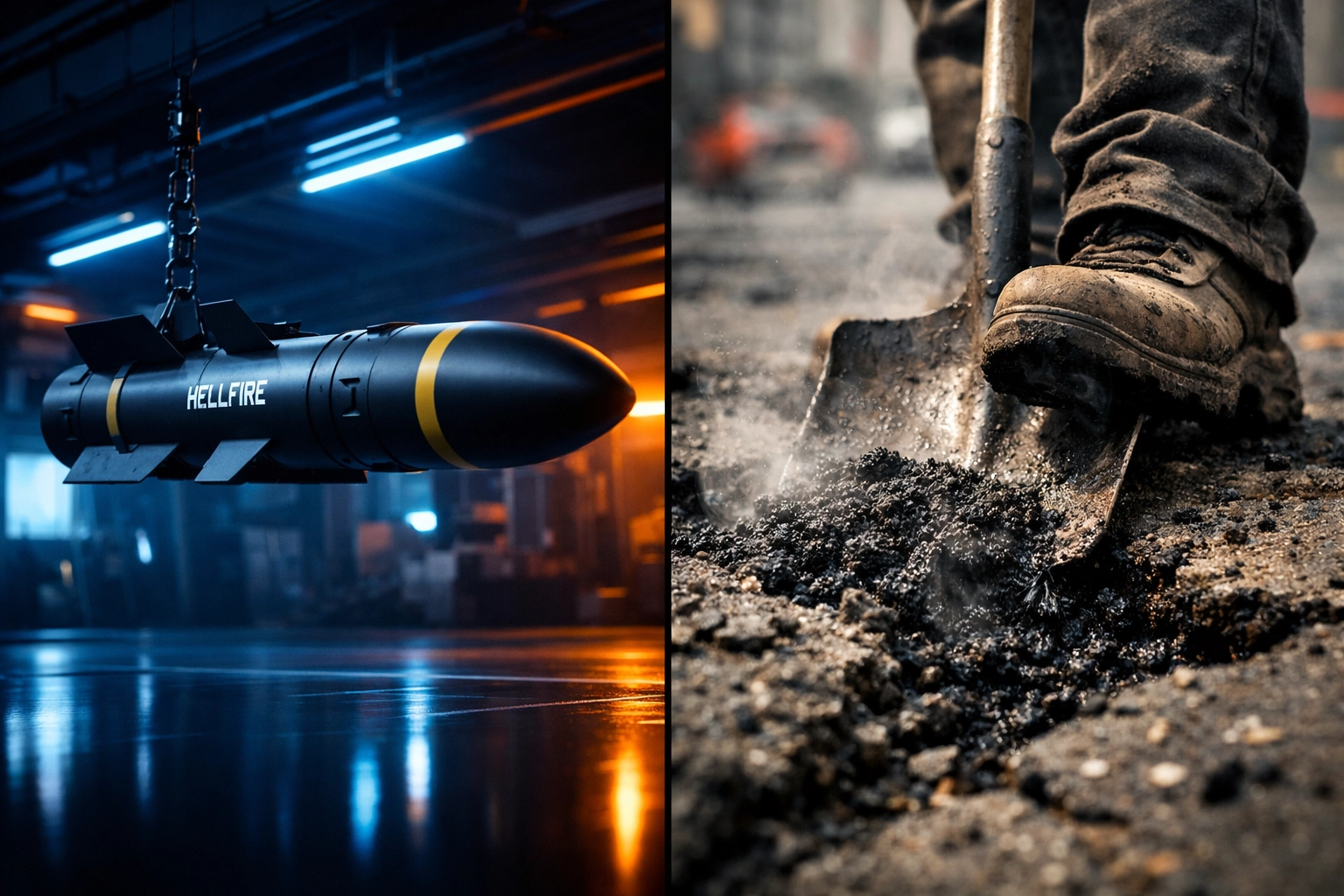
Let’s talk turkey: or rather, let’s talk Hellfire missiles. A single AGM-114 Hellfire missile costs roughly $150,000. To a D.C. politician, that’s a rounding error. To you and me, that’s a house in a decent suburb or a fleet of new trucks for a small business.
But let’s look at it through the lens of infrastructure. The average cost to fix a pothole: properly, not just throwing some loose gravel in it and hoping for the best: ranges from $50 to $150 depending on the city and the labor costs.
Do the math. For the price of one single "boom" in a desert halfway across the world, we could fix between 1,000 and 3,000 potholes. Imagine your entire commute, from your driveway to your office parking lot, being glass-smooth. That’s the trade-off. Every time you see a grainy video of a precision strike, think of 3,000 jolts to your suspension that didn’t have to happen.
It gets crazier when you scale up. Take the F-35 Lightning II. It’s a marvel of engineering, a stealth fighter that can basically see through its own floor. It also costs about $100 million per unit. For the price of just one of those jets, we could pave hundreds of miles of high-speed highway or finally fix that crumbling bridge in the center of town that’s been restricted to "light vehicles only" for the last five years.
Why Potholes Don’t Have Lobbyists
You might be wondering: "If everyone hates potholes and everyone loves smooth roads, why do we keep voting for the missiles?"
It’s a fair question. The answer, as it usually is in economics, comes down to who is selling the product.
Defense spending is "sexy" to Washington. It’s high-tech, it’s patriotic, and it comes with massive, well-funded lobbying groups. Lockheed Martin, Raytheon, and Boeing don’t just build hardware; they build political influence. They have offices within walking distance of the Capitol. They employ thousands of people in key congressional districts. When a new missile program gets funded, it’s framed as "national security" and "job creation."
Potholes, on the other hand, are boring. Nobody gets a bronze statue for overseeing a successful drainage pipe replacement. There is no "Big Asphalt" lobbyist taking senators out to steak dinners to discuss the strategic importance of the 4th Street overpass. Infrastructure is a "maintenance" item, and in the world of politics, maintenance is the first thing to get cut when the budget gets tight.
It’s a lot like car insurance or medical care. We’ve seen this trend in other industries: like the runaway costs in the medical world where we spend 20% of our GDP but aren't getting healthier. We’re over-investing in the "catastrophic" (war, specialty surgery) and under-investing in the "preventative" (roads, basic health).
The "C-" Grade Nation
Currently, the American Society of Civil Engineers regularly gives U.S. infrastructure a grade of 'D+' or 'C-'. Our roads are crowded and aging, our bridges are structurally suspect, and our water systems are leaking trillions of gallons a year.
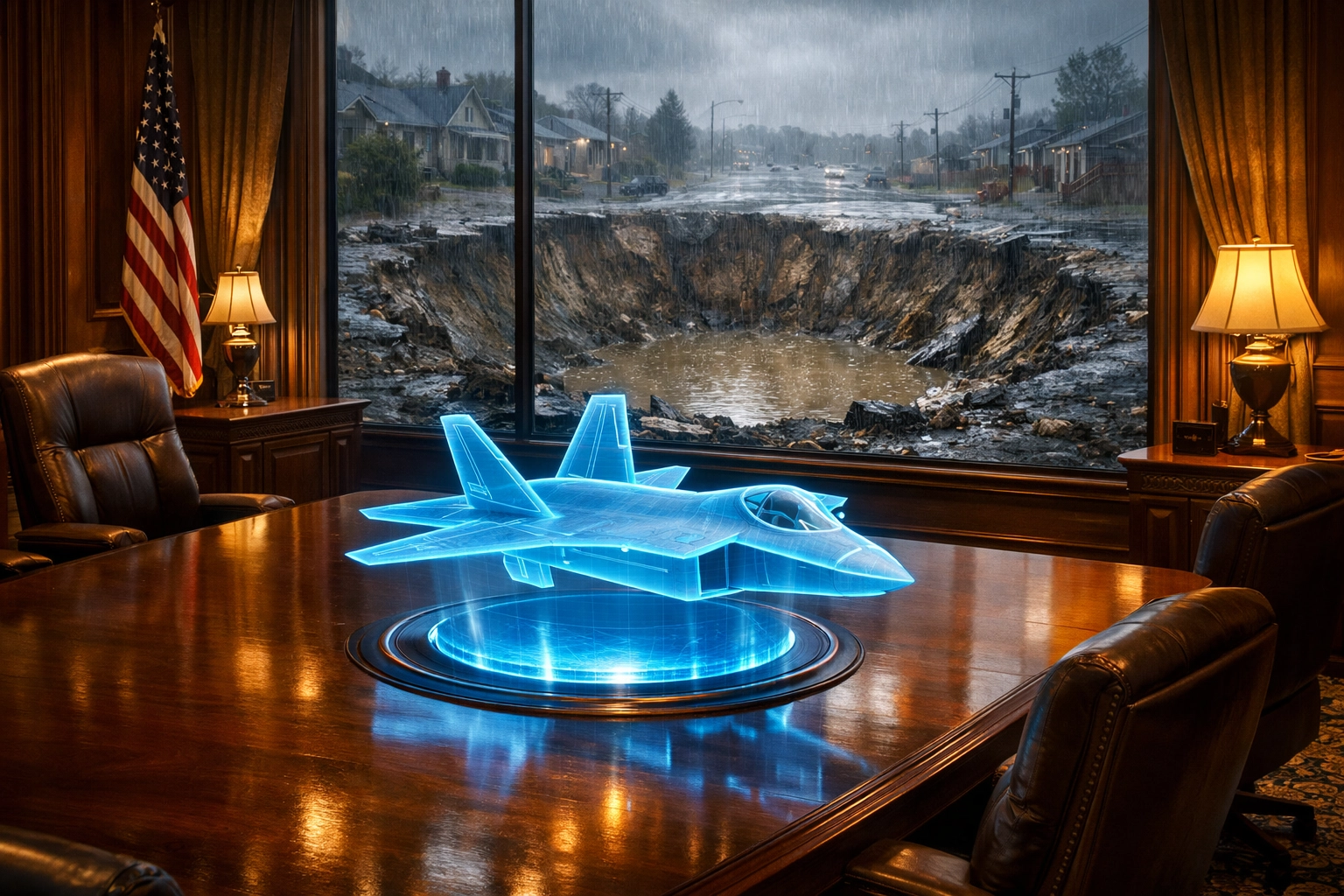
Meanwhile, our defense spending is more than the next nine nations combined. We are essentially the guy who lives in a house with a leaking roof and a cracked foundation, but has a state-of-the-art home theater and a literal tank parked in the driveway. It looks cool from the street, but it’s a miserable place to live when it starts raining.
Research shows that only about one in ten voters actually supports increasing defense spending. Yet, the budget continues to climb. Why? Because the Military-Industrial Complex has become a "runaway train," much like the medical industry. It’s become a part of our version of capitalism where profit incentives and "national pride" have outpaced common sense.
The ROI of a Smooth Ride
Let’s look at the Return on Investment (ROI).
When we spend $1 billion on defense, we get a more powerful military. That’s great for global stability, sure. But when we spend $1 billion on infrastructure, the economic "multiplier effect" is massive.
- Lower Car Expenses: The average American spends hundreds of dollars a year on repairs caused by bad roads. That’s a "hidden tax" that goes straight into the pocket of your local mechanic instead of your savings account.
- Supply Chain Speed: Everything you buy: from eggs to iPhones: gets to you via a truck. If those trucks are sitting in traffic or taking detours around broken bridges, the price of your groceries goes up.
- Job Reliability: If the train is always late or the road is always closed, the economy slows down.

Just like the "health expense" philosophy we’ve talked about before: where spending $100 on a gym membership saves $10,000 in heart surgery: spending a few million on road maintenance saves billions in economic friction later. We need to start looking at our tax dollars not as "spending," but as an investment in our own daily lives.
Security vs. Comfort?
The argument always comes back to: "But John, we need the missiles to be safe!"
Nobody is saying we should have a zero-dollar defense budget. We live in a complicated world. But there is a point of diminishing returns. Is the 1,001st missile making us twice as safe as the 1,000th? Probably not. Would fixing 3,000 potholes make your life twice as good tomorrow morning? Almost certainly.
We have a "maintenance crisis" in this country. We love the new, the shiny, and the explosive. We hate the old, the grimy, and the functional. But the backbone of a great nation isn't just its ability to project power abroad; it's the ability of its citizens to get to work without losing a hubcap.

It’s high time we reclassify "infrastructure" as a national security priority. Because if we can’t move goods, people, and services across our own country without hitting a three-foot-deep crater, it doesn't really matter how many F-35s we have sitting on a tarmac.
We need to invest in the things that lengthen our lives and create quality outcomes for the "Regular Guy." It’s the last frontier of common-sense economics. Let’s trade a few "booms" for a few "smooths." Your tires: and your coffee: will thank you.
Be mindful, be watchful and good luck.