



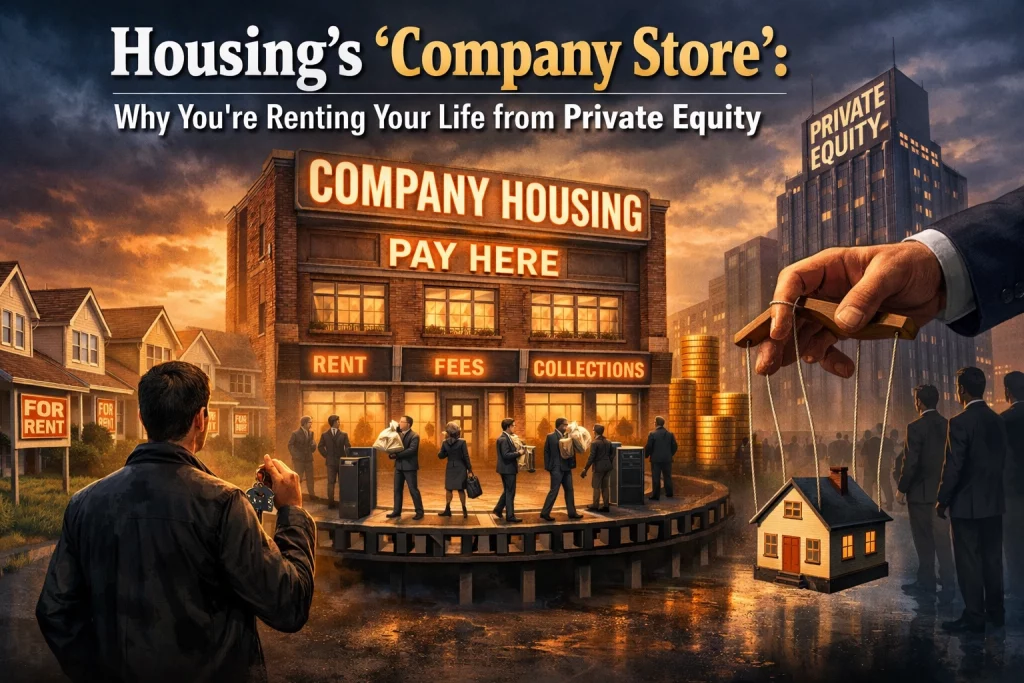
You’ve heard the old Tennessee Ernie Ford song, "Sixteen Tons," right? There’s a line in there that every working person in the early 20th century knew by heart: "You load sixteen tons, what do you get? Another day older and deeper in debt. St. Peter don't you call me 'cause I can't go… I owe my soul to the company store."
Back then, the "Company Store" was a literal building owned by the coal mine or the textile mill. They paid you in "scrip", fake money that was only good at their store, and charged you double for eggs and flour. By the time you finished your shift, you hadn't earned a dime of real wealth; you’d just cycled your labor back into the owner’s pockets.
Fast forward to 2026. We like to think we’re way smarter than those guys in the flat caps and soot-covered faces. We have iPhones, high-speed internet, and 401(k)s. But if you look at the math of the American neighborhood over the last decade, you’ll realize we haven't escaped the Company Store. We just gave it a makeover and a Manhattan zip code.
Today’s "scrip" is your paycheck, and the "Company Store" is the single-family home you’re renting from a private equity firm.
The Great Neighborhood Heist
For forty years, I’ve watched how capital moves. In the 80s, we saw the "Barbarians at the Gate", the Leveraged Buyout (LBO) kings who would swoop in, buy a company like RJR Nabisco or raid Disney, load it with debt, strip the assets, and walk away with the gold while the workers wondered where their pensions went.
But a few years ago, these same private equity giants realized they had run out of companies to strip. They needed a new asset class. They looked at the map of America and saw something better than a factory: your neighborhood.
It started in the wake of the 2008 financial crisis. While regular guys were losing their shirts and their homes to foreclosure, the big banks and government-sponsored entities like Fannie Mae and Freddie Mac were holding a "fire sale." But they didn't hold that sale for you. They didn't make it easy for a young family to buy a foreclosed starter home for $80,000. Instead, they bundled those homes into giant portfolios and sold them to Wall Street for pennies on the dollar.

That was the "Clearance Sale" that birthed the modern corporate landlord. Private equity firms took that cheap debt, bought up hundreds of thousands of homes, and turned them into "Single-Family Rentals" (SFRs). They didn't just buy a house; they bought the future equity of the American middle class.
By the Numbers: Why You Can't Compete
Let’s look at the math, because the math never lies. Since 2020, single-family home prices have skyrocketed by 47.1%. If you’re a regular guy trying to save for a down payment, you’re trying to hit a moving target that’s tied to a rocket ship.
But why is the target moving so fast? Because you’re not bidding against another family. You’re bidding against an algorithm.
Institutional investors now own more than 500,000 homes across the U.S. In some cities, they’ve cornered the market. In Atlanta, investors own roughly 25% of the single-family rentals. In Jacksonville, it’s 21%. In Charlotte, it’s 18%.
When a "starter home" hits the market in these areas, a private equity firm sees it instantly. They don't need a mortgage contingency. They don't need an inspection to be perfect. They come in with a cash offer, often 10% or 20% over asking price, and they close in days. For them, paying an extra $30,000 is a rounding error. For you, it’s five more years of saving.

Once they own the block, they do what every LBO artist does: they "optimize." In the corporate world, that means cutting staff. In the housing world, that means aggressive rent hikes and predatory property management. Rental costs for single-family homes have jumped 30% in just a few years. They aren't raising rent because their costs went up; they’re raising rent because they can. They’ve removed the competition.
The Return of the Company Store
This is where the "Company Store" analogy gets scary. In the old days, the goal of the American Dream was ownership. Why? Because ownership is the only way a regular guy builds "forced savings." Every mortgage payment you make is a little bit of wealth staying in your pocket (eventually).
When private equity turns a neighborhood into a rental colony, they are effectively "colonizing" your lifetime earnings.
Think about it:
- You work 40–60 hours a week for a corporation.
- You get paid in USD.
- 40% to 50% of that paycheck goes immediately back to a different corporation (the landlord) to cover rent.
- Because rent is so high, you can’t save enough to buy a house.
- Because you can't buy a house, you stay a permanent renter.
The cycle is closed. Your labor is being recycled directly into the hands of the people who own the assets. You are "renting your life" from the very entities that are pricing you out of owning it. By 2030, it’s projected that institutional investors will control 40% of the single-family rental market.
If we hit that number, the "American Dream" isn't just on life support, it’s been sold for parts.
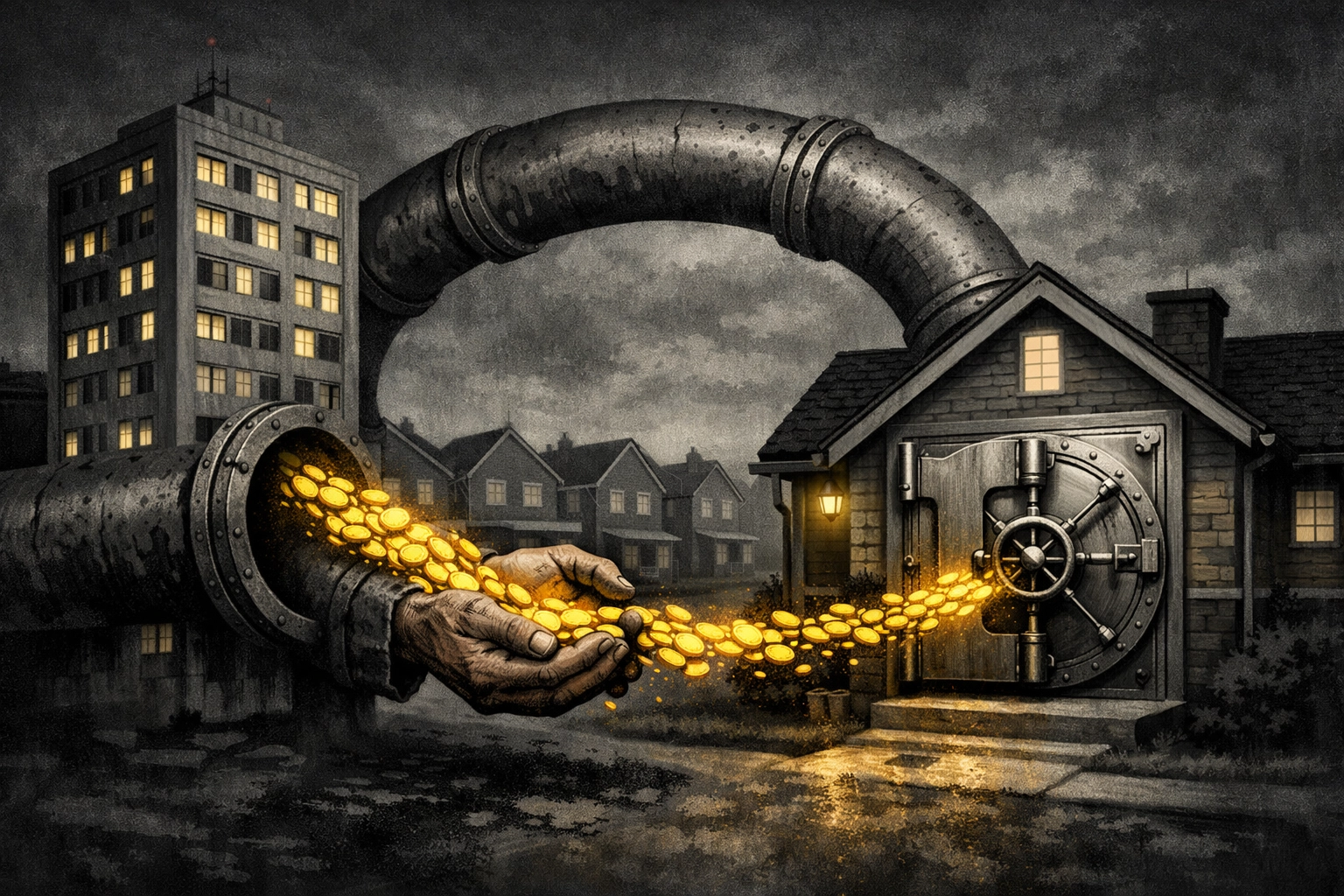
The "Asset-Stripping" of the Suburbs
When I talked about the Disney raid in previous posts, I mentioned how LBO firms strip a company of its value to pay back the debt they used to buy it. Private equity is doing the exact same thing to our suburbs.
A neighborhood used to be a collection of stakeholders. People who owned their homes cared if the school was good, if the grass was cut, and if the neighbor’s kid was doing okay. They had "skin in the game."
A corporate landlord doesn't have skin in the game; they have an Excel spreadsheet. Research shows that neighborhoods with high investor ownership see a 30% spike in eviction probability. Why? Because a human landlord might give you a week’s grace if your car breaks down. An algorithm doesn't care. The algorithm sees a late payment and triggers an eviction notice because the faster they can churn a tenant, the faster they can raise the rent for the next person.
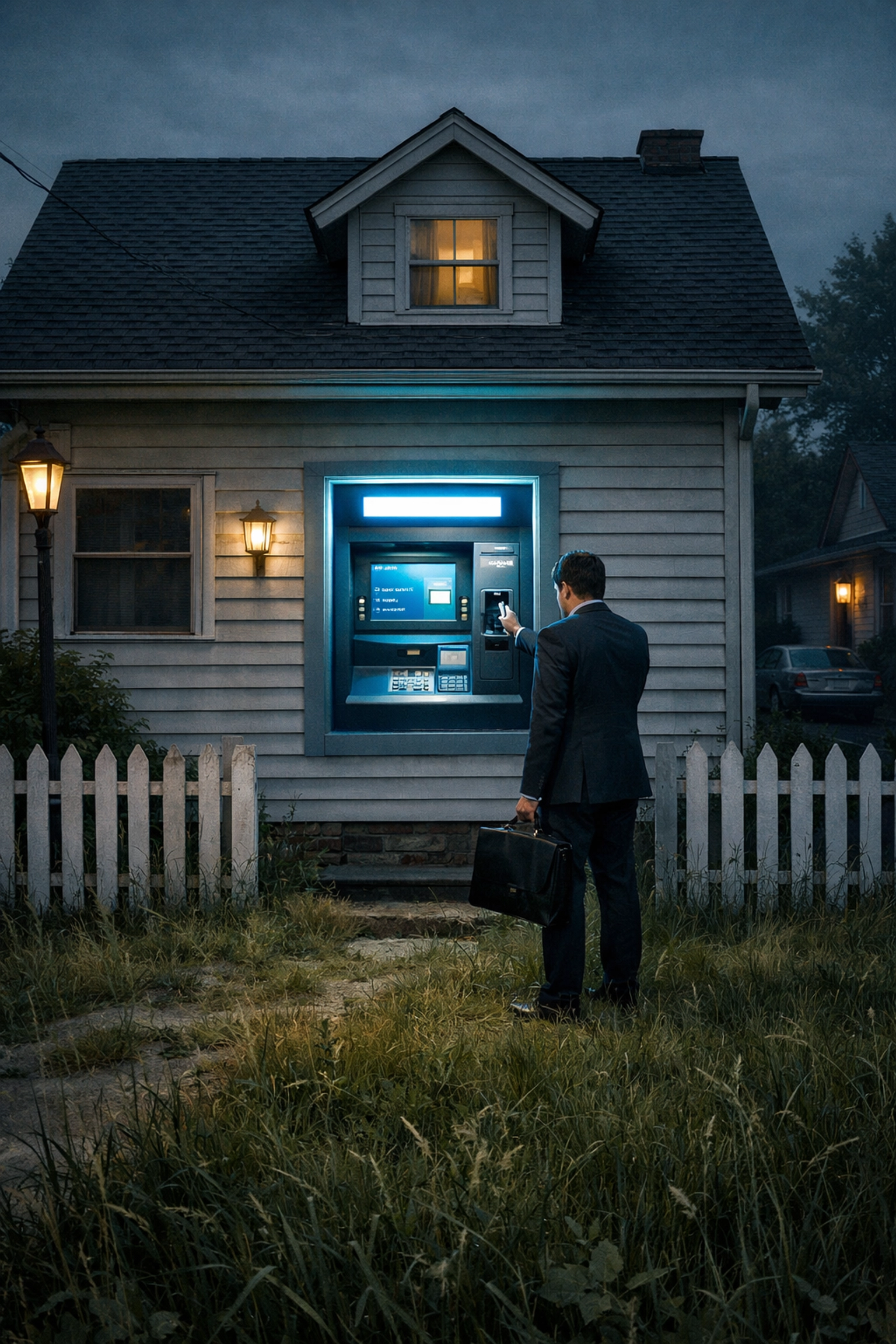
This is the "LBO of the American Neighborhood." They are stripping the social capital, the stability and the community, and replacing it with "yield." They are turning our streets into a giant ATM for their shareholders.
Can We Break the Scrip?
The regular guy is getting squeezed from both ends. On one side, inflation is eating his grocery budget. On the other side, private equity is eating his housing future.
Historically, we’ve had some protections. The Hart-Scott-Rodino Act was supposed to keep giant companies from gobbling up entire industries without anyone noticing. But there’s a massive loophole for residential real estate. These firms have been able to accumulate thousands of homes under a web of shell companies, escaping the kind of antitrust scrutiny that would hit them if they tried to do this with, say, the airline industry.
If we want to stop the return of the Company Store, we have to call it what it is: a monopoly on the most basic human need.

We need to stop incentivizing Wall Street to buy up the house next door. We need to close the regulatory gaps that let them outbid families with "cheap debt" that the regular guy can’t access. Because right now, we are heading toward a future where the only thing you’ll own is your debt, and the only person you’ll be working for is your landlord.
The math of the last forty years shows that capital always flows toward the path of least resistance. Right now, that path runs right through your front yard. It’s time we put up a fence.
Be mindful, be watchful and good luck.