



If you woke up this morning, Thursday, April 30, 2026, and checked the financial news, you probably saw the same ugly story wearing a fresh tie: oil is still sitting at levels that make the regular guy pay attention whether he wants to or not.
Earlier this week Brent crude blasted up to $108 a barrel. That was the shock price, the panic price, the cable-news-chyrons-in-all-caps price. And even though markets have spent the last few days trying to sort out headlines, threats, supply fears, and the usual Wall Street guessing game, the bigger point hasn’t changed at all.
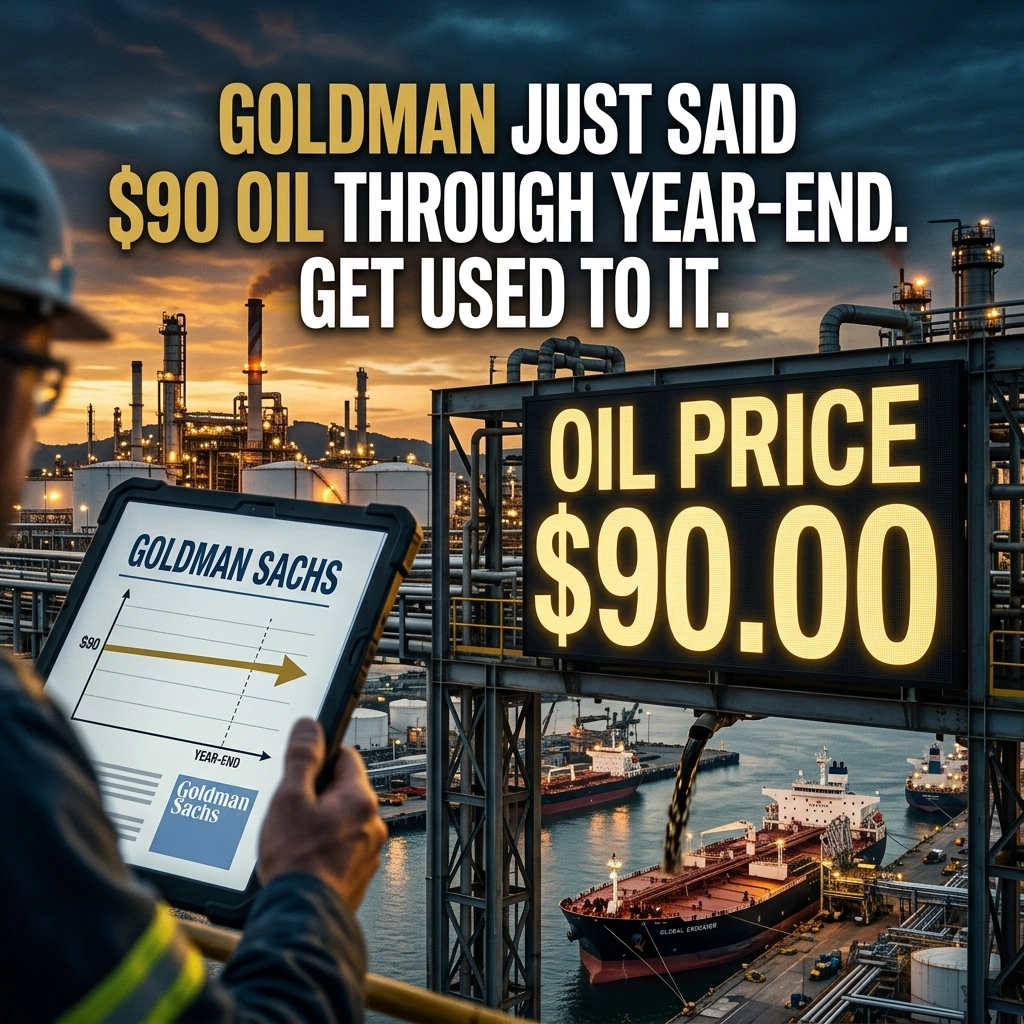
Here at Regular Guy Economics, we don’t want you hypnotized by the spike. The number that matters most right now, the one that should be penciled into your budget with permanent marker, is $90.
Why $90? Because Goldman Sachs is still telling the market that roughly $90 oil through year-end is the realistic base case. Citi may still lean a little friendlier, but even the optimistic crowd is nowhere near the calm, pre-crisis setup we had when oil was hanging around the low $70s before this mess blew up.
That is what matters for market sentiment today. Traders may debate whether the panic high was too hot, too fast, or a little dramatic. But for the regular guy, the important takeaway is much simpler: Wall Street is now treating higher energy costs as the new normal, not a weekend tantrum. And when higher oil becomes a baseline instead of a blip, it leaks into everything you buy.
The Math of the "New Floor"
Let’s look at the plain math, because numbers still don’t care about anybody’s political speech.
Before this conflict started, oil was sitting around $73 a barrel. At that price, the global economy can still breathe. Gas is manageable, shipping is less chaotic, and inflation doesn’t feel like it is waiting outside your front door with a baseball bat. Goldman Sachs is now pointing the market toward a Q4 average of about $90.
That is roughly a 23% increase in the price of the world’s most important commodity.
Think about that in normal-person language. If your boss told you this morning, Thursday, April 30, that your paycheck was getting cut by 23% through Christmas, you’d call that a crisis. But when oil does it, people act like it is an abstract problem for hedge funds and foreign ministers. It’s not. It is a slow-motion pay cut for everybody who buys food, drives to work, orders packages, or pays a utility bill.

That is why today’s market mood matters. Wall Street may stop hyperventilating over the $108 spike, but if traders settle into the idea that $90 is the floor, then the whole economic foundation gets repriced higher. Even if diplomacy improves tomorrow, risk premiums, tanker rerouting, insurance costs, and supply-chain friction do not vanish in an afternoon. The market is telling you that the damage is no longer just about a scary headline. It is getting baked into the system.
The Trucking Tax: Why Your Amazon Prime Fee is About to Jump
Most regular guys still think about oil by looking at the gas station sign on the corner. Fair enough. But the real sneak attack happens in diesel.
Semi-trucks don’t run on optimism, policy statements, or happy thoughts. They run on diesel. And diesel comes from the same barrel that Goldman says is likely to stay near $90 instead of drifting back into the comfortable old range. When the floor for oil climbs by more than 20%, the cost to move goods from a warehouse in Indiana to a store in Kentucky climbs right along with it.
Trucking companies usually respond with fuel surcharges. That is just business-speak for, "Congratulations, you’re paying for this too." If Amazon, Walmart, Target, or Kroger has to spend more to move inventory, they are not taking that hit as a charitable act for the American consumer. They are passing it down the line until it lands on your receipt.
This is why the regular guy should care less about intraday price swings and more about the broader market message on April 30. The headline spike gets the attention. The sticky floor does the damage. You see $108 oil on the screen, maybe $104 the next day, maybe $101 after that, and people think the danger is fading. But if the market keeps accepting $90 as the resting place, then the higher cost structure keeps marching forward anyway. That is how your cereal, your dog food, your lawnmower part, and your "free" shipping all quietly get more expensive.
Your Summer Travel Budget Just Got Nuked
If you are planning a road trip or a flight this summer, this week’s market tone was not exactly a love letter to your budget.
Airlines are pretty good at hedging fuel, but they are not magicians. Fuel is still one of their biggest expenses, and when Goldman tells the market to expect $90 oil through year-end, airline executives hear one thing very clearly: protect margins now, apologize later. Translation: pricier tickets, tighter fare sales, and more fees dressed up as "dynamic pricing."
For the road trippers, the math is plain enough to hurt. If you drive a vehicle that gets 20 miles per gallon and you are planning a 1,000-mile round trip, a roughly $1 bump at the pump adds about $50 to the trip in fuel alone. That may not sound fatal, but then stack on hotel rates, higher food costs, and all the diesel-driven freight costs buried inside everything you buy along the way.

The Plastic Paradox: It’s Not Just Fuel
Here’s the thing people forget: we don’t just burn oil. We live in it.
About 10% of every barrel of oil goes toward making "feedstock" for plastics and chemicals. Look around your room right now. Your laptop casing? Oil. The polyester in your shirt? Oil. Your toothbrush, your phone case, the insulation in your walls, and the sneakers on your feet? All oil.
When the floor for oil moves to $90, the cost of raw plastic pellets goes up. This affects manufacturing at the most basic level. If you’re a small business owner in Ohio making plastic components for medical devices, your raw material cost just took a double-digit jump. You either raise your prices or you go out of business.
This is why "sticky inflation" is the buzzword of 2026. Once these prices go up to account for $90 oil, they rarely come back down, even if oil eventually drops back to $70 in 2027. Businesses get used to the new margins.
Plain Math, No Panic: How to Budget
We aren't here to tell you the world is ending. It’s not. But we are here to tell you that the math of your household budget needs an update.
If Goldman is right and we are looking at $90 oil as the base case for the rest of the year, here is how a "regular guy" should play it:
- Audit Your Commute: If you’ve been thinking about carpooling or taking the light rail, now is the time. That $1.00+ "war tax" per gallon is going to be here through Christmas.
- Watch the "Fringe" Costs: Keep an eye on delivery fees and service surcharges. Plumbers, HVAC techs, and landscapers are all going to start adding "fuel recovery fees" to their bills. Ask about them upfront.
- The Grocery Lag: Buy non-perishables now. The price of canned goods and dry pasta is largely dictated by transportation costs. Those costs are going up. Buying an extra three months of the basics today could save you 10-15% by August.
- Don't Panic Buy Gas: Don't be the guy sitting in a two-hour line to save four cents a gallon because of a scary headline. The $108 spike might retreat to $95 in a week. Focus on the long-term floor, not the daily volatility.
The Bottom Line
As of today, Thursday, April 30, 2026, the market is still telling the same story: the panic may cool, but the price structure has changed.
Goldman Sachs isn’t trying to be dramatic. They’re just looking at a world where supply risk remains elevated, shipping friction is real, and demand has not politely disappeared. When they say "$90 oil through year-end," they are telling you that the cost of being a regular person is likely heading higher whether or not the daily headlines calm down.
That makes this a shadow tax on the regular guy. Nobody voted for it. Nobody mailed you a warning label. But you’ll pay it at the gas pump, at the grocery store, in airfare, in delivery fees, and in all the little household purchases that suddenly feel just a bit more insulting.
So don’t get too distracted by whether oil closes today at $108, $103, or $99. The bigger issue is that Wall Street is getting comfortable with $90. And once the market gets comfortable, your budget usually gets uncomfortable.
Be mindful, be watchful and good luck.