



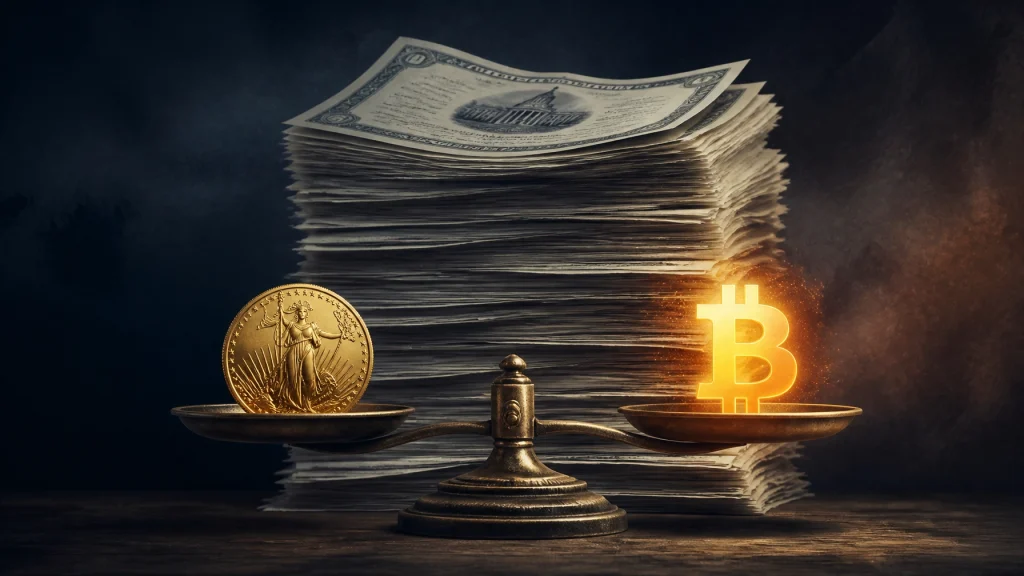
Gold trading around $4,650 an ounce and Bitcoin breaking above $77,000 sounds like a winning combination if the only objective is watching charts go up.
But markets are not always celebrating when these assets rise together.
Sometimes they are sending a warning: investors are becoming less comfortable with the value of money, the size of government debt, or the ability of policymakers to keep borrowing costs under control.
That does not mean the United States is about to collapse. It does mean the price of trust is changing.
The “debasement trade” is back
Gold and Bitcoin are very different assets. Gold has been used as money and a store of value for thousands of years. Bitcoin is a young, volatile digital asset whose history can fit inside a high-school textbook.
Yet investors often group them together when they become concerned that traditional money will lose purchasing power.
This is sometimes called the debasement trade. In plain English, it means buying assets that cannot be printed as easily as dollars, euros, or yen.
Gold has been climbing toward $4,650 per ounce, near a three-month high. Bitcoin gained roughly 23.2% in seven days, breaking out of a trading range around $62,000 to $67,000 before moving above $77,000.
The easy explanation is momentum. Prices rise because prices are rising.
The more interesting explanation is that investors are looking beyond the next inflation report or Federal Reserve meeting. They are asking a much larger question:
How will the government finance all of this debt without making money worth less?
That question is uncomfortable because there is no painless answer.

Why Treasury buybacks made people nervous
The Treasury recently announced that it would at least double the size of certain buyback operations involving longer-dated government bonds, raising the amount from $2 billion to at least $4 billion per operation.
The Treasury describes these transactions as liquidity support. The basic idea is that the government buys older, less actively traded bonds in the market, helping dealers and investors move in and out of positions more easily.
That is not the same thing as the Federal Reserve creating money to purchase government debt. It is important not to flatten every government bond operation into “money printing.” The details matter.
But markets also care about the message.
Long-term interest rates had been rising, and the government has a large and growing supply of debt to sell. When Treasury steps in with bigger buybacks, investors may reasonably wonder whether this is merely market maintenance: or an effort to keep long-term borrowing costs from becoming politically and financially painful.
Treasury Secretary Scott Bessent has said the buybacks could be larger than $4 billion. Official Treasury documents describe the expanded operations as applying to longer-dated securities, including bonds in the 10-to-20-year and 20-to-30-year maturity ranges. The Treasury buyback announcement provides the mechanical details.
The market’s interpretation was less mechanical.
The message many investors heard was: long-term borrowing costs are becoming a problem, and policymakers are looking for ways to manage them.
That interpretation helped push the dollar lower and gave gold another reason to rise.
The long end of the bond market is where the argument lives
The Federal Reserve controls a short-term interest-rate target. It does not directly set the rate on a 30-year mortgage, a 30-year Treasury bond, or every other long-term loan in the economy.
Those rates are determined by buyers and sellers in the bond market.
Investors who lend money to the government for 30 years want compensation for several risks:
- Inflation may reduce the purchasing power of their interest payments.
- Government borrowing may increase the supply of bonds.
- Economic growth and future interest rates may be difficult to predict.
- The dollar may be worth less by the time the bond matures.
- Political decisions may change the fiscal outlook.
When uncertainty rises, investors demand more interest before agreeing to lock up their money for decades. That extra compensation is one reason long-term yields can remain high even when the Fed is expected to cut short-term rates.
This is why a Treasury buyback can be read two ways.
The charitable interpretation is that Treasury is improving the functioning of the bond market. A smoother market can reduce unnecessary volatility and make government borrowing more efficient.
The skeptical interpretation is that Treasury is trying to put a floor under bond prices and a ceiling over borrowing costs because the market is demanding too much compensation for holding long-term government debt.
Both interpretations can be true at the same time. Markets are complicated enough to hold two thoughts in their heads without requiring a congressional hearing.
Bitcoin’s rally had a mechanical boost
Bitcoin’s jump was not purely a grand philosophical vote against fiat currency. Leverage played a major role.
Many traders had bet that Bitcoin would fall. They sold futures or borrowed money to establish short positions. When Bitcoin moved higher instead, those traders faced losses.
Some were forced to buy Bitcoin to close their positions. That buying pushed the price higher, which forced more short sellers to buy. The process feeds on itself.
That is a short squeeze.
Imagine a crowded theater where everyone is trying to leave through one door. The first person moves quickly, the next person gets pushed, and suddenly the exit becomes a stampede. In a short squeeze, the exit is the “buy” button.
More than $4 billion in bearish crypto positions were reported liquidated around Friday’s move, although estimates vary depending on the exchanges, assets, and time window being counted. CoinGlass tracks these liquidations in real time through its crypto liquidation data.
The important point is not whether the total was precisely $4 billion, $3.5 billion, or some other number. The important point is that forced buying can make a rally look like a broad, confident investment decision when part of it is simply traders being removed from the field.
Bitcoin can rise because investors want a scarce digital asset.
It can also rise because leveraged traders made a bad bet.
Those are not the same thing.

Gold is not a magic answer either
Gold’s reputation as a safe haven is deserved, but “safe” does not mean “always rising.”
Gold produces no income. It does not pay interest or dividends. Its price depends on what another buyer is willing to pay later.
Gold often benefits when:
- Real interest rates fall.
- The dollar weakens.
- Inflation expectations rise.
- Geopolitical risks increase.
- Central banks diversify their reserves.
- Investors lose confidence in government finances.
But any of those trends can reverse. A stronger dollar, higher real yields, easing inflation, or a serious fiscal reform package could pressure gold prices.
At $4,650, gold is not a secret hiding place known only to three guys in a warehouse. The trade is visible. A great deal of optimism, fear, and policy interpretation may already be reflected in the price.
The World Gold Council’s gold-price data is useful for tracking the asset without relying on somebody shouting about it in a television commercial.
The caveat that matters
Gold rising while the dollar weakens is suggestive. Bitcoin rising at the same time is also suggestive.
But neither proves that investors have abandoned U.S. Treasury bonds.
A weaker dollar alongside high long-term yields can reflect several things:
- Uncertainty about inflation.
- Changing expectations for economic growth.
- Shifting interest-rate forecasts.
- Foreign investors adjusting currency hedges.
- Concerns about fiscal policy.
- A temporary repositioning after a crowded trade.
Markets are not laboratory experiments. There is rarely one clean cause connected to one clean effect.
The Treasury buyback program may improve liquidity without representing a bailout. Gold may be rising because central banks and investors want diversification. Bitcoin may be rising because a short squeeze collided with renewed enthusiasm for digital assets.
The correlation is meaningful, but it is not proof.
What this means at the kitchen table
The lesson is not “buy gold.”
It is not “buy Bitcoin.”
It is not “sell everything and store canned beans beneath the floorboards.”
The lesson is that money, debt, and asset prices are connected. When investors believe governments are becoming more expensive to lend to, the repricing does not stay neatly inside the bond market.
It can show up in:
- Mortgage rates.
- Auto loans.
- Credit-card interest.
- Stock-market valuations.
- The dollar’s exchange rate.
- Commodity prices.
- Retirement-account balances.
- The cost of imported goods.
A government that pays more to borrow has less room for everything else. Higher debt service competes with infrastructure, defense, social programs, tax cuts, and emergency spending. Eventually, the cost appears somewhere: through higher taxes, reduced services, inflation, financial repression, or slower growth.
That is why gold and Bitcoin rising together deserve attention. They may be telling investors that the old assumption: government debt is automatically the safest asset in the room: is being questioned at the margins.
The dollar is still the world’s dominant reserve currency. Treasury bonds remain among the deepest and most liquid markets on Earth. There is no need for theatrical panic.
But the direction of travel matters.
When governments get expensive to lend to, everything you own reprices.
Disclosure: Regular Guy Economics is not a financial advisor. This article is for educational and informational purposes only and is not investment advice. Gold, Bitcoin, bonds, and other assets can lose value, sometimes rapidly. Readers should consider their own circumstances and consult a qualified professional before making financial decisions.
For more plain-English coverage of markets, debt, and the economy, visit Regular Guy Economics.
Be mindful, be watchful and good luck.