



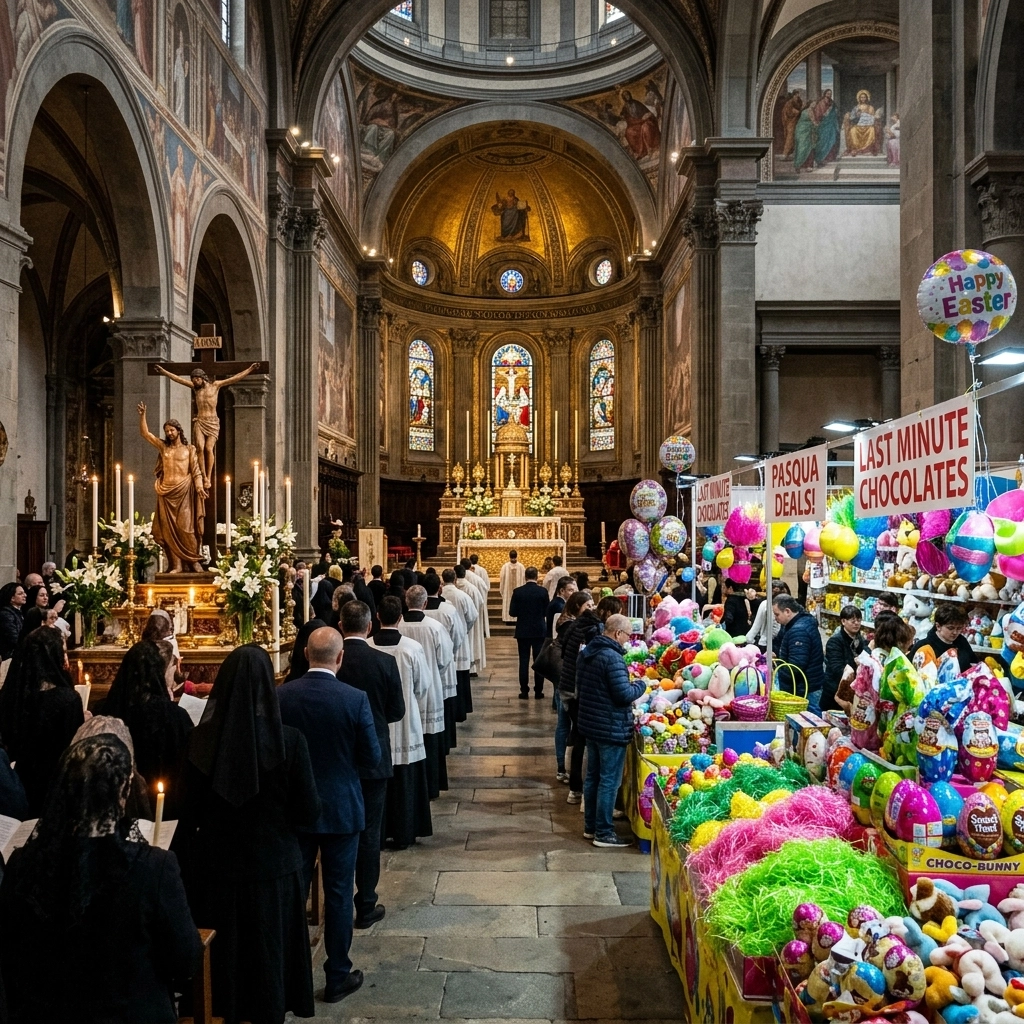
Let’s be real for a second. If you walked into a grocery store today without knowing anything about world history or theology, you’d probably think we were all part of some strange cult that worships giant, flightless birds and hyper-fertile rodents. Between the neon-colored marshmallow chicks and the aisles overflowing with plastic grass that will inevitably end up in a sea turtle’s lunch, the actual "reason for the season" has become a bit of a scavenger hunt.
At Regular Guy Economics, we usually talk about inflation, the Fed, or why your car insurance suddenly costs as much as a small yacht. But today, I want to talk about a different kind of market shift: the rebranding of "Pasqua" into "Easter." I am thankful for Joe and Lina Funaro, my dear friends who reminded me to write something different today.
It’s one of the most successful marketing pivots in human history. We’ve taken the most sacred, somber, and ultimately triumphant moment in the Christian faith, the Resurrection, and turned it into a $21 billion consumerist frenzy. Here’s how the sacred got hijacked by the secular, and how fertility symbols took the wheel.
Pasqua vs. Easter: A Tale of Two Names
First off, let’s talk about the name. In almost every other language, the word for this holiday is some variation of "Pasqua" or "Pascha." It comes from the Hebrew Pesach, or Passover. For Christians, this is a direct link to the Lamb of God and the sacrifice that changed everything. It’s a word rooted in liberation, sacrifice, and divinity.
But in the English-speaking world, we call it "Easter." Why? Because early marketing gurus (otherwise known as 8th-century cultural influencers) decided to blend the Resurrection story with the festival of Eostre.
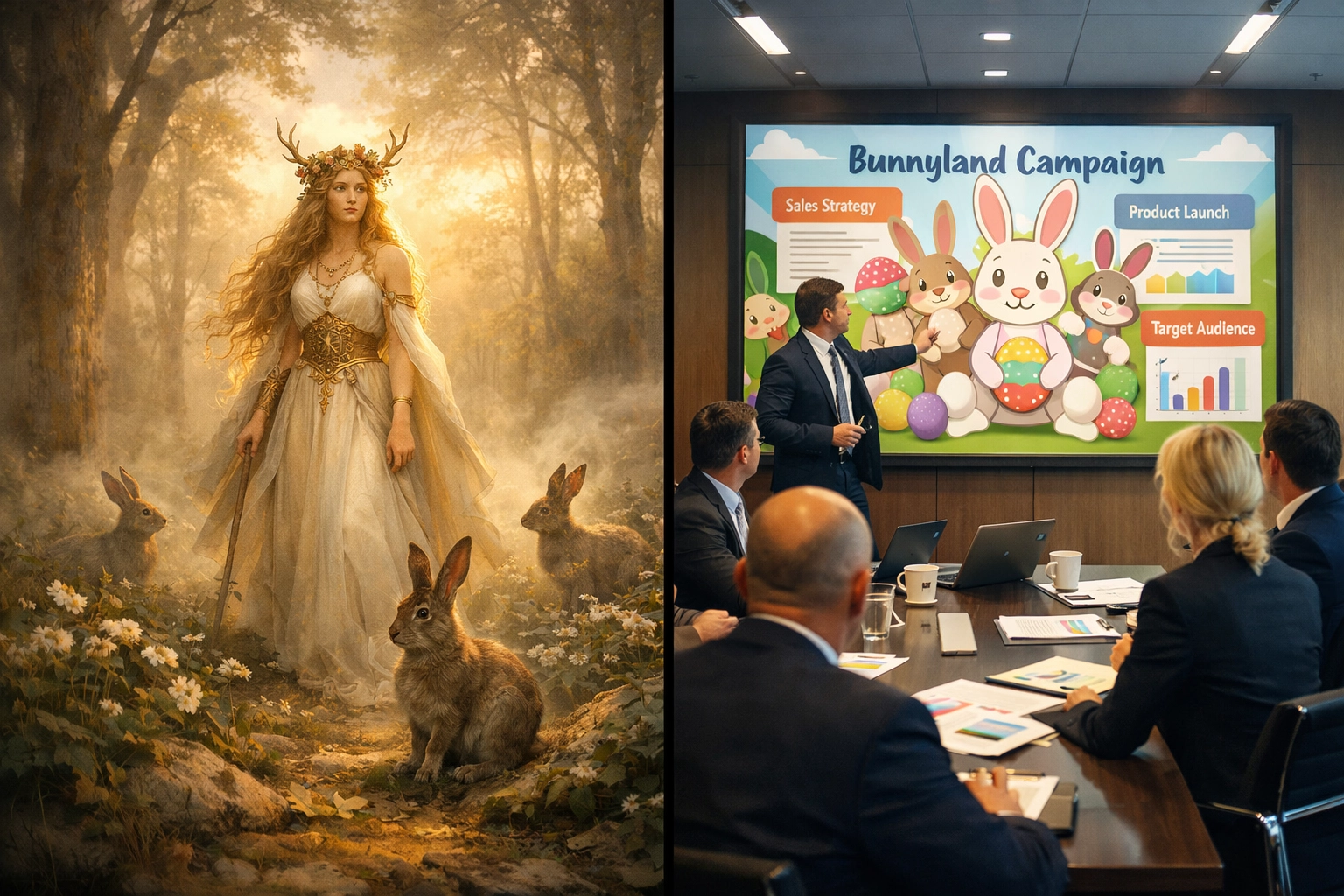
Eostre was the Germanic goddess of dawn and spring. She was all about new life, which sounds great on paper, but her version of "new life" was much more about biology than biology-defying miracles. By folding the Christian celebration into a pre-existing pagan spring festival, the "brand" became easier to sell to the masses. It was the original "merger and acquisition" of the religious world.
The Bunny in the Room: Fertility as a Product
If you’re wondering what a rabbit has to do with an empty tomb, the answer is: absolutely nothing.
Rabbits and hares were the symbols of Eostre because, well, rabbits are really good at making more rabbits. They represent fertility in its most literal, earthy sense. When the church was trying to convert Northern European tribes, they didn't just delete the local customs; they "rebranded" them.
Over time, the terrifyingly fertile hare of Eostre became the cuddly Easter Bunny. By the 1700s, German immigrants brought the "Oschter Haws" (Easter Hare) to America. This hare would lay colored eggs for well-behaved children.
Wait, a rabbit laying eggs?
Mathematically and biologically, it makes zero sense. But from an economic perspective, it’s a goldmine. You can’t really "sell" a resurrection in a cardboard box, but you can definitely sell a stuffed bunny and a dozen chocolate eggs.
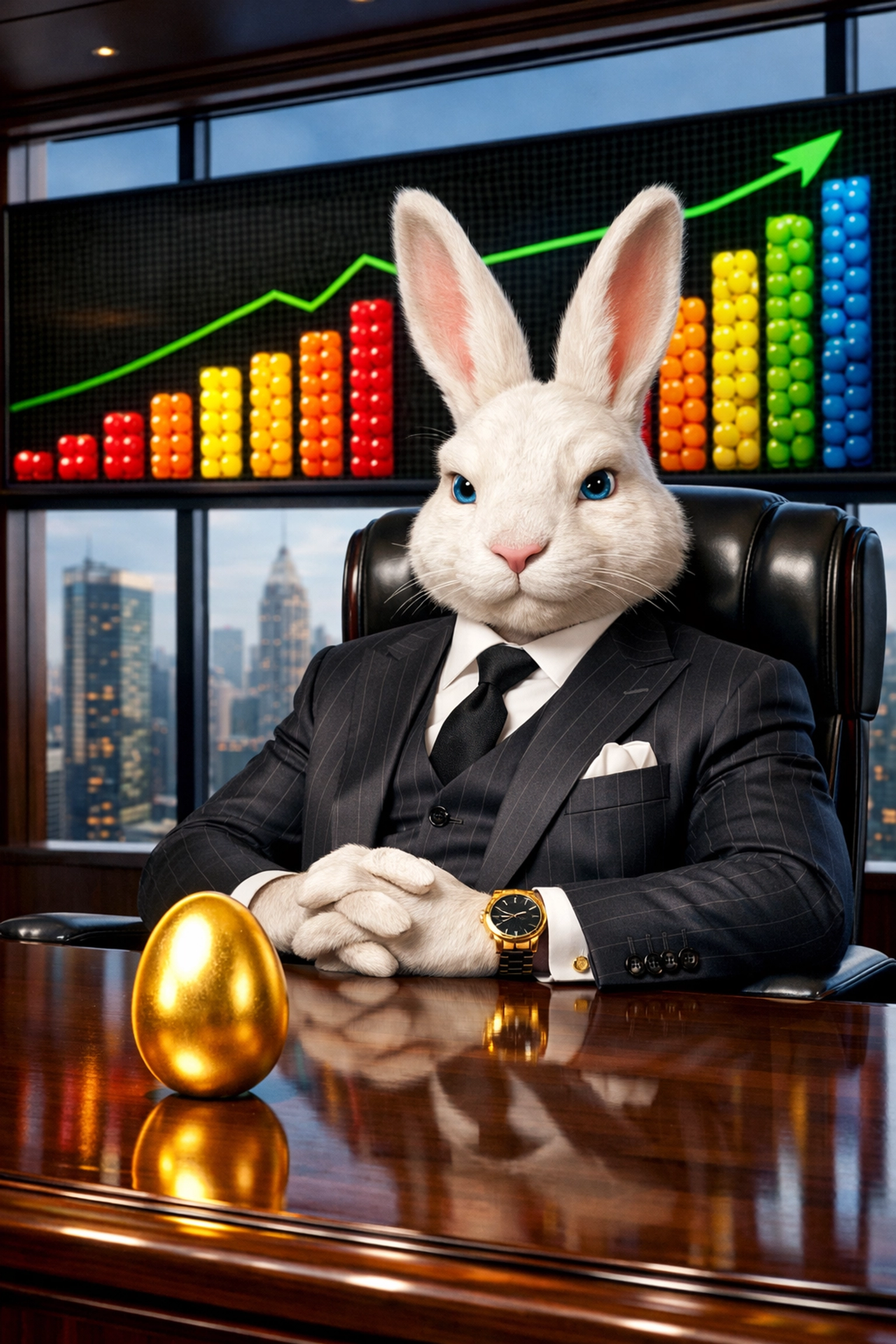
The Economics of the Egg
Speaking of eggs, they were another pagan symbol of rebirth and the "cosmic egg" of the universe. In the early Christian church, eggs were actually a practical thing: they were forbidden during Lent, so people would boil them to preserve them and then feast on them when Sunday finally rolled around. It was a celebration of the end of fasting.
But leave it to modern capitalism to take a simple boiled egg and turn it into a multi-billion dollar confectionery industry. Retailers realized pretty quickly that real eggs have a short shelf life and don't come in "Cool Ranch" or "Milk Chocolate" flavors.
Enter the plastic egg.
According to recent retail data, Americans spend over $3 billion on candy alone during this period. We aren't just celebrating a holiday; we are fueling a massive Q2 revenue spike for Big Sugar. The egg has been decoupled from the miracle of life and re-attached to the miracle of high-fructose corn syrup.
The "Christmas-ification" of Spring
The research is clear: retailers have applied the same scorched-earth marketing strategy to Easter that they use for Christmas. It’s no longer enough to go to a church service and have a nice lunch with the family. Now, you need the "Easter Basket."
This isn't just a basket; it’s a gift-delivery vehicle. We’ve seen a trend where Easter is becoming "Christmas Junior." Parents are now buying Lego sets, video games, and expensive electronics to stuff into these baskets. Why? Because a hollow chocolate bunny doesn’t hold a child’s attention for more than ten minutes, and retailers need to move inventory.

The commercialization reflects a pattern where the "experience" of the holiday is defined by what you buy rather than what you believe. When the primary memory a child has of Pasqua is hunting for plastic shells filled with jellybeans, the gravity of the Resurrection starts to feel like an afterthought: a footnote in a glossy sales flyer.
Plastic Grass and the Spiritual Cost
One of the most annoying parts of this commercial hijack is the plastic grass. You know the stuff. It’s green, it’s static-y, and you’ll be finding it under your sofa cushions until at least August.
This single-use plastic is the perfect metaphor for what’s happened to the holiday. It’s a cheap, synthetic imitation of something real (life/growth) that provides a momentary aesthetic "pop" but ultimately leaves behind a mess that someone else has to clean up.
When we prioritize the "plastic grass" version of the holiday, we lose the "Pasqua" heart. The Resurrection is supposed to be about the ultimate victory over death, a moment of profound hope and spiritual renewal. It’s a call to be mindful of our souls and our neighbor. Instead, we’re often just mindful of the "3 for $10" sale on Peeps.
The commercial machine wants us to feel a "pressure to purchase." If you don't have the perfect table setting or the biggest basket, are you even celebrating? This is the same "buzz saw of madness" we see in the medical industry or the car insurance market: where the middleman (the retailer) inserts themselves between the consumer and the actual value, jacking up the price and diluting the quality of the experience.
Bringing Pasqua Back to the Heart
Look, I’m not saying you shouldn't eat a chocolate egg or enjoy a hunt with the kids. I’m a regular guy; I like chocolate as much as the next person. But we have to recognize the hijack for what it is.
The commercialization of Easter is an attempt to turn a sacred mystery into a predictable commodity. Capitalism is great for a lot of things: innovation, efficiency, getting a flat-screen TV to your door in 24 hours: but it’s terrible at preserving the "sacred."
When we look at our bank statements after the holiday, we should ask ourselves: how much of this was for the Resurrection, and how much was for the "Plastic Grass"?
Pasqua is supposed to put something specific in the Christian heart: a sense of radical, unearned grace. It’s about a tomb that couldn't hold a Man who was also God. That’s a heavy, beautiful, world-changing concept. It doesn't need a bunny to make it more palatable, and it certainly doesn't need a marketing budget.
As we move forward, maybe we can try to separate the spring festival from the Paschal mystery. Let the kids have their candy, sure. But let's not let the "AI-optimized" marketing of the retail giants convince us that the "good news" is found in the seasonal aisle of a big-box store.
The real Pasqua isn't for sale. It was already paid for, and the receipt is an empty grave, not a credit card statement.
Be mindful, be watchful and good luck.