



October 31, 2026
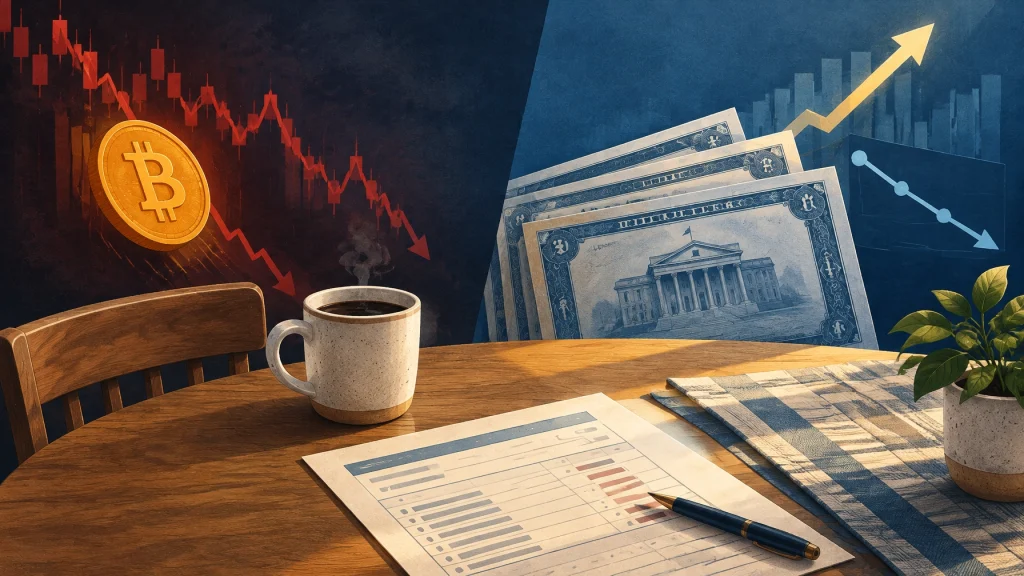
The market served up a useful little puzzle this week: Bitcoin dropped below $82,000 while investors rushed toward U.S. Treasury bonds. One asset slid; the other rallied. If Bitcoin is “digital gold,” shouldn’t it shine when markets get scary?
Not necessarily. This week’s trading offered a reminder that labels are cheap and market behavior is the evidence.
One timing note matters: the sharp Treasury rally came mainly on Thursday, October 22, when the 10-year yield fell about 19 basis points and briefly dipped below 5%. Bitcoin also fell below $82,000 amid the risk sell-off. On Friday, yields bounced back somewhat as oil above $100 revived inflation worries. So this wasn’t a perfectly synchronized, all-day seesaw. It was a broader risk-off episode, and the direction of the moves still tells a useful story. CNBC reported the Treasury move, while Bitcoin’s drop below $82,000 came amid pressure on speculative assets.
Risk-on, risk-off: two market buckets
“Risk-on” and “risk-off” are shorthand for what investors tend to do when their mood changes.
In risk-on periods, investors are more willing to own assets that can deliver bigger gains but may also swing sharply: crypto, speculative growth stocks, small companies and lower-rated corporate bonds. In risk-off periods, they often reduce those holdings and seek assets they believe will be steadier or easier to sell.
That second group may include U.S. Treasury securities, the dollar and, depending on the circumstances, gold. These are not magic shields. They’re simply assets that investors may prefer when uncertainty rises.
The labels don’t tell you whether an asset is morally good, economically productive or guaranteed to hold its value. They describe how investors tend to trade it under pressure. A life jacket is useful in a storm; a speedboat is useful when you’re trying to get somewhere fast. Different tools, different conditions.
Bitcoin has spent about fifteen years trying to graduate from the risk bucket to the safety bucket. But when it sells off alongside high-growth tech and other speculative trades, it behaves less like a shelter and more like what many investors still treat it as: a risky asset. The wider tech sell-off also reflected worries about the cost and eventual payoff of the AI investment boom.

Why Treasury bonds can rally when the government has problems
A reasonable question: if Washington runs large deficits and inflation is a worry, why would investors buy government bonds during a stressful week?
Because “safe” is relative. The U.S. Treasury market is the deepest and most liquid government-bond market in the world. In plain English, it’s enormous, and buyers and sellers can generally find one another quickly. When investors want to move large sums toward a familiar asset, Treasuries are often one of the first places they look.
That does not mean the government has no fiscal problems, or that Treasuries protect purchasing power in every scenario. It means that when investors want liquid, dollar-denominated assets, Treasury securities remain a major destination. The U.S. government can raise taxes and borrow in dollars; the Federal Reserve also has the ability to create dollars. Those features make Treasury obligations different from a household’s IOU, but they do not erase the risks of inflation, changing interest rates or political dysfunction.
The simplest signal from the bond market is the yield-price relationship. Bond prices and yields generally move in opposite directions. When buyers rush to existing bonds, those bonds become more valuable, so their prices rise. Because their promised payments are fixed, paying more for the same payments means the yield, the return implied by the new price, falls.
Think of a used car with a fixed $1,000 rebate attached. If buyers suddenly bid the car’s price up, that same rebate is a smaller return on the bigger purchase. Bonds work differently in the details, but the basic intuition is similar: higher price, lower yield.
A 19-basis-point move means a change of 0.19 percentage points. It may sound tiny, but in a market measured in trillions, that kind of move is not background noise. It tells you investors were actively bidding for Treasuries. And Treasury yields matter well beyond Wall Street: they help shape borrowing costs across the economy, including mortgage rates and some corporate financing.

Three funds can still be one trade
Here’s the kitchen-table lesson: assets that fall together don’t diversify you very much.
A portfolio holding a technology fund, a growth-stock fund and a crypto fund may look like three separate investments. But if all three rise and fall with investors’ appetite for speculative growth, the portfolio could be making one big bet in three different outfits.
Diversification is about spreading exposure across things that may behave differently, not merely collecting different ticker symbols. Stocks, bonds and cash can have distinct roles. So can investments in companies of different sizes, industries and countries. The point is not to predict which one wins next Tuesday. It’s to avoid making your whole financial future depend on one market mood.
That’s why the old 60/40 portfolio, roughly 60% stocks and 40% bonds, keeps showing up, despite being mocked as boring. In a period when stocks struggle and high-quality government bonds rally, the bond allocation may soften the blow. Boring is not a defect when it is doing the job you hired it to do.
But the caveat matters: bonds do not always rise when stocks fall. In 2022, inflation surged and central banks raised rates aggressively. Both stocks and bonds suffered as investors repriced the cost of money. When inflation and rising interest rates are the main problem, bonds can lose value alongside equities. The relationship between asset classes can change with the cause of the market stress.

What regular investors can take from this week
First, don’t count on crypto as a hedge. Bitcoin may have periods when it rises for reasons different from stocks, but this week’s tape showed that it can fall with speculative assets when investors pull back from risk. It may still be an investment some people choose to own; that is not the same as having the job of protecting a portfolio during a sell-off.
Second, look through your “diversified” funds. What do they actually own? If several funds hold many of the same large technology companies, or depend on the same expectations for future growth, you may have more overlap than you realize. A quick check of each fund’s top holdings can expose the duplicates.
Third, give cash and short-term Treasuries a fair look as the low-drama part of a plan. Short-term government securities and cash-like accounts have recently offered yields above 4%, though rates change and future returns are not guaranteed. They do not offer the same growth potential as stocks, and inflation can still eat away at what your money buys. But safety that pays something is more useful than safety that pays nothing.
The lesson isn’t “sell everything and hide in bonds.” It’s that every holding should have a purpose. Growth investments are for growth. Cash can cover near-term needs. Bonds may provide income and, in some sell-offs, balance. Crypto remains volatile and can behave more like a speculative trade than a shelter. None of those roles is interchangeable.
This week brought the pieces together: Bitcoin below $82,000, worries about the cost of AI investment, and the Nasdaq’s worst day since June. The Treasury market’s rally on Thursday showed investors reaching for safety; Friday’s partial yield rebound showed that inflation fears can quickly complicate the picture. The tape taught the lesson. The job is to make sure a portfolio isn’t built on the assumption that everything risky will always rise together, or that it will reliably protect you when trouble arrives.
Be mindful, be watchful and good luck.
This article is for educational purposes only and is not investment advice. Markets and financial products involve risk, and past performance does not guarantee future results. Consider speaking with a qualified financial professional about decisions that fit your circumstances.