



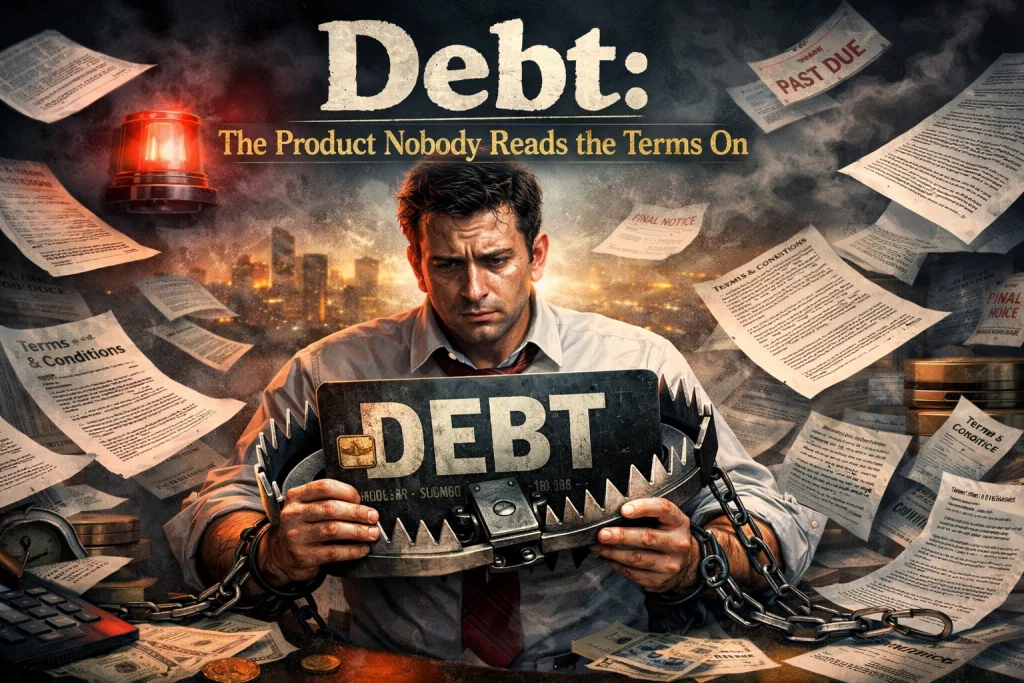
We’ve all done it. You’re sitting in a cramped office at a car dealership, or maybe you’re staring at a screen trying to finalize a credit card application. A 40-page document slides across the desk, or a "Terms and Conditions" box pops up with a scroll bar so small it looks like a speck of dust. You don’t read it. You can’t read it. You just want the keys to the truck or the ability to buy that new couch. You sign your name, click "I Agree," and walk out.
In that moment, you think you’ve just bought a product. But here’s the "Regular Guy" reality: Debt isn't the thing you used to buy the product. Debt is the product. And it’s the only product in the world where the customer has almost no idea what they’re actually signing up for until it’s too late.
At Regular Guy Economics, we like to peel back the curtain. Today, we’re looking at how debt quietly reorganizes your entire life, changes your choices, and acts as the invisible hand pushing you into corners you never intended to visit.
The Readability Myth: It’s Not the Words, It’s the Weight
There’s a common myth that debt contracts are written in some ancient, mystical tongue that only lawyers and druids understand. Interestingly, research actually shows that consumer loan agreements have reading scores similar to your daily news articles. It’s not that the words are too big; it’s that the complexity is staggering.
A typical private debt contract is a mountain of "what-ifs." It’s a choose-your-own-adventure book where every path leads to you paying more money. These documents contain hundreds of details, specifically detailing a "large number of specific contingencies" just to cover every possible state of nature. If you lose your job, there’s a clause. If you die, there’s a clause. If the wind blows slightly to the left on a Tuesday, there’s probably a clause for that, too.
Because these contracts are so dense, we stop treating them like agreements and start treating them like obstacles. We just want to get to the other side. But when you don’t read the terms, you aren't just missing out on the interest rate; you’re missing the blueprint for how your life is about to change.

Debt as a Social Architect
When we talk about debt, we usually talk about numbers. "I owe $30,000 on my student loans" or "My mortgage is $2,500 a month." But debt isn't just a number on a spreadsheet. It is a tool that reorganizes society.
Think about it: Debt dictates where you live, what you eat, and, most importantly, where you work.
If you have zero debt, you have the "Freedom to Fail." You can start that weird goat-cheese-delivery business you’ve been dreaming about. You can take a lower-paying job at a non-profit because you care about the mission. But the moment you take on a massive "Product Nobody Reads," your options vanish. You can’t take the dream job; you have to take the "Grind Job" because the Grind Job covers the monthly payment.
Debt turns "options" into "obligations." It’s the ultimate stabilizer for the status quo. If everyone is buried under a mountain of monthly payments, nobody is going to go out and start a revolution or quit their job in a huff. We become a society of "yes-men" because the "No" is too expensive.
The Medical Debt Trap: A Case Study in Unsustainability
Nowhere is the "Terms Nobody Reads" problem more dangerous than in the medical industry. Let’s look at the facts. In 1960, medical costs in the U.S. were about 5% of our Gross Domestic Product (GDP). We are now staring down the barrel of that number hitting 20% by 2025.
We are spending a fifth of everything we produce just to stay vertical, yet for the first generation in history, our kids might not live longer than we do. We’ve got more cancer, more obesity, and more Type 2 diabetes than ever before. We’re taking a cocktail of prescription meds with side effects that sound worse than the actual cold you’re trying to cure.
Medical debt is the final boss of debt products. You don't even get to "sign" the terms most of the time: you just show up in an emergency room and get hit with a bill three weeks later that looks like a phone number.

This is where the "Corporate Town" vibe starts to creep in. Back in the day, the New York Times reported that giants like Amazon, Berkshire Hathaway, and JPMorgan Chase were forming their own independent healthcare companies to serve their employees. Their goal? To be "free from profit-making incentives and constraints."
Why? Because even the biggest capitalists on the planet realized that the medical debt/cost machine is a runaway train. When medical expenses trend up every year while every other business process is being optimized to zero, something has to give. These companies realized that a sick, debt-ridden employee is an unproductive employee. They’re trying to "backstop" the system because the system they built is starting to eat its own tail.
The "Monthly Payment" Mirage
The reason the Debt Machine works so well is that it refocuses our brains. We stop looking at the total cost of our lives and start looking at the "Monthly Nut."
The banks don't want you to think about the $500,000 you’ll pay over 30 years for a $250,000 house. They want you to think about the $1,800 a month. By breaking life down into 30-day chunks, they make the unsustainable feel manageable.
This is how debt reorganizes your choices. You start making decisions based on "Can I swing this for 30 days?" instead of "Is this good for me for 30 years?" It’s the same logic that has us spending $100 on a gym membership to avoid a $10,000 cardiac bill later, or $500 on healthy, organic nutrition to avoid a $50,000 cancer treatment. We are trained to avoid the immediate "cost" even if it leads to a much larger "debt" down the road.

Who Actually Benefits?
Let’s be real: capitalism is great for a lot of things. High-tech medical devices are cool. Being able to buy a car without having $40,000 in cash is convenient. But when the spirit of medicine: or the spirit of basic human living: runs into the reality of the insurance and debt marketplace, it’s a "buzz saw of madness."
The people who benefit from you not reading the terms are the ones who view your life as a "finite math" problem. To an insurer or a lender, you are a set of actuarial data. They want your debt to be just high enough that you stay in the workforce and keep paying, but not so high that you "total" your life and declare bankruptcy.
It’s a delicate balance, and they use those 40-page contracts to make sure the house always wins.
Breaking the Script
So, what’s a "Regular Guy" to do?
First, we have to start viewing debt as a choice-limiting drug. Every dollar you owe is a minute of your future that you’ve already sold to someone else. When you sign those terms, you aren't just buying a product; you’re selling your future flexibility.
Second, we need to take a page out of the big corporate playbook and start "optimizing" our own health and costs. If Amazon and JPMorgan are building their own systems to escape the profit-incentive trap of medical debt, maybe we should be looking at our own lives the same way. Incentivize yourself to be healthy. Negotiate. Be mindful of the "monthly payment" trap.
Debt is a product. It has a price, it has terms, and it has a shelf life. If you don't read the manual, don't be surprised when the machine starts running your life instead of the other way around.
The economic narrative is written by people who want you to keep clicking "I Agree." It’s time to start reading the fine print of your own life.
Be mindful, be watchful and good luck.